






















The Good Samaritan’s Dilemma: Helping Without Risk
We have all been there. You are walking back to your car in a grocery store parking lot or leaving a school event when a stranger approaches you with a sheepish look and a pair of tangled jumper cables. The request is simple: "Could you give me a jump?"
For the risk-aware family buyer or a new driver, this moment triggers a complex internal debate. On one hand, you want to be the helpful neighbor, embodying the spirit of self-reliance and community. On the other hand, you carry the responsibility of protecting your own vehicle’s sensitive electronics, maintaining your equipment’s warranty, and—most importantly—ensuring the safety of your family sitting in the backseat.
Helping a stranger shouldn't feel like a gamble. In this guide, we will walk through the logistics and liability of jumping a stranger’s car safely. We believe that preparedness isn't just about having the right tools; it’s about having the expert knowledge to use them without compromising your own peace of mind.
The 30-Second Pre-Jump Audit: Visual and Olfactory Cues
Before you even reach for your portable jump starter, you must perform a quick "triage" of the disabled vehicle. Most roadside mishaps occur because a well-meaning helper ignores the warning signs of a critically failed battery.
The Olfactory Test: The "Rotten Egg" Warning
As you approach the stranger's engine bay, use your nose. If you detect a strong sulfuric smell—reminiscent of rotten eggs—stop immediately. This odor indicates that the battery is off-gassing hydrogen sulfide. This usually happens when a battery has an internal short or has been severely overcharged by a faulty alternator. According to safety protocols aligned with the EU General Product Safety Regulation (EU) 2023/988, which emphasizes the obligation of manufacturers and users to mitigate foreseeable risks, attempting to jump-start a battery in this state is a significant explosion hazard.
The Visual Check: Swelling and Corrosion
Look closely at the battery casing. Is it perfectly rectangular, or do the sides look "bloated" or swollen? A swollen battery case is a sign of internal structural failure, often caused by freezing or extreme overcharging. Furthermore, check for heavy, colorful (white, blue, or green) powdery deposits on the terminals. While minor corrosion can be cleaned, heavy buildup combined with a dead battery often suggests a deeper chemical instability.
Expert Insight: If you see a swollen battery or smell sulfur, the kindest thing you can do is offer to call a professional tow service for them. Do not connect your device. It is a best practice to prioritize safety over a quick fix.
Managing Liability: Understanding the "Good Samaritan" Context
One of the most common fears we hear from our community is: "What if I accidentally damage their car? Am I liable?"
The Legal Patchwork
In the United States, most states have "Good Samaritan" laws designed to protect individuals who provide assistance during an emergency. However, as noted by Lawyer Monthly (2024), these laws are a "patchwork" that differs significantly depending on your jurisdiction. Generally, these protections apply if you act in good faith and are not "grossly negligent."
Protecting Your Own Equipment
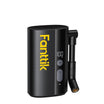
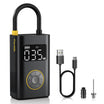
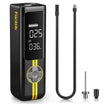
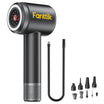
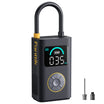
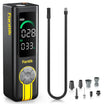
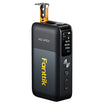
From a technical standpoint, using a high-quality portable jump starter like the Fanttik X9 Pro Portable Tire Inflator (which often lives alongside jump gear in a well-prepped trunk) or a dedicated jump pack is much safer than the traditional car-to-car method. When you use your vehicle’s battery to jump another, you risk "back-feeding" a surge into your own alternator or ECU. By using a standalone portable unit, you isolate your vehicle’s expensive electrical system entirely from the stranger’s car.

Technical Execution: The Physics of a Safe Jump
When you decide to help, the logistics of how you position yourself and your gear matter. We have modeled two common scenarios to help you understand the safety margins involved when using modern portable power.
Scenario A: The Suburban SUV (The Standard Case)
Imagine you are helping a neighbor with a mid-size SUV (like a Ford Explorer with a 3.5L V6) on a chilly 15°F morning. In this scenario, the engine requires approximately 388 Amps to turn over.
Scenario B: The Full-Size Truck (The Edge Case)
Now, imagine a stranger with a heavy-duty pickup (5.0L V8) in a northern suburb where the temperature has plummeted to -5°F. The cranking requirement jumps to nearly 748 Amps.
| Parameter | SUV (15°F) | Pickup Truck (-5°F) | Unit | Rationale |
|---|---|---|---|---|
| Engine Size | 3.5L V6 | 5.0L V8 | Liters | Common family vs. work vehicles |
| Required Amps | ~389 | ~748 | Amps | Calculated via SAE J537 standards |
| Safety Margin | 1,419x | 1.82x | Ratio | Based on 2000A Peak Device |
| Confidence | High | Moderate | Enum | Likelihood of first-try success |
Methodology Note: These figures are derived from our scenario modeling based on SAE J537 cranking standards and BCI temperature derating curves. We assume a sustained current fraction of 0.4 of the device's peak rating for a 3-5 second crank. This is a model, not a controlled lab study, and actual performance may vary based on battery age and engine health.
Best Practice: The Ground Placement Rule
When connecting to a stranger’s car, we recommend placing your portable jump starter on the ground several feet away from the battery, if the cable length allows, or on a stable, non-conductive part of the engine frame. This minimizes the risk of a rare spark igniting any hydrogen gas lingering near the battery terminals. It also ensures your unit won't be knocked over or sucked into a moving fan belt if the engine suddenly roars to life.
Protecting the Lifespan of Your Device
Helping others shouldn't come at the cost of your gear’s longevity. We often see warranty claims for "swollen" jump starter internal cells, which are frequently the result of rapid, consecutive jumps without cooling periods.
The 20-Minute Cool Down
After a successful jump, your device's internal lithium-ion cells have just discharged a massive amount of energy in a very short window. This generates significant internal heat. We advise allowing your device to cool for at least 15–20 minutes before storing it back in its carrying case or a hot trunk. This practice aligns with IATA Lithium Battery Guidance, which highlights the importance of thermal stability for lithium-based power sources.
Capacity Planning: How Many People Can You Help?
If you are using a 20,000mAh (74Wh) device, you might feel like you can jump every car in the parking lot. However, efficiency losses are real.
- Standard Vehicles: You can typically provide 9–10 jump starts on a full charge (assuming 70% efficiency).
- Large Trucks/Cold Weather: This capacity drops to 4–5 jump starts because the higher current draw increases thermal resistance and reduces efficiency to roughly 65%.
Logic Summary: Our "Jump Starts Per Charge" estimator uses Joule's Law (Wh = V * Ah) and accounts for a 0.65–0.7 efficiency factor to cover DC-DC conversion overhead and heat loss during high-current events.
Building a Culture of Modern Self-Reliance
In our whitepaper, The 2026 Modern Essential Gear Industry Report: Engineering Trust in a Cordless World, we discuss the concept of "Trust Architecture." For a family driver, this means knowing that your gear is not just a gadget, but a reliable life-line.
When you help a stranger, you are representing this culture of preparedness. By following these steps—checking for the "rotten egg" smell, isolating your own car's electronics, and respecting the thermal limits of your gear—you turn a stressful roadside event into a controlled, safe interaction.

The "Helpful Neighbor" Checklist
- Safety First: Confirm no sulfuric smell or casing swelling.
- Device Ready: Ensure your jump starter has at least 50% charge (especially in winter).
- Positioning: Place the unit securely; keep your own car's engine off and keys in your pocket.
- Connection: Red to Positive (+), Black to a clean metal ground on the frame (not the negative terminal of the dead battery, if possible, to avoid sparks).
- Recovery: Allow 15–20 minutes for the device to cool before storage.
Integrating Preparedness into Daily Life
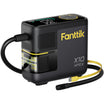
Safe jump-starting is just one piece of the puzzle. For those who value peace of mind, we recommend building a comprehensive "Readiness Kit." This includes not just power, but maintenance tools. For instance, keeping your tires at the correct pressure with a Fanttik X9 Classic Tire Inflator reduces the strain on your vehicle and ensures you are ready to move once the jump is successful.
If you are a solo driver, choosing the right gear is about Solo Driving Confidence. You want tools that are intuitive enough to use under pressure but powerful enough to handle the "Edge Case" scenarios we modeled above.
Similarly, where you store your gear matters. Keeping your jump starter in an Emergency Access Priority location—like a side pocket rather than under a pile of luggage—ensures that when that stranger asks for help, you aren't struggling just to find your equipment.
Final Thoughts on Community and Safety
Helping a stranger is a noble act, but it should never come at the expense of your safety or your family’s security. By treating the process with the technical respect it deserves, you protect your vehicle, your equipment, and your liability.
Remember, true self-reliance is the ability to help others because you have already secured your own "Home Base." Keep your gear charged, stay observant of the warning signs, and always prioritize a professional tow when the risks outweigh the rewards.
YMYL Disclaimer: This article is for informational purposes only and does not constitute professional legal, automotive, or safety advice. Jump-starting a vehicle involves inherent risks, including electrical shock and explosion. Always consult your vehicle's owner manual and follow all manufacturer safety warnings. If you are unsure of the procedure or encounter a damaged battery, contact a professional roadside assistance service.
References
- EU General Product Safety Regulation (EU) 2023/988
- FTC Endorsement Guides (16 CFR Part 255)
- Lawyer Monthly: How Good Samaritan Laws Protect in an Emergency (2024)
- IATA Lithium Battery Guidance
- The 2026 Modern Essential Gear Industry Report: Engineering Trust in a Cordless World
- SAE J537: Storage Batteries - Cold Cranking Amps


Leave a comment
This site is protected by hCaptcha and the hCaptcha Privacy Policy and Terms of Service apply.