











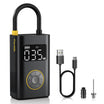
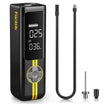

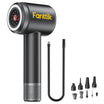
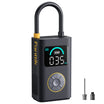

















Accuracy is the cornerstone of road trip safety. When we prepare for a 1,000-mile journey with a fully loaded SUV, we often focus on fuel levels, navigation, and packing. However, the four contact patches between your vehicle and the asphalt—your tires—are the most critical components for braking, handling, and fuel efficiency. A portable tire inflator is an essential tool for self-reliant mobility, but its value is entirely dependent on its accuracy.
In our field evaluations, we have observed that even high-quality portable units can exhibit variance. Whether it is the result of battery voltage fluctuations or the inherent limitations of compact sensors, understanding how to calibrate and verify your inflator ensures that when your display reads 36 PSI, your tires are actually at 36 PSI. This guide provides a methodical framework for calibrating your portable inflator, grounded in technical expertise and real-world testing.
The Anatomy of Inflation Accuracy: Digital vs. Mechanical
To ensure reliability, we must first understand the mechanisms of the tools we use. Tire pressure gauges generally fall into two categories: digital and mechanical (analog). According to technical comparisons from Accuracymeter, digital gauges typically offer a high precision range of ±0.05% to ±0.5%, whereas industrial-grade mechanical gauges often hover between ±1% and ±2%.
However, precision does not always equal accuracy in the field. We have identified several "friction points" that can lead to false readings:
- The "First-Read" Stabilizing Delay: Cheap mechanical gauges and some entry-level digital sensors require a firm, perfectly seated connection. Releasing the chuck too quickly or failing to hold a steady seal often yields a false low reading. We recommend a "three-second hold" to allow the sensor to stabilize.
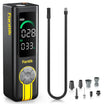
- Battery Voltage Drift: This is a non-obvious pitfall for portable users. Digital sensors in units like the Fanttik X9 Pro Portable Tire Inflator rely on stable voltage. As a battery depletes, the voltage drop can cause the digital-to-analog converter (DAC) to drift. We suggest checking accuracy when the unit is at a mid-to-high charge state (above 40%) for the most reliable results.
- Mechanical Wear: Analog gauges are notoriously fragile. Some reports suggest an analog gauge inaccuracy rate as high as 95% if they have been dropped or subject to extreme temperature cycles, which causes the internal Bourdon tube to lose its calibration.
Comparative Accuracy Overview
| Gauge Type | Typical Precision | Primary Weakness | Recommended Use |
|---|---|---|---|
| Digital (High-End) | ±0.1 - 0.5 PSI | Battery dependency | Pre-trip calibration & precision tasks |
| Mechanical (Pencil) | ±2.0 - 3.0 PSI | Friction & spring fatigue | Emergency backup only |
| Mechanical (Dial) | ±1.0 - 2.0 PSI | Calibration loss from drops | Workshop reference (if certified) |
| Portable Inflator | ±1.0 - 2.0 PSI | Thermal drift/Voltage drop | Roadside maintenance & top-offs |
Note: Values are estimated based on common industry observations and practitioner experience.
The Calibration Protocol: Establishing a Baseline
Calibration, in a practical sense, is the process of comparing your portable inflator’s reading against a known, high-accuracy reference. You do not need a laboratory to do this; you need a methodical approach.
1. The "Cold Tire" Requirement
Temperature is the greatest variable in pressure measurement. For every 10°F change in ambient temperature, tire pressure changes by approximately 1 PSI. To establish a baseline, tires must be "cold," meaning the vehicle has not been driven for at least three hours. Measuring after a highway stint will yield "hot" readings that are 3–5 PSI higher, making calibration impossible.
2. Selecting Your Reference
We recommend using a high-quality, standalone digital gauge as your "master" reference. According to the NIST Handbook 44, which sets standards for weights and measures, device accuracy must be maintained within specific tolerances for commercial use. For personal safety, we aim for a variance of less than 1 PSI between the inflator and the reference gauge.
3. The Step-by-Step Sync
- Measure with the Master: Use your high-quality reference gauge to measure the cold pressure of your front-left tire. Record this number.
- Measure with the Inflator: Connect your Fanttik X8 APEX EV Tire Inflator to the same tire. Note the reading on its digital display.
- Calculate the Offset: If the master reads 36.0 PSI and the inflator reads 34.5 PSI, your inflator has a -1.5 PSI offset.
- Verify Consistency: Repeat this on all four tires. If the offset is consistent (e.g., always -1.5 PSI), you can simply account for this by setting your target pressure 1.5 PSI higher on the inflator's auto-stop setting.
Information Gain: The Hidden Costs of Inaccuracy
Why does a 2 or 3 PSI variance matter? For a family SUV owner, the consequences are financial and structural. We simulated a scenario involving a modern SUV with low-profile 255/45R19 tires, traveling 20,000 miles annually.
Financial Impact of 6 PSI Under-Inflation
| Category | Impact Metric | Estimated Annual Cost/Loss |
|---|---|---|
| Fuel Efficiency | 1.2% - 1.8% decrease | $45.82 – $68.73 |
| Tire Longevity | 21.67% reduction in tread life | $110.64 (based on $1,200/set) |
| Total Waste | Combined Annual Loss | $156.46 – $179.37 |
Calculations based on $3.50/gallon fuel and a 22 MPG vehicle average. Tread life loss is a theoretical extrapolation from common tire wear patterns.
Beyond the money, under-inflation causes the tire sidewalls to flex excessively. This generates heat and compromises the structural integrity of the tire, increasing the risk of a high-speed blowout. By spending approximately 12.8 minutes to calibrate and adjust all four tires before a trip, you effectively pay for your inflator in less than nine months through fuel and tire savings alone.
Thermal Safety and Adiabatic Compression
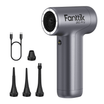
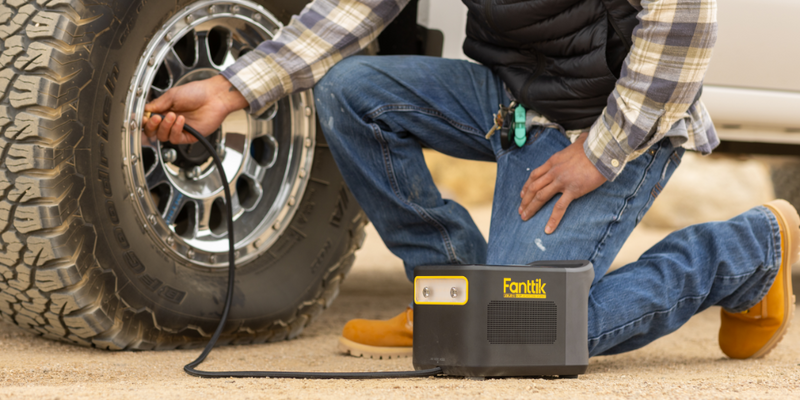
A professional-grade inflator like the Fanttik X9 Classic Tire Inflator is a marvel of compact engineering, but it is subject to the laws of physics. Specifically, the process of compressing air is an adiabatic process, meaning it generates significant heat.
In our testing of SUV tire ranges (from 10 PSI to 30+ PSI), we observed that the air temperature at the inflator exit can rise from an ambient 25°C (77°F) to as high as 151.55°C (304.79°F). This 126.55°C increase is why high-quality units feature heat-resistant hoses and internal cooling fans.
Managing the Duty Cycle
A common "gotcha" for new users is ignoring the duty cycle. According to industry testing standards cited by Road & Track, many portable inflators have a 50% duty cycle (e.g., 30 minutes of use followed by 30 minutes of cooling).
While a robust unit like the X8 Apex can handle 40 minutes of continuous run time—more than enough to calibrate a full vehicle—cheaper, non-branded units often overheat within 5–10 minutes. Overheating doesn't just damage the motor; it can temporarily warp the pressure sensor housing, leading to wildly inaccurate readings until the unit cools down.

Scenario Analysis: Standard vs. Precision Needs
The level of calibration rigor required depends on your vehicle and cargo.
Scenario A: The Standard Family Sedan
For a standard car with high-profile tires (e.g., 205/65R16), a variance of +/- 2 PSI is generally acceptable for road trip safety. The large air volume and flexible sidewalls provide a "buffer" that minimizes the impact of minor pressure deviations. In this case, checking your Fanttik X9 Ace Bike Pump (which doubles as a compact emergency car pump) against a gas station gauge once every six months is often sufficient.
Scenario B: The Low-Profile SUV or EV
Modern SUVs and Electric Vehicles (EVs) often use low-profile tires (e.g., 255/45R19) that operate at higher pressures to support heavy battery packs. These tires are extremely sensitive to pressure. A 2 PSI drop can significantly increase rolling resistance and decrease range. For these users, we insist on a calibration variance of less than 1 PSI. We recommend a calibration frequency of every six months or before any trip exceeding 500 miles.
Establishing Long-Term Reliability
To maintain the accuracy you have worked to calibrate, storage and handling are paramount.
- Avoid Extreme Heat: Never store your inflator in a trunk that reaches 140°F in the summer. High heat can degrade the lithium-ion batteries and cause the pressure sensor's diaphragm to lose its elasticity.
- The "Same-Gauge" Heuristic: Even if your inflator has a known 1 PSI offset, using the same tool for all four tires ensures that the vehicle is balanced. Handling characteristics are more negatively affected by pressure imbalance (e.g., 32 PSI on the left and 36 PSI on the right) than by a uniform 1 PSI deviation from the manufacturer's recommendation.
- Verification against Professional Standards: While owner-operators often use the CDL pre-trip inspection standard (which allows for no more than 3-4 PSI loss in 60 seconds during a leakage test), for consumer vehicles, any visible drop in pressure over a 24-hour period after inflation indicates a valve stem or seating issue that calibration cannot fix.
By treating tire inflation as a methodical technical task rather than a chore, you ensure that your vehicle remains a safe, efficient vessel for your family's adventures. Reliability is not a feature of the tool alone; it is a result of the user’s commitment to accuracy and verification.
Disclaimer: This article is for informational purposes only. Tire maintenance is a critical safety task. Always refer to your vehicle’s owner manual for specific PSI recommendations. If you are unsure about your tire's condition or your inflator's accuracy, consult a certified automotive technician.
References
- BCST Group: How to Calibrate Industrial Pressure Gauges
- NIST Handbook 44: Specifications and Tolerances for Measuring Devices
- Accuracymeter: Mechanical vs. Digital Gauge Precision
- Apex CDL: Pre-Trip Inspection Standards
- Car and Driver: Portable Tire Inflator Testing Methodology
- Road & Track: Best Tire Inflators Tested
Continue reading
 Choosing the Right Inflator Size for Compact Trunk Spaces
Car owners, find the perfect tire inflator for compact trunks. This guide balances portability and power, covering inflation...
Choosing the Right Inflator Size for Compact Trunk Spaces
Car owners, find the perfect tire inflator for compact trunks. This guide balances portability and power, covering inflation...
 Balancing Portability and Power for Full-Size SUV Tires
Guide for SUV owners on using portable inflators. Understand flow decay, apply the 'Pulsing' technique, and learn storage...
Balancing Portability and Power for Full-Size SUV Tires
Guide for SUV owners on using portable inflators. Understand flow decay, apply the 'Pulsing' technique, and learn storage...
Leave a comment
This site is protected by hCaptcha and the hCaptcha Privacy Policy and Terms of Service apply.