






















Quick Action Checklist: 6 Essentials for Charging Safety
For workshop managers and safety officers, these six steps represent the baseline for high-volume lithium-ion management. Implement these before scaling your charging capacity:
- Non-Combustible Base: Use cement board or steel; never charge on wood or plastic.
- Dedicated 20A Circuit: Prevent electrical noise and breaker trips from high-draw tools.
- Active Ventilation: Aim for a 1:1 CFM-to-Watt ratio to prevent heat stacking.
- IP54 Protection: Shield chargers from conductive metal dust and shavings.
- 30-Minute IR Scans: Use an infrared thermometer to detect cell temperature deltas.
- PPE-Ready Response: Keep heat-resistant gloves and dry sand within arm’s reach.
Engineering Safety into High-Volume Maker Spaces
In any professional workshop or high-traffic maker space, the charging station is often the busiest—and most overlooked—infrastructure component. While a single charger on a wooden bench might suffice for a casual hobbyist, scaling to a 10-bank or 20-bank hub introduces complex thermal and electrical risks that generic home safety standards often fail to address.
A primary risk factor in these environments is the "battery orphan"—packs left unattended on chargers for extended periods. This practice can accelerate cell degradation and increase the likelihood of a thermal event. To mitigate these risks, we must move beyond simple power strips and design dedicated, engineered charging zones. This guide outlines a methodical approach to building a station that prioritizes precision, reliability, and risk mitigation.
The Invisible Threat: Thermal Load and Adiabatic Heating
When charging multiple high-capacity lithium-ion batteries simultaneously, significant heat is generated as a byproduct of internal resistance and charging inefficiency. In our scenario modeling of a 10-bank station drawing roughly 500W, the cumulative thermal load requires active management.
Under worst-case conditions—such as a 35°C (95°F) summer day in an uncooled, enclosed cabinet—theoretical adiabatic heating models (where no heat escapes) suggest that internal temperatures could rise by approximately 75°C, reaching a threshold of 110°C (230°F). At these temperatures, the risk of electrolyte off-gassing and subsequent thermal runaway increases significantly.
Engineering Note: The 110°C peak is a theoretical maximum derived from the energy balance equation ($Q = mc\Delta T$), assuming 10 simultaneous 5A fast-charge events at 85% efficiency within a sealed 15-cubic-foot enclosure. This highlights the necessity of the ventilation heuristics discussed later.
For those managing professional spaces, understanding this "credibility math" is essential. As noted in the industry white paper The 2026 Modern Essential Gear Industry Report (a manufacturer-led study on cordless trends), engineering explicit safety margins is a primary pillar of building a trustworthy workspace.

Physical Infrastructure and Ingress Protection
Most makers rely on standard UL or CE compliance for their chargers. However, these standards do not always mandate protection against conductive particulates common in workshops.
The IP54 Standard for Maker Spaces
We recommend that centralized charging stations be designed to meet or exceed IP54 ingress protection principles. This ensures internal electronics are shielded against dust ingress that could cause a short circuit. If building a custom enclosure, ensure intake vents are filtered (using MERV 8 or higher) and the housing creates a physical barrier against falling metal debris.
Non-Combustible Surfaces
Mounting chargers directly onto wooden workbenches or plywood French cleat walls is a common hazard. Even a minor malfunction can ignite dry wood.
- The Minimum Standard: Install a layer of 1/8-inch cement board or a dedicated metal tray beneath all chargers.
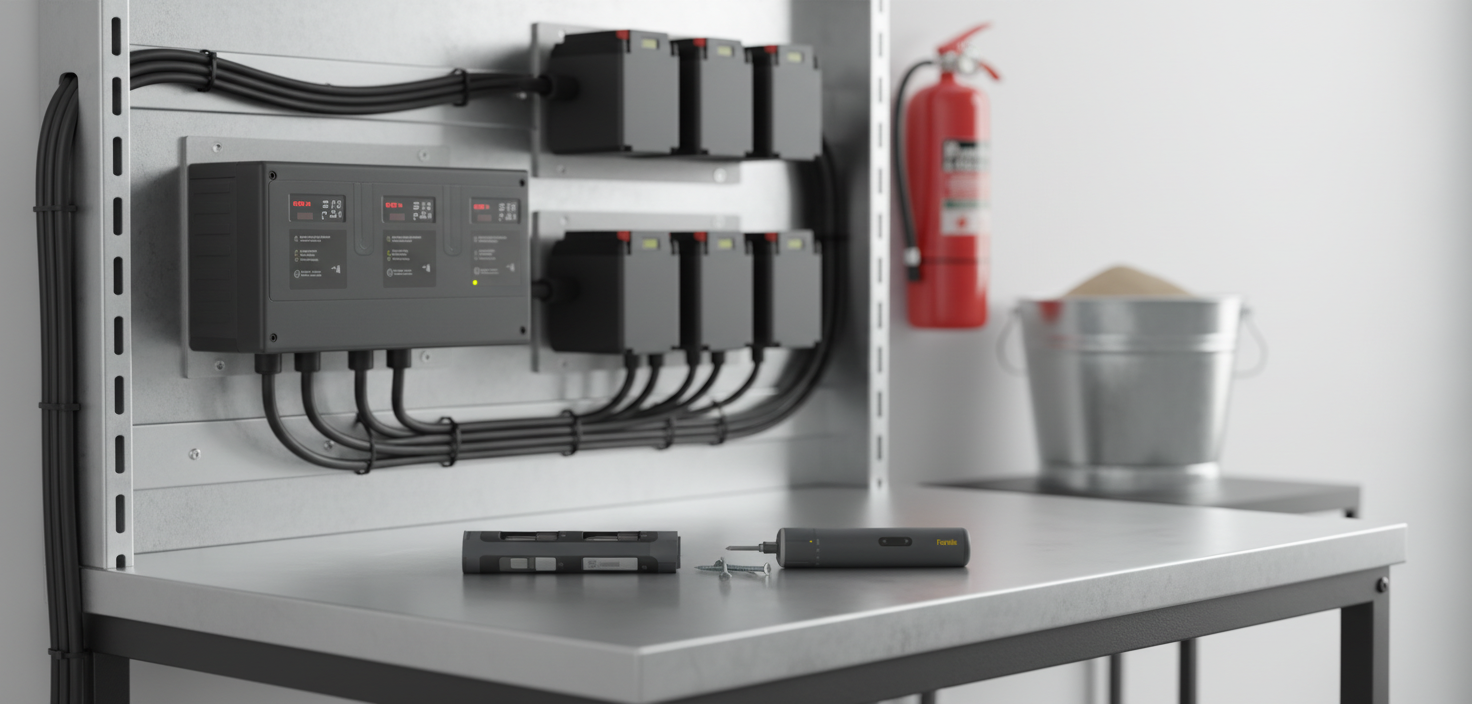
- The Professional Approach: Use a steel industrial rack or a heavy-duty metal cabinet. This provides a non-combustible thermal barrier that helps prevent a localized cell failure from spreading to the building structure.
Electrical Load Management
A 10-bank charging station is a significant electrical load. Each 5Ah battery pack requires approximately 168Wh for a full charge cycle when accounting for conversion losses.
- Dedicated Circuits: A full 10-bank station can draw upwards of 1.6kWh per cycle. We strongly advise against sharing this load with high-draw tools like table saws or CNC routers, as voltage sags can interfere with charger logic. A dedicated 20A circuit is the baseline recommendation.
- Cable Routing: Use fixed conduit or secure cable routing channels to avoid "spaghetti" wiring. If using a mobile charging cart, it should be anchored when in use to prevent tipping or becoming a trip hazard.
Ventilation: The 1 CFM Heuristic
Proper airflow is the most effective way to dissipate heat. We employ a practical engineering heuristic for workshop ventilation: Provide at least 1 cubic foot per minute (CFM) of exhaust airflow per watt of cumulative charging power.
This 1:1 ratio is a "rule of thumb" designed to maintain a temperature delta ($\Delta T$) of less than 10°C (18°F) above ambient temperature.
| Parameter | Value | Rationale |
|---|---|---|
| Cumulative Power Draw | 500W | 10 chargers at ~50W each |
| Required Airflow | 500 CFM | Based on 1 CFM/Watt heuristic for $\Delta T < 10^\circ C$ |
| Ambient Temp Limit | 35°C (95°F) | Recommended maximum for safe operation |
| Ingress Protection | IP54 | Required for conductive dust environments |
Operational Safety Protocols
The Battery Logbook
Experienced managers track fleet health by noting:
- Initial Voltage: Batteries dropped below their safe discharge floor (typically 2.5V per cell) should be inspected before charging.
- User Accountability: Ensures batteries aren't left "orphaned" for days.
- Charge Duration: Helps identify packs with high internal resistance (taking unusually long to charge).
Active Thermal Monitoring
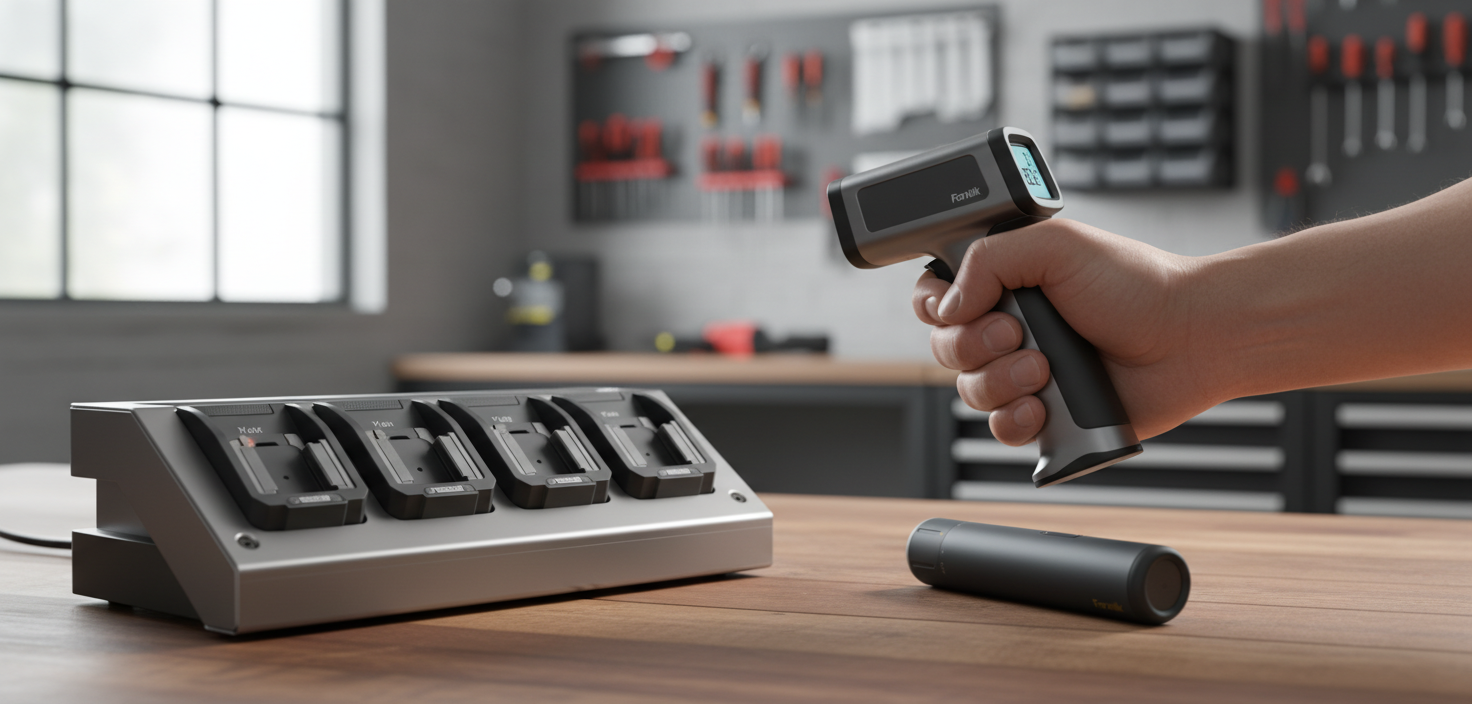
Infrared (IR) thermometers are indispensable. Practitioners should scan battery surfaces every 30 minutes during fast-charge cycles.
- The 10°C Rule: Any pack showing a temperature delta greater than 10°C (18°F) from its neighbors should be isolated for inspection.
- Advanced Monitoring: For automated spaces, I²C infrared array sensors (like the Melexis MLX90640) can provide non-contact monitoring, potentially triggering an automatic power cutoff if a hotspot is detected.
Emergency Response: PPE and Procedures
While workshops should have a Class ABC fire extinguisher for structural fires, they are often ineffective against the self-oxidizing nature of a lithium-ion thermal runaway.
- Dry Sand: Keep a 5-gallon bucket of dry sand adjacent to the station. Sand can smother small peripheral fires and act as a heat sink.
-
Emergency PPE: Handling a compromised battery requires specific Personal Protective Equipment:
- Gloves: Heavy-duty, heat-resistant welding gloves (rated for at least 500°F).
- Face Protection: A polycarbonate face shield over safety goggles.
- Tools: Long-handled steel tongs or a square-nose shovel for moving the pack.
- Isolation Protocol: If a battery hisses, swells, or off-gasses, and if it is safe to do so, move it to a "fire-safe" ceramic or metal bin and cover it with sand. Warning: Never attempt to move a battery that is actively venting or shooting flames; evacuate and contact emergency services.
- Compliance: Ensure protocols align with OSHA's Lithium Battery Safety Guide.
Methodology & Modeling Assumptions
The following parameters were used to derive the thermal and energy requirements discussed. This is a scenario model, not a controlled lab study.
| Parameter | Value | Unit | Rationale |
|---|---|---|---|
| Simultaneous Packs | 10 | Count | Standard high-volume station capacity |
| Pack Capacity | 5 | Ah | Typical 18650-based power tool battery |
| Charging Current | 5 | A | Fast-charge setting for professional use |
| Efficiency Factor | 0.85 | Ratio | Combined charger and chemical efficiency |
| Ambient Temp | 35 | °C | Worst-case summer workshop temperature |
Analysis Limits: These results apply to commercial-grade maker spaces. Home workshops with 1–2 chargers will experience significantly lower thermal loads. The 1 CFM/W heuristic is a conservative engineering guideline to ensure rapid air exchange.
Disclaimer: This article is for informational purposes only and does not constitute professional legal, fire safety, or electrical engineering advice. Lithium-ion batteries pose significant fire risks. Always consult with a certified electrician and local fire marshal when designing charging infrastructure.
References & Resources
- Regulatory Standards:
-
Technical & Industry Data:
- The 2026 Modern Essential Gear Industry Report (Manufacturer Whitepaper)
- Melexis Temperature Sensor ICs (Data Sheet)
- NASA: Adiabatic Processes (Fundamental Physics)

Leave a comment
This site is protected by hCaptcha and the hCaptcha Privacy Policy and Terms of Service apply.