











































To drill hardwood hinge pilot holes, work in three steps. Mark the screw centers from your hinge's own layout. Pick a bit sized to the screw's core and the wood, then drill to a checked depth stop set for your door.

Done this way, the screw drives with less force and lands where the hinge needs it, while a checked depth stop helps control bit depth to reduce the risk of breaking through the finished face.
How to Drill Cabinet-Door Hinge Pilot Holes in Hardwood
Treat the hinge, the screw, and the door in your hands as the only valid reference. Whether mounting standard cabinet doors or upgrading workshop cabinets with specialty hardware, dimensions borrowed from a different hinge or door can put holes in the wrong spot or at the wrong depth.
Mark the Hinge Screw Positions
Start with the layout or template made for your exact hinge. Transfer its screw centers to the door, and keep the hinge aligned to the door edge the way its instructions describe. If you're installing a cup hinge, seat it first so the screw holes in the cup show you exactly where to mark.
As one model-specific example, the H002 placement instructions from Blum locate the hinge from a cup centerpoint measured up from the bottom of the door. They also say to use a square-edge tool so the hinge's front edge stays parallel with the door edge. Those measurements belong to that hinge only, so use them as a pattern for the process, not as numbers for your hardware.
Choose a Bit for the Actual Screw and Hardwood
Use the hinge or screw maker's pilot size first when one is given. Without it, size the bit to the screw itself. Per general wood-screw pilot sizing guidance, the pilot should be about the diameter of the shank minus the threads. That's the solid core you'd see if you ground the threads off. The same guide notes that hardwoods compress less than softwoods, so they call for a pilot slightly larger than you'd use in pine.
To check a bit, hold it behind the screw. You should see the threads sticking out on both sides while the core stays hidden behind the bit.
For a concrete case, the Blum H002 pilot-hole instructions call for a 1/8-in (3 mm) bit and holes less than 5/8 in deep for the kit's included #6 x 5/8-in screws. That spec covers only those screws in that kit.
Set the Depth Stop and Drill
A pilot hole has to be deep enough for the screw and shallow enough to leave the door face intact.
- Measure the door at each screw location. Do this at the hinge area, recess or cup hole included, not just at the door edge. Compare that thickness with the pilot depth your hardware calls for.
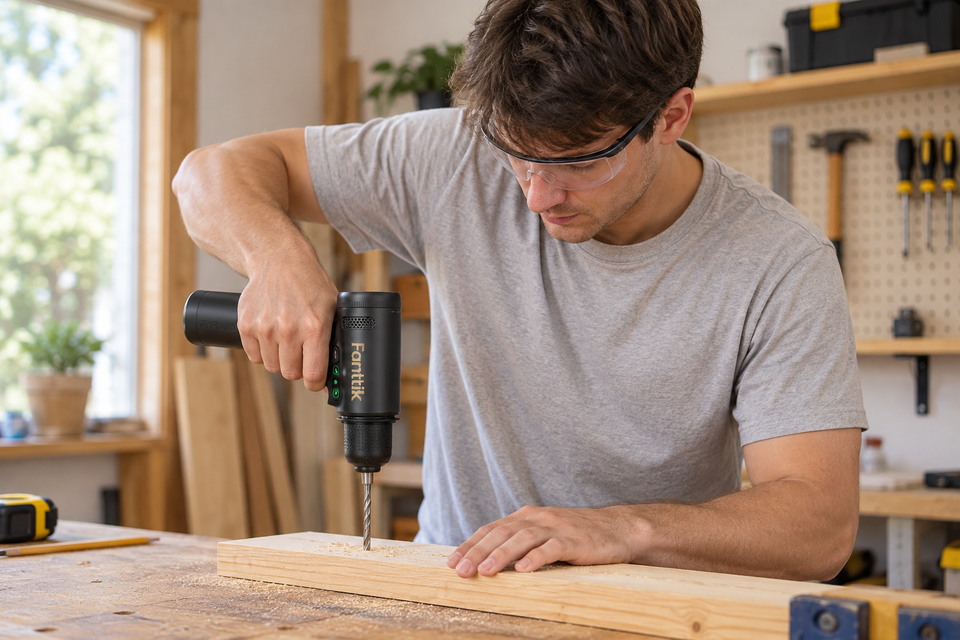
- Set a physical stop. Lock a stop collar on the bit at the planned depth. According to this physical depth-stop guidance, tape can shift or compress after a few holes and won't actually stop the bit. A secured collar gives more reliable control. Snug the set screw just enough to hold, and keep it off the bit's cutting lip.
- Test on scrap. Drill one hole in scrap and measure it. Adjust the collar until the hole matches your planned depth.
- Drill straight to the stop. Use a sharp bit and steady, light pressure. Recheck the collar every few holes.
- Stop if the numbers don't fit. If the recommended depth won't leave solid wood behind the face, don't drill. Check the screw length and hinge instructions first.

Matching the pilot to the screw is how pilot holes can reduce splitting risk in dense woods like oak and maple. It lowers the driving force and the pressure on the surrounding wood. It doesn't remove that risk, and a depth stop improves control without making breakthrough impossible.
FAQs
Do I really need pilot holes for hinge screws in hardwood?
In hardwood, yes, they're strongly advised. Driving a screw without one forces wood aside with nowhere to go. That can split or crack the wood, strip the screw head, or snap a small screw. A pilot also helps the screw start exactly where the hinge needs it.
What if the screw is still hard to drive after drilling the pilot?
Don't force it. The general guidance is to step up to a slightly larger pilot rather than overpower the screw. Make sure the new size still stays below the outside thread diameter so the threads have wood to bite into.
Can I use masking tape instead of a stop collar?
Tape can work as a visual marker for a few holes where exact depth isn't critical. It can creep up the bit and compress, and it won't physically stop the bit. For hinge holes near a finished face, a secured collar is the safer choice.
Are the Blum H002 dimensions safe to use for other hinges?
No. The 1/8-in bit, the under-5/8-in depth, and the placement measurements apply to that kit and its included screws. Use your own hinge's instructions, or size from your screw's core if none are given.
Leave a comment
This site is protected by hCaptcha and the hCaptcha Privacy Policy and Terms of Service apply.