






































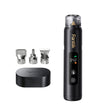



Car polishing pads come in three broad foam roles. Cutting foam handles heavier correction, polishing foam handles moderate correction, and finishing foam handles light refinement. Pick the role that fits your paint's defects, then pair it with the compound or polish that the same product system lists for that job.
Before you work the whole car, try that pairing on a small, out-of-sight area. Keep it only if the result meets your goal. Pad color won't tell you how aggressive a pad is on its own, because each brand's colors belong to its own lineup.

Which Foam Pad and Abrasive Pairing Fits Each Goal?
One clear example comes from DiTEC, which matches each of its three compounds to specific foam pads for use on a dual-action (DA) polisher. Check your own machine's pad guidance before carrying those pairings over to a compact cordless buffer such as the Fanttik P10 Pro Mini Car Buffer Polisher. The table follows DiTEC's documented compound-and-foam pairings and applies only to that product system.
| Your goal | DiTEC compound + foam pad | Stated use |
|---|---|---|
| Heavier correction | Heavy Cut compound + yellow high-cut foam | Moderate-to-high correction |
| Moderate correction | Medium Cut compound + orange medium-cut foam | Moderate correction; one-step use |
| Fine correction or finishing | Fine Cut compound + red low-cut or gray minimal-cut foam | Fine correction or finishing; gray suits softer, darker paint |
Read each row as one combination, not two separate picks. The compound has its own cut level, and so does the pad. DiTEC matches them so the pad's role supports what the compound is built to do. Swapping in a random pad changes the combination, even if the compound stays the same.
The last row has two pad options. Red low-cut foam and gray minimal-cut foam both work with Fine Cut compound. The document calls out gray as especially suitable for softer and darker paint. So if your car has soft or dark paint and you only need fine refinement, the gray option is the one DiTEC points you to. The same document also describes Fine Cut compound as well suited to DA polishers.
Keep these colors tied to DiTEC. Yellow, orange, red, and gray describe this lineup only. Another brand may use the same color for a different cut level. When you shop outside this system, read the pad's cut description and the compound maker's pad advice instead.
How Do Cutting, Polishing, and Finishing Foam Differ?
The main difference is how much paint each pad role is meant to remove. "Cut" measures how aggressively a pad and abrasive level the clear coat to reduce defects such as swirls and light scratches, where more cut removes defects faster while less cut refines the surface with minimal material removed.
Lake Country's pad guidance lays out this range well. In that guidance, heavier cutting pads tend to remove paint material more quickly but can leave fine imperfections of their own. Soft finishing pads remove very little paint material but can produce the glossiest results. Intermediate pads sit between the two. The same guidance says foam pads are a natural fit for orbital machines, which includes DA polishers.
That trade-off explains why the roles often work in sequence. A cutting pad does the heavy lifting on deeper defects. It may leave behind fine marks that a polishing or finishing step then refines. If your paint only has light defects, you may be able to start at the polishing or finishing role and skip the heavier step entirely.
Treat these as relative roles within one maker's lineup, not a universal scale. One brand's "medium" pad won't match another brand's "medium" exactly. The pad also isn't the whole story. The same foam can act more or less aggressively depending on the compound or polish you pair with it. That's why a pad label alone doesn't give you a complete combination. You still need the abrasive product the manufacturer recommends for that pad.
How to Choose a Pairing for the Paint in Front of You
Pick a documented pairing that matches your goal, then let a small test area decide. This keeps the choice tied to how your paint actually responds, not to a color or a guess.
- Start with the exact product instructions. Read the instructions for your polisher, pads, and compound or polish. Only use a pad-and-product combination those instructions allow, and follow their stated use conditions.
- Match the pairing to the defects you see. Look at the paint under good light. Deeper swirls and scratches point toward a higher-correction pairing. Light marks or dullness point toward a fine-cut or finishing pairing. Choose the documented combination whose stated goal is closest to what you see, and lean toward the gentler option when two seem to fit.
- Try it on a small, inconspicuous area. Work a small section, such as a lower door panel, before moving across the car. Wipe it clean and inspect it. Check whether the defects you targeted are reduced and whether the pass left any new haze or fine marks.
- Keep it, or change one step. If the section meets your goal, use that pairing on the rest of the car. If defects remain, try the next more corrective pairing from the same product system. If correction looks good but the finish shows fine marks, follow up with that system's lower-cut finishing pairing. Change one thing at a time so you can tell what made the difference.

For a more detailed walk-through of this comparison, Detailed Image's guide to setting up a test panel shows how to split a small area into sections and vary the pad and product up or down until you reach the result you want. It treats its example combinations as starting points, not absolutes, and your product instructions still set what's compatible.
FAQs
Can I use one brand's pad colors to pick pads from another brand?
No. Colors belong to each manufacturer's own lineup, and the same color can mean a different cut level at another brand. Read the pad's written cut description, such as high-cut, medium-cut, or low-cut, and check which compound that maker pairs it with.
Is a one-step polish realistic with a medium pairing?
Within DiTEC's system, the Medium Cut compound with orange medium-cut foam is listed for one-step use as well as moderate correction. Whether one step is enough on your car depends on how your paint responds. If a test section still shows fine marks after that pass, add a finishing step with a lower-cut pairing.
Do foam pads work on a dual-action polisher?
Yes. Lake Country describes foam pads as a natural fit for orbital machines, including DA polishers. Your polisher's own instructions still decide which pad sizes and backing plates it accepts, so confirm those before you buy car polishing pads for it.
Why does a finishing pad come after a cutting pad instead of replacing it?
They do different jobs. A cutting pad removes more paint to reduce deeper defects but can leave fine marks. A finishing pad removes very little, so it can refine those marks but can't do heavy correction on its own. On paint with only light defects, a finishing pairing alone may be all you need.
Continue reading
 Why Does My Tire Look Flat Even When Full? Radial Sidewall Flex Explained
A tire's shape under load can't tell you its pressure. This guide explains sidewall flex and indentations, then...
Why Does My Tire Look Flat Even When Full? Radial Sidewall Flex Explained
A tire's shape under load can't tell you its pressure. This guide explains sidewall flex and indentations, then...
 Portable Car Coffee Machine Guide: Brewing Fresh Coffee on Road Trips
A road-trip coffee guide that splits setups into vehicle-powered, battery, and hot-water paths, with checks for power, servings,...
Portable Car Coffee Machine Guide: Brewing Fresh Coffee on Road Trips
A road-trip coffee guide that splits setups into vehicle-powered, battery, and hot-water paths, with checks for power, servings,...

Leave a comment
This site is protected by hCaptcha and the hCaptcha Privacy Policy and Terms of Service apply.