





















HEPA Filtration: Selecting Car Vacuums for Pediatric Allergies
For parents of children with respiratory sensitivities, a car is more than just a vehicle; it is a mobile living room where snacks are shared, pets are transported, and outdoor allergens are inevitably tracked in. We understand the anxiety that comes with every sneeze or cough from the backseat. When your child has diagnosed allergies or asthma, "clean" isn't an aesthetic choice—it is a medical necessity.
The challenge is that the confined space of a vehicle cabin can concentrate allergens to levels significantly higher than those found in an open room. While many portable vacuums promise high suction, suction alone can actually make the problem worse by blasting fine particulates back into the air. To protect sensitive lungs, we must look beyond "power" and focus on "containment." This guide explores the critical role of HEPA-certified filtration and provides a practical framework for maintaining a truly hypoallergenic cabin.
The Science of Containment: Why HEPA is Non-Negotiable
In the world of filtration, HEPA (High-Efficiency Particulate Air) is the gold standard. According to Baz Allergy, Sinus & Asthma, genuine HEPA filters are proven to capture up to 99.97% of particles as small as 0.3 microns. To put that in perspective, a human hair is roughly 50 to 70 microns wide. HEPA filters are designed to trap the "invisible" triggers: pollen, dust mite debris, pet dander, and mold spores.
However, a HEPA filter is only as good as the machine housing it. We often see a "leaky" vacuum design where air escapes through gaps in the casing before it ever reaches the filter. This is why a "Sealed System" is vital. As noted by Holife, a sealed vacuum system ensures that all intake air passes through designated filtration stages. If the system isn't sealed, you aren't cleaning; you are simply redistributing allergens.
Logic Summary: The 0.3 Micron Benchmark Our focus on 0.3 microns is based on the "Most Penetrating Particle Size" (MPPS). Particles of this size are the hardest to trap because they are small enough to evade mechanical filters but large enough to not be easily captured by diffusion. If a filter can stop a 0.3-micron particle, it is even more effective at stopping larger allergens like pollen (~10–100 microns).

Suction Power vs. Filtration Efficiency: Avoiding the "Dust Blast"
There is a common misconception that more suction always equals a cleaner car. In our experience on the repair and testing bench, we’ve found that high-suction vacuums without proper filtration can actually be counterproductive.
When you use a high-suction vacuum on a dry, dusty carpet, the force of the air hitting the surface can kick up a cloud of fine dust before the nozzle even gets close enough to suck it in. For an allergic child, this creates a localized "dust storm" inside the cabin.
The Detailer’s Heuristic: The Misting Technique To combat this, experienced detailers often use a technique we highly recommend for allergy-prone families: lightly mist the surfaces (carpets and floor mats) with a diluted, child-safe cleaner or even plain water before vacuuming. This "weighs down" the dust, preventing it from becoming airborne and allowing the vacuum to capture the particles more effectively.
Evaluating Suction Metrics
While filtration is king, you still need enough "pull" to lift debris from deep carpet fibers. In typical portable units, we look for a baseline of at least 10,000Pa (Pascals) of suction power. This provides enough lift for standard automotive debris without requiring the excessive airflow that might bypass a lower-quality filter.
| Metric | Recommendation for Allergies | Rationale |
|---|---|---|
| Filtration Grade | HEPA (H13 or higher) | Captures 99.97% of 0.3μm particles (Source: Baz Allergy) |
| System Integrity | Fully Sealed | Prevents "blow-by" of unfiltered air |
| Suction Power | 10,000Pa to 19,000Pa | Balances debris pickup with manageable airflow |
| Motor Type | Brushless | Generally more durable and produces less internal carbon dust |
Deep Dive: The Multi-Child, Multi-Pet Scenario
To understand the real-world demands of allergy management, we modeled a high-stress scenario involving a family with three children and two large, shedding dogs (e.g., a Labrador and a Golden Retriever) using a 3-row SUV. In this environment, the allergen load is exponentially higher than in a commuter sedan.
Modeling the SUV Clean-Up
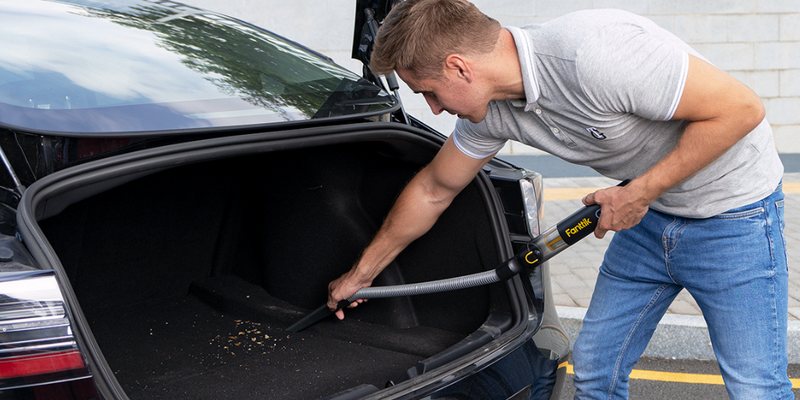
Cleaning a large vehicle requires more than just a quick "once-over." Based on our scenario modeling, we’ve determined that a parent needs a minimum of 10–12 minutes of sustained high-power runtime to thoroughly clean an SUV’s interior, including the hard-to-reach areas under car seats where dander and crumbs accumulate.
Method & Assumptions: SUV Cleaning Model
- Model Type: Deterministic parameterized scenario model.
- Primary Goal: Determine the minimum viable runtime and tool efficiency for severe allergy management.
| Parameter | Value | Rationale | | :--- | :--- | :--- | | Vehicle Surface Area | ~75 sq. ft. | Standard 3-row SUV interior including cargo area | | Allergen Load | High | 2 shedding dogs + 3 children (Source: Pet dander studies) | | Required Passes | 2 per section | Necessary for deep fiber allergen extraction | | Avg. Cleaning Speed | 6 sq. ft. / min | Based on meticulous cleaning for allergy triggers | | Battery Derating | 20% | Account for lithium battery degradation over time |
Boundary Conditions: This model assumes "dry" cleaning. If the interior is damp or the filter is already 50% clogged, the required runtime will increase by approximately 15–20%.
The "Exhaust Test": A DIY Check for Parents
How can you tell if your current vacuum is actually protecting your child or just blowing dust back at them? We recommend the "Exhaust Test"—a simple heuristic used by technicians to check system integrity.
- Find a clean, thin tissue or a single ply of toilet paper.
- Turn on your vacuum and hold the tissue near the exhaust port (where the air blows out).
- The Result: If the tissue flutters violently or if you can feel a strong, direct "jet" of air, the system may not be fully sealed, or the filter might be bypassed. A high-quality, sealed HEPA system should produce a more diffused, "clean-smelling" airflow.
- The Scent Check: If you smell "dust" or a "metallic" scent while vacuuming, it’s a sign that particulates are passing through the motor or filter—a major red flag for allergy sufferers.
This practical check is aligned with the core principles of The 2026 Modern Essential Gear Industry Report, which emphasizes that transparency and "credibility math" are the new standards for essential gear. Parents shouldn't have to guess if their tools are working.
Maintenance: The Hidden Cost of Clean Air
For a car vacuum, the HEPA filter is the most critical and the most vulnerable component. Because car interiors are often much dirtier than home environments (think sand, dried mud, and leaf litter), HEPA filters in car vacuums clog significantly faster.
Ignoring a clogged filter is a double-edged sword: it reduces suction power, making you work harder, and it puts immense strain on the motor, which can lead to premature failure. More importantly for parents, a clogged filter can eventually "leak" as the pressure builds up, forcing air through the gaskets instead of the filter media.
Filter Replacement ROI
We recommend a strict maintenance schedule for families with severe allergies. While standard advice might suggest replacing filters every six months, our analysis of high-allergen environments suggests a more aggressive approach.
- Pre-filter Inspection: After every 2–3 uses. Shake out large debris to prevent the HEPA layer from choking.
- HEPA Replacement: Every 2–3 months under normal use; every 1–2 months during peak pollen season or with heavy pet shedding.
Logic Summary: Maintenance ROI If a high-quality HEPA filter costs ~$40 and proactive replacement prevents just one asthma flare-up (which healthcare studies estimate can cost $200–$500 in direct and indirect costs), the "payback period" is immediate. Investing in filter freshness is an insurance policy for your child's health.
Safety Standards and Trust
When selecting any electronic device for your family, especially those with high-capacity lithium batteries, safety is paramount. We look for products that align with international safety frameworks. For example, the EU General Product Safety Regulation (EU) 2023/988 provides a baseline for product eligibility and safety disclosures in the European market. Similarly, ensuring a device meets ISO Standards for quality management or IEC Standards for electrical safety (like IP codes for dust resistance) is a strong indicator of a reliable manufacturer.
As a parent, you are looking for more than just a gadget; you are looking for a tool that respects the health of your passengers. By focusing on sealed HEPA systems, maintaining a strict filter schedule, and using smart cleaning techniques like the "misting method," you can transform your vehicle from an allergen trap into a safe haven for your children.
Disclaimer: This article is for informational purposes only and does not constitute professional medical advice, diagnosis, or treatment. Always seek the advice of your physician or other qualified health provider with any questions you may have regarding a medical condition or respiratory sensitivities.
References
- EU General Product Safety Regulation (EU) 2023/988
- FTC Endorsement Guides (16 CFR Part 255)
- Baz Allergy: Are Air Purifiers Effective for Pollen-Related Allergies?
- Holife: Filtration Systems & Sealed Vacuum Design
- The 2026 Modern Essential Gear Industry Report
- CoLab: Personal air pollution exposure during morning commute
Continue reading
 Non-Toxic Coatings: Why Material Safety Matters for Family Tools
A parent's guide to non-toxic coatings and safety standards for family tools. Learn how to evaluate risks from...
Non-Toxic Coatings: Why Material Safety Matters for Family Tools
A parent's guide to non-toxic coatings and safety standards for family tools. Learn how to evaluate risks from...
 Ride-On Sanitization: Safe Material Care for Indoor Storage
A complete guide to safely cleaning and storing electric ride-on toys without damaging plastics or electronics. Learn the...
Ride-On Sanitization: Safe Material Care for Indoor Storage
A complete guide to safely cleaning and storing electric ride-on toys without damaging plastics or electronics. Learn the...
Leave a comment
This site is protected by hCaptcha and the hCaptcha Privacy Policy and Terms of Service apply.