

































The Holiday Road Trip Safety: The Essential Pre-Travel Vehicle Audit
The holiday season is a high-stakes marathon of family reunions and gift-laden "trunk Tetris." For many, the joy of travel is often shadowed by the "what-ifs" of a flat tire or a dead battery in a remote area. Based on our experience supporting thousands of families through roadside gear feedback, we’ve found that most travel anxiety stems from a lack of verified readiness rather than the drive itself.
The 10-Minute "Peace of Mind" Summary
If you are leaving in the next hour, here are the three non-negotiables:
- The Load Check: If your car is fully packed, add 2–3 PSI to your rear tires (staying under the "Max Press" on the sidewall) to account for the extra weight.
- The Cold Start Rule: Batteries lose significant power in freezing temps. If your car struggles to start now, it likely won't start at your destination.
- The "Full Cycle" Test: Don't just pack your emergency inflator or jump starter—turn them on and run them for 30 seconds to ensure the battery isn't "surface charged" but actually functional.
The Practitioner’s Secret: The "Full Operational Cycle"
One of the most common failure points we see isn't a faulty device, but a lack of user familiarity. We often hear from motorists who bought a high-end portable inflator months ago, only to realize they don't know how to set the target PSI while standing on a dark, slushy shoulder.
Before you pack, we recommend performing a Full Operational Cycle on all safety gear. This is a practical heuristic used by professional drivers to ensure gear integrity:
- Mechanical Check: Connect all hoses and terminals to ensure threads aren't stripped and clamps have strong tension.
- Parameter Setup: Practice setting the auto-shutoff pressure on your inflator while wearing gloves.
- Load Test: Run your inflator for 2–3 minutes. Based on internal quality testing, we’ve observed that defective battery cells often "plummet" in voltage after 60 seconds of actual motor load, even if they show 100% charge while idle.
- Manual Verification: Use a secondary manual gauge to verify the digital readout.
Section 1: The Tire Audit—Physics and the "Holiday Load"
Tires are the only contact point between your family and the road. During the holidays, temperature drops and maximum vehicle weight converge to challenge tire integrity.
The 10-Degree Heuristic
According to The Family Handyman, cars typically require 30 to 35 PSI. However, a common engineering rule of thumb (derived from the Ideal Gas Law) is that for every 10°F drop in ambient temperature, tire pressure can drop by approximately 1 PSI.
If you calibrated your tires in a 60°F garage and drive into a 20°F mountain pass, you could be 4 PSI under-inflated. This level of under-inflation can increase sidewall heat and elevate the risk of a blowout.
The "Max Capacity" Adjustment
When your car is loaded with five passengers and 200 lbs of luggage, your "standard" PSI may be insufficient.
- Practical Rule of Thumb: If you are near your vehicle's Gross Vehicle Weight Rating (GVWR), consider increasing rear tire pressure by 2–3 PSI.
- Critical Boundary: Never exceed the "Max Press" listed on the tire sidewall. This adjustment helps maintain the tire's contact patch and reduces the "squirmy" handling common in overloaded SUVs.
| Parameter | Value/Range | Unit | Rationale |
|---|---|---|---|
| Standard PSI | 30–35 | PSI | General passenger car baseline [2] |
| Temp Sensitivity | ~1 | PSI per 10°F | Engineering Heuristic (Ideal Gas Law) |
| Load Adjustment | +2 to +3 | PSI | Workshop Rule of Thumb for max-load |
| Max Press Limit | See Sidewall | PSI | Safety ceiling to prevent casing failure |
| Inspection Depth | >4/32 | Inches | Minimum safe tread for wet/snowy roads |
Note: These figures are scenario-based estimates. Always prioritize the Tire and Loading Information placard located on your driver-side door jamb.
Section 2: The Power Audit—Cold Cranking and "Double Displacement"
A dead battery is a frequent cause of holiday roadside assistance calls. Cold weather drastically changes the chemistry inside lead-acid cells, reducing their ability to provide a "jolt" to the starter motor.
Understanding CCA vs. CA
As noted by Car and Driver, Cold Cranking Amps (CCA) is the standard metric for performance at 0°F. In contrast, Cranking Amps (CA) is measured at 32°F.
The Double Displacement Heuristic: In freezing temperatures, lithium-ion jump starters may deliver 20–30% fewer effective cranking amps due to internal resistance (a common observation in our battery stress tests). To ensure a margin of safety, we suggest the following:
- The Rule: Select a unit rated for at least double your vehicle’s engine displacement in liters.
- Example: If you drive a 3.5L V6, look for a jump starter rated for at least a 7.0L gas engine. This provides the "overhead" needed to overcome a completely frozen battery.
Maintenance of the "Safety Net"
A jump starter is only a safety net if it is charged. According to industry maintenance guides, you should store these units at 50–80% charge. While we recommend a "Quarterly Readiness Audit," a top-off the night before departure is a best practice for holiday travel.
Section 3: The Cabin Audit—Mental Clarity and Emergency Access
A cluttered car is a safety hazard. In an emergency, loose items can become projectiles. We approach cabin organization as a "cockpit management" task.
The "Non-Driver Access" Bag
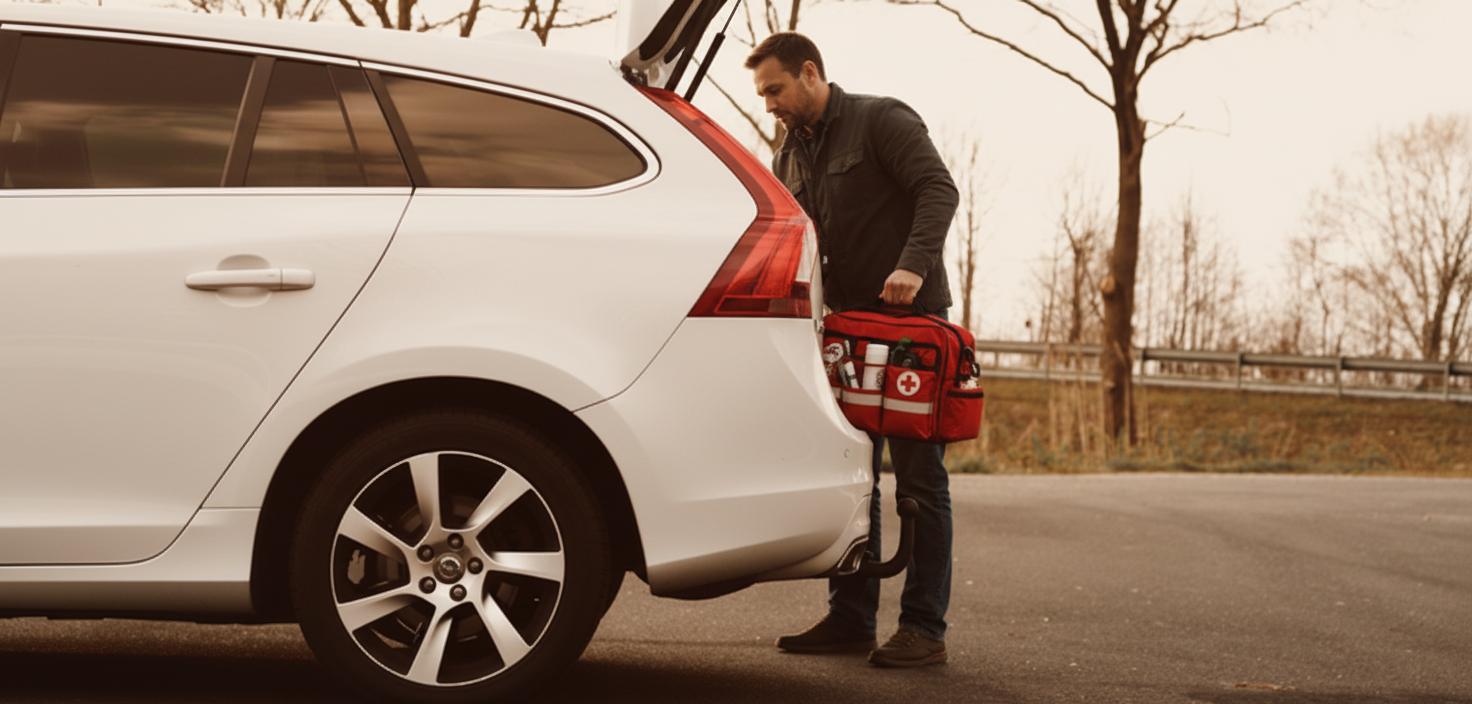
We recommend placing child-specific needs—flashlights, snacks, emergency blankets, and a first-aid kit—in a brightly colored, easy-to-open bag in the passenger footwell.
- The Benefit: If the driver is occupied with a repair, a passenger (or even an older child) can access essentials instantly without rummaging through a packed trunk.
The "Sensory Reset" Clean
Long drives are taxing. A 10-minute "deep suction" of the cabin—removing crumbs and dust—can significantly reduce sensory fatigue. Using a high-power handheld vacuum to clear the "driver's zone" (cup holders and floor mats) creates a professional, calm environment that aids focus.
Section 4: Redundancy—The 1:1 Power Rule
In modern travel, being "stranded" often means being "disconnected." For family safety, we advocate for the 1:1 Power Heuristic: pack one dedicated backup power source for every primary safety device you carry.
If you rely on a smartphone for navigation, ensure every adult has a dedicated high-capacity power bank. This redundancy ensures that a single point of failure (like a blown fuse in your car's 12V port) doesn't result in a total loss of GPS utility.
Section 5: The "Trust Layer"—Compliance and Engineering
When buying safety gear, you are buying a promise of performance. Reputable brands invest in rigorous testing to ensure their products work in the "real world."
As detailed in The 2026 Modern Essential Gear Industry Report (an internal Fanttik whitepaper based on our engineering benchmarks), trust is a function of "credibility math." Look for products citing:
- UN 38.3 Certification: Ensures lithium batteries can safely withstand the vibrations and thermal shocks of road travel.
- IEC 60529 (IP Ratings): If you are using an inflator in a rainstorm, an IP-rated housing (like IPX4) is essential for preventing short circuits.
- Realistic Specs: Avoid products claiming "infinite" battery life. Measured, realistic specs are a hallmark of engineering integrity.
Note: These standards align with the EU General Product Safety Regulation (2023/988), which prioritizes traceability and consumer safety.
The Pre-Trip Checklist: A 10-Minute Final Walkthrough
On the morning of your departure, perform this final "Pilot's Walkaround":
- The "Squat" Test: Walk around the car and look at the "bulge" of each tire. If one looks flatter, check it immediately.
- The Terminal Check: Ensure your jump starter clamps are clean. Corrosion can prevent the high-amperage flow needed for a cold start.
- The Light Sweep: Test blinkers, brake lights, and high beams. Visibility is your first line of defense.
- The Fluid "Quick-Check": Ensure your windshield washer fluid is rated for sub-freezing temperatures. Standard fluid can freeze in the lines, leaving you with zero visibility on a salty highway.
Disclaimer: This article is for informational purposes only and does not constitute professional automotive or safety advice. Vehicle requirements vary significantly by make, model, and environmental conditions. Always consult your vehicle's owner's manual and a certified mechanic before making significant adjustments or embarking on long-distance travel.
References & Authoritative Sources
- EU General Product Safety Regulation (EU) 2023/988
- The Family Handyman: Ideal Tire Pressure in Cold Weather
- Car and Driver: Best Portable Jump Starters Tested
- IATA Lithium Battery Shipping & Safety Guidance
- NIST AI Risk Management Framework (for Trust Systems)
- ISO Standards Catalogue: Quality & Safety
- The 2026 Modern Essential Gear Industry Report (Fanttik Whitepaper)



Leave a comment
This site is protected by hCaptcha and the hCaptcha Privacy Policy and Terms of Service apply.