




























The Silent Guardian: Why Maintenance Matters
We have all been there: a crisp winter morning, a hurried schedule, and the dreaded rhythmic clicking of a car that refuses to start. In these high-consequence moments, a portable jump starter is more than a tool; it is a promise of self-reliance. However, the most sophisticated engineering is rendered useless if the device itself has succumbed to the "silent drain" of seasonal dormancy.
Maintaining a jump starter’s readiness during the off-season is not merely about keeping it plugged in. It is a methodical process of managing electrochemical stability, thermal exposure, and voltage health. Based on our observations from handling thousands of customer support inquiries and analyzing field-return data, the primary cause of emergency gear failure isn't a manufacturing defect—it is a misunderstanding of how lithium-ion cells "breathe" while they sit in a garage or trunk.
In this guide, we will move past generic advice to provide a technical, data-backed protocol for ensuring your equipment is ready when the stakes are highest.
The Physics of Hibernation: Understanding Self-Discharge
Every battery, no matter how high the quality, experiences self-discharge—a slow, internal chemical reaction that consumes energy even when the device is powered off. While generic specification sheets often cite a monthly loss of 5% to 8%, our internal benchmarks for premium lithium-ion cells show a more optimistic reality of 2% to 3% at a stable room temperature of 20°C (68°F).
However, this rate is not static. It is governed by the Arrhenius equation, which describes how chemical reaction rates increase exponentially with temperature. For every 10°C (18°F) increase in ambient temperature, the self-discharge rate effectively doubles. This means a jump starter stored in a 40°C (104°F) garage in July is losing energy four times faster than one stored in a climate-controlled basement.
Logic Summary: Our self-discharge estimates are based on the Lithium-ion battery - Wikipedia chemical kinetics model, assuming a standard NMC (Nickel Manganese Cobalt) chemistry common in high-output portable starters.
The 80% Heuristic vs. The 50% Reality
There is a persistent debate in the automotive community regarding the "ideal" charge level for storage. You may have heard the "80% rule," which suggests keeping the unit nearly full to ensure immediate readiness. While practical for short-term standby, storing a lithium-ion battery at 100% or even 80% for six months can accelerate capacity fade.
High states-of-charge (SoC) increase stress on the battery's anode and promote the growth of the solid-electrolyte interphase (SEI) layer, which permanently reduces the amount of energy the battery can hold. For long-term seasonal storage (exceeding three months), data suggests that a 40% to 60% SoC is the "sweet spot" for cell longevity.
The Compromise Protocol:
- Storage Phase: Charge the unit to approximately 50-60%. This minimizes chemical stress and lithium plating.
- Ready Phase: One week before you anticipate needing the unit (e.g., the first week of November), top it off to 100%.
This approach aligns with the IATA Lithium Battery Guidance, which mandates a 30% SoC for transport to maximize safety and stability, though we recommend slightly higher for consumers to account for the lack of professional monitoring.
Scenario Modeling: The Northern Diesel Challenge
To demonstrate why a "one-size-fits-all" approach to maintenance fails, we modeled a high-stress scenario involving a heavy-duty diesel pickup in a sub-zero climate. Diesel engines require significantly more cranking power than gasoline engines due to their high compression ratios, and cold temperatures simultaneously sap battery power while thickening engine oil.
Modeling Note: Winter Confidence Analysis
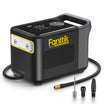
We simulated the performance of a 2000A peak-rated jump starter (similar to a premium unit like the Fanttik T8 Apex) attempting to start a 6.7L diesel engine at -15°F (-26°C).
| Parameter | Value | Unit | Rationale |
|---|---|---|---|
| Engine Displacement | 6.7 | Liters | Common heavy-duty diesel (e.g., Ford Power Stroke) |
| Ambient Temperature | -15 | °F | Typical Northern US/Canada winter night |
| Required Cranking Amps | ~2,576 | A | Adjusted for diesel compression + temp derating |
| Vehicle Battery CCA | 850 | A | Standard heavy-duty truck battery rating |
| Available Vehicle Amps | ~244 | A | BCI Standard: ~29% available at -15°F |
| Jump Starter Gap | ~2,332 | A | The power the portable unit must supply |
Methodology & Assumptions: This is a scenario model, not a controlled lab study. We used SAE J537 cranking standards and BCI temperature derating curves. We assume the diesel engine requires 2x the cranking amps of a gasoline equivalent and that the jump starter's sustained output is 40% of its peak rating.
In this specific "Northern Diesel" scenario, the standard 50% storage rule is dangerous. At -15°F, the usable energy in a lithium-ion pack drops by roughly 40%. If you store your unit at 50% in these conditions, you may only have enough energy for a single, failed attempt. For owners of large diesel vehicles or those in extreme climates, we recommend maintaining a 100% charge throughout the winter months, accepting the slight trade-off in long-term cell life for the absolute certainty of a start.
The Temperature Trap: Cold Storage vs. Cold Operation
A common mistake is conflating "storage" with "readiness." While cold temperatures (0°C to 10°C) are actually good for slowing down self-discharge during storage, they are bad for a battery's ability to deliver high current during a jump start.
If you store your jump starter in a frozen trunk, the internal resistance of the cells increases. When you try to jump the car, the voltage may "sag" so deeply that the unit's safety software triggers a low-voltage shutoff, even if the indicator lights show a full charge.
The Proactive Solution:
- Store Indoors: Keep the unit in a climate-controlled environment (15-25°C / 59-77°F) as recommended by standard lithium-ion research.
- The "Warm-Up" Trick: If the unit has been in the cold, bring it inside or place it in the passenger cabin with the heater on for 15 minutes before attempting a jump. This lowers internal resistance and restores the unit's ability to deliver its rated peak Amps.
Monthly Maintenance Checklist
To ensure your device remains a reliable safety net, we suggest a methodical "First of the Month" routine. This is based on patterns we have observed in high-reliability fleet management.
- Visual Inspection: Check the casing for any signs of swelling (a symptom of gas buildup from cell degradation) or cracks. Ensure the cable clamps are free of corrosion.
- Voltage Verification: Do not rely solely on the "bar" indicators. If your unit has a digital display, note the percentage. If it has dropped more than 5% in a month at room temperature, it may indicate a parasitic drain or an aging cell.
- The "Top-Up" Logic: If the unit is below 60% and you are in the off-season, charge it back to 60%. If you are entering the "high-need" season (Winter or Summer road trip season), charge it to 100%.
- Firmware/Port Check: Ensure the USB ports are clear of lint. For smart units, check if there are any recommended firmware updates from the manufacturer that optimize charging algorithms.
Safety, Compliance, and Engineering Trust
Reliability is not an accident; it is an engineering requirement. As noted in the 2026 Modern Essential Gear Industry Report, the market for emergency tools has shifted from "flashy specs" to "demonstrable credibility."
When choosing or maintaining a unit, look for compliance with international safety standards. For example, the EU General Product Safety Regulation (EU) 2023/988 emphasizes traceability and safety documentation. A jump starter that lacks clear thermal protection or over-discharge protection is a liability in a hot car. High-quality units utilize sophisticated Battery Management Systems (BMS) to prevent "thermal runaway"—a rare but serious risk where an overstressed cell enters a self-heating cycle.
Logic Summary: Our safety recommendations align with IEC 62133 standards for portable sealed secondary cells, which define the safety requirements for lithium batteries in consumer electronics.

Avoiding the "Indicator Light" Illusion
One of the most frequent "gotchas" we encounter is the "Surface Charge" or "Voltage Depression" phenomenon. A jump starter that has sat for months may show four green lights (100% charge), but as soon as the load of a starter motor is applied, the voltage collapses.
This happens because the chemical ions inside the battery become "sluggish" after long periods of inactivity. The only true way to verify health is a load test, but for most consumers, the best proxy is a regular discharge/recharge cycle. Every six months, we recommend using the jump starter's USB port to charge a tablet or phone from 0% to 100%, then recharging the jump starter. This "stretches" the cells and ensures the BMS is accurately calibrated to the battery's actual capacity.
Summary of Off-Season Strategies
To simplify your seasonal transition, refer to this strategy matrix based on your specific vehicle and climate needs.
| User Profile | Storage Location | Target Charge | Check Frequency |
|---|---|---|---|
| Standard Sedan (Gas) | Climate-controlled closet | 50-60% | Every 3 Months |
| Diesel Truck (Cold Climate) | Indoors (Warm) | 100% (In Winter) | Every 2-3 Weeks |
| Fleet/Professional | Workshop (Stable Temp) | 60% | Monthly Logged |
| Summer Traveler | Coolest part of cabin | 80% | Monthly |
Building a Culture of Preparedness
A jump starter is an investment in your peace of mind. By treating it with the same methodical care you give your vehicle’s engine—monitoring temperatures, managing charge levels, and performing regular health checks—you ensure that your silent guardian is ready to speak when it matters most.
For more deep dives into preserving your automotive gear, explore our guides on Selecting the Right Jump Starter Capacity for Stored Fleets or Why Lithium Jump Starters Struggle in Sub-Zero Conditions.
Disclaimer: This article is for informational purposes only. Battery maintenance involves electrical components; always refer to your specific product manual for safety instructions. If you notice a swollen battery or a "rotten egg" smell, stop using the device immediately and consult a professional.
Sources
Continue reading
 Using Manual Override Modes on Deeply Discharged Batteries
A guide to using Boost modes on portable jump starters to revive deeply discharged vehicle batteries, including the...
Using Manual Override Modes on Deeply Discharged Batteries
A guide to using Boost modes on portable jump starters to revive deeply discharged vehicle batteries, including the...
 Why Dormant Vehicles Fail to Start Despite a Full Jump Pack
Explains battery sulfation, the current sink effect, and includes a checklist for starting diesel trucks in sub-zero temperatures.
Why Dormant Vehicles Fail to Start Despite a Full Jump Pack
Explains battery sulfation, the current sink effect, and includes a checklist for starting diesel trucks in sub-zero temperatures.

Leave a comment
This site is protected by hCaptcha and the hCaptcha Privacy Policy and Terms of Service apply.