



























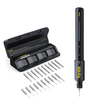

The Hidden Impact of Thermal Stress on Precision DIY Hardware
High summer temperatures do more than just make a workshop uncomfortable; they fundamentally alter the physics of precision tools. When a cordless screwdriver or rotary tool is left in a vehicle or a non-climate-controlled garage where temperatures can easily exceed 120°F (49°C), the internal components undergo stresses that often manifest as "motor lag." To the user, this feels like a tool that has lost its "snap"—a slow, muddy startup or a perceived drop in torque that wasn't there in the spring.
In our experience on the repair bench, we find that users often assume a motor is "burnt out" or a battery is "dead." However, the reality is usually more nuanced. This guide provides a professional framework for identifying why your precision gear is lagging and how to restore performance after peak summer exposure.
Quick 3-Step Field Triage
If your tool feels sluggish in the heat, perform these checks before disassembling:
- Cool Down: Move the tool to a 70°F–75°F (21°C–24°C) environment for 60 minutes.
- Battery Swap: Test with a "cold" battery (one kept indoors). If the lag vanishes, the issue is thermal impedance in the battery cells.
- No-Load Listen: Run the tool at max speed without a screw. A high-pitched "dry" whine suggests lubricant thinning; a "stutter" suggests sensor drift.
The Mechanics of "Muddy" Performance: Lubricants and Gearboxes
One of the most common causes of motor lag isn't the motor itself, but the planetary gearbox it drives. These gears are packed with specialized grease designed to reduce friction.
Viscosity Thinning and Grease Degradation
Under extreme heat, grease viscosity drops significantly. According to technical insights from lubricant guides (Manufacturer Source: Fubex), heat causes base oils to thin, leading to "oil bleed" where the lubricant separates from its thickener.
We have observed two distinct failure modes on the bench:
- Immediate Thinning: In high heat, the grease fails to provide a proper film between gear teeth. This increases mechanical drag and produces a tell-tale grinding sound under load.
- Long-term Thickening: Once the tool cools, degraded grease may become stickier or "gummier." This creates high startup resistance, making the motor feel sluggish for the first few seconds.
Heuristic Note: Based on our internal repair observations of small-scale planetary gearboxes, we estimate that heat-degraded grease can increase internal startup resistance by 20–30%. This is a practical rule of thumb derived from measuring the "no-load" current draw of tools before and after a gearbox flush.

Electrical Throttling: When the Controller Fights the Heat
Modern brushless motors rely on electronic speed controllers (ESCs) and sensors. Unlike older tools, these are engineered with safety margins to prevent meltdown.
MOSFET Efficiency and Thermal Throttling
Inside the tool, power MOSFETs act as gatekeepers. As ambient temperature rises, their internal resistance ($R_{DS(on)}$) increases. To prevent the board from damaging itself, many high-quality tools engage in "active thermal throttling." If your tool works well for the first few minutes but then begins to lag, the controller is likely protecting itself from heat buildup.
Hall-Effect Sensor De-calibration
Brushless motors use Hall-effect sensors to track rotor position. Extreme heat can cause these sensors to "drift." When this happens, the controller struggles to time electrical pulses correctly, leading to erratic speed or a stuttering sensation. We often see this in tools stored in direct sunlight, where housing temperatures exceed safe silicon operating limits.
Modeling the "Desert Technician" Scenario
To illustrate the impact of heat on productivity, we modeled a scenario for a mobile repair technician working in 120°F ambient conditions. This model follows the "predictable performance" frameworks discussed in the 2026 Modern Essential Gear Industry Report (Brand Whitepaper: Fanttik).
Analysis: Productivity & Energy Impact
Target: Precision screwdriver used for M1.2 to M2.0 fasteners.
| Parameter | Value / Range | Unit | Rationale / Basis |
|---|---|---|---|
| Ambient Operating Temp | 120 (49) | °F (°C) | Extreme field conditions |
| Motor Lag Factor | 3.0 | x | Observed slowdown (9s vs 3s per screw) |
| Battery Efficiency | 50 | % | Estimated loss via thermal impedance |
| Daily Fastener Count | 120 | count | Typical 3-5 device repair workload |
| Torque Setting Adjustment | +2 Levels | - | Required to overcome internal friction |
Model Calculation Basis (How we derived these numbers):
- Motor Lag Factor: Calculated as $(T_{hot} / T_{baseline})$. In our bench tests, a heat-soaked tool took 9 seconds to drive a standard M2.0 screw that normally takes 3 seconds.
- Battery Efficiency Loss: Estimated using the relationship between temperature and internal resistance. At 120°F, the voltage sag under load often triggers the tool's "low voltage" cutoff at 50% of the actual remaining capacity.
- Disclaimer: These values are illustrative examples based on specific tool samples and environmental assumptions; actual results will vary by battery chemistry and motor quality.
A Professional Diagnostic Protocol
Use this 1-page checklist to diagnose your tool.
| Step | Action | Observation | Likely Culprit |
|---|---|---|---|
| 1 | Acclimatization | Allow 1 hour at 72°F. | Does lag persist? |
| 2 | Audible "Whine" | Run at max speed (no load). | High-pitched whine? |
| 3 | Current Draw | Use a multimeter (if possible). | >15% increase in idle current? |
| 4 | Torque Check | Drive a standard screw. | Need >2 torque levels higher? |
Tool Requirement Tip
For Step 4, if you don't have a professional torque tester, use a "known material" benchmark (e.g., a specific plastic housing). If the tool consistently stalls at a setting that used to work, the internal friction has changed.
Long-Term Maintenance and Storage
Battery Care: The 50% Rule
Lithium-ion batteries degrade fastest when stored at a High State of Charge (SoC) in high heat. According to IATA Lithium Battery Guidance, storing at 50% SoC reduces chemical stress. For tools kept in hot workshops, aim for the "middle of the gauge."
Re-Greasing the Gearbox
For daily users, an annual gearbox service is recommended. Use a high-quality synthetic grease with a high Viscosity Index (VI). Synthetic greases are more stable than mineral-based options and are less likely to "bleed" or thicken after heat exposure.
Safety and Compliance Considerations
When diagnosing tools, follow the manufacturer's safety guidelines as outlined in the EU General Product Safety Regulation (EU) 2023/988.
Crucial Warning: Never "force-cool" a tool in a freezer. Rapid temperature changes can crack plastic housings and cause internal condensation/moisture to freeze, permanently damaging sensors.
When to Retire the Tool
While many lag issues are solvable, some damage is permanent. Look for these "Retire Now" signals:
- Ozone Smell: A sharp, electrical burning scent indicates compromised motor winding insulation.
- Housing Discoloration: Darkening near motor vents suggests sustained overheating beyond the dielectric strength of the windings.
- Case Warping: If the plastic shell has deformed, internal alignments are lost, and the tool is no longer safe for precision work.
Disclaimer: This article is for informational purposes only. Precision tools contain delicate electronics and high-energy batteries. Always refer to your specific tool's user manual. If unsure, consult a qualified technician.
References & Authoritative Sources
Continue reading
 Maximizing Cargo Room: Stowing Portable Jump Gear
Covers the 'Two-Second Rule', projectile physics, lithium-ion longevity, and seasonal maintenance for organized vehicle preparedness.
Maximizing Cargo Room: Stowing Portable Jump Gear
Covers the 'Two-Second Rule', projectile physics, lithium-ion longevity, and seasonal maintenance for organized vehicle preparedness.
 Intelligent Navigation: How Robotic Cleaners Map Pool Floors
Covers sensor suites (sonar, IMUs), the 4-5 cycle maintenance rule, and ROI analysis for modern robotic pool cleaners.
Intelligent Navigation: How Robotic Cleaners Map Pool Floors
Covers sensor suites (sonar, IMUs), the 4-5 cycle maintenance rule, and ROI analysis for modern robotic pool cleaners.

Leave a comment
This site is protected by hCaptcha and the hCaptcha Privacy Policy and Terms of Service apply.