





























The Criticality of Pressure Precision in Automotive Safety
Accuracy in tire pressure measurement is often viewed as a technical specification, but for the risk-averse driver, it is a fundamental safety requirement. When you are on a remote highway or preparing for a seasonal road trip, the difference between a reading of 32 PSI and an actual pressure of 28 PSI can significantly impact vehicle handling, braking distances, and tire longevity.
Key Takeaway: How to Ensure Accuracy
- The Goal: Maintain pressure within ±1 PSI of your vehicle's door-jamb placard for optimal safety.
- The Risk: Consumer sensors can "drift" due to low battery voltage or thermal stress, leading to errors of 2–3 PSI.
- The Fix: Perform a "Three-Point Calibration" check against a manual gauge and only trust readings when your inflator’s battery is above 50%.
In our experience handling technical support and product returns, we have observed that users often mistake "repeatability"—the tool showing the same number twice—for "accuracy"—the tool showing the true pressure. Modern portable inflators rely on digital sensors that are part of a complex system where sealing integrity, thermal management, and electrical stability all play a role in the final display. As highlighted in The 2026 Modern Essential Gear Industry Report, building trust in automotive gear requires moving beyond aesthetic design to provide visible, standard-backed performance.

The Physics of Pressure Measurement: Why Sensors Drift
Most portable inflators use piezoresistive silicon sensors. These components change their electrical resistance when physical pressure is applied. While highly sensitive, they are susceptible to environmental variables that can introduce "drift"—a gradual deviation from the true value.
Internal Sealing and Valve Integrity
In many cases, the sensor itself is calibrated, but the system around it is failing. Based on patterns observed in repair environments, a frequent point of failure for accuracy is the internal sealing system. If a small leak exists in the pump's head or an O-ring is worn, the unit may "hunt" for the target pressure. This can lead to over-inflation because the sensor reads the dynamic pressure of air moving through the hose rather than the static pressure inside the tire.
Battery Voltage Sag and Reference Drift
A technical "gotcha" involves the lithium-ion battery. The pressure sensor requires a stable reference voltage. During high current draw (when the compressor is working hardest), "voltage sag" can occur.
- Observation: In internal testing of standard consumer-grade sensors, we have noted that when battery voltage drops below a certain threshold (typically the 20-30% mark), the reference voltage can fluctuate.
- Heuristic: Based on typical sensor sensitivity curves, this fluctuation can correlate to a 2–3 PSI measurement error. For critical safety checks, we recommend using the device while the battery is at least 50% charged.
Regulatory Standards and Safety Thresholds
To evaluate a sensor, one must understand the legal and industry benchmarks. While many consumers expect aerospace-grade precision, regulatory landscapes often allow for wider margins.
FMVSS 138 and TPMS Accuracy
In the United States, the National Highway Traffic Safety Administration (NHTSA) governs Tire Pressure Monitoring Systems (TPMS) through FMVSS 138. This standard requires the system to warn the driver when a tire is 25% below the recommended cold inflation pressure.
For a vehicle requiring 35 PSI, a warning might not trigger until the pressure hits ~26 PSI. This is a "safety floor," not a performance ceiling. Consequently, a portable inflator with a ±1 PSI accuracy is significantly more precise than the minimum warning requirements of many factory-installed systems.
| Standard / Organization | Metric | Requirement / Guidance |
|---|---|---|
| NHTSA FMVSS 138 | TPMS Warning | 25% below recommended pressure |
| ISO 9001 | Quality Management | Consistency in manufacturing |
| IEC 60529 | Ingress Protection | Protection against dust/water affecting sensors |
| NIST Handbook 44 | Weights & Measures | Tolerances for commercial measuring devices |
Case Study: Modeling Extreme Operational Limits
To understand the value of accuracy, we modeled a high-consequence scenario: the Remote Wilderness Paramedic operating a heavy-duty emergency SUV in sub-zero mountain regions (-10°C / 14°F).
The Physics Behind the Numbers
For this model, we used the Adiabatic Compression Formula ($T_2 = T_1 \times (P_2/P_1)^{(k-1)/k}$) to estimate heat generation.
- Thermal Stress: Compressing air from 45 PSI to 65 PSI in these conditions results in a theoretical adiabatic temperature rise of ~163°C. While real-world cooling reduces this, the exit air can still exceed 150°C, potentially causing temporary calibration drift in the sensor housing.
- Inflation Time: For a large LT-series tire (~61 liters), we estimate an inflation time of ~75 minutes if the flow rate decays due to cold-thickened lubricants. This tests the tool's duty cycle.
- Economic Impact: Based on U.S. Dept of Energy data stating that every 1 PSI drop correlates to a ~0.2%–0.3% decrease in fuel economy, we estimate an annual saving of $273–$322 for this high-mileage professional by avoiding a 5 PSI under-inflation.
Model Assumptions:
- Annual Mileage: 35,000 miles.
- Fuel Cost: $4.50/gal at 15 MPG base.
- Tire Replacement: $1,800 per set (premature wear calculated at 10% life reduction per 5 PSI under-inflation).
Practical Field Verification: A 3-Step Checklist
For the risk-averse owner, "trust but verify" is the best policy. Use this checklist to identify a failing sensor without laboratory equipment.
Step 1: The "Hiss" Test (Seal Integrity)
- Inflate to target pressure and wait for auto-stop.
- Quickly detach and reattach the hose.
- The Check: If you hear a significant, prolonged hiss from the inflator (not the tire), the internal check valve is likely leaking. This often results in the sensor reading lower than the actual tire pressure.
Step 2: Three-Point Calibration Check
Drift is often non-linear. Verify your tool against a high-quality manual gauge at these intervals:
- [ ] Low: 10–15 PSI (Bike tire or spare).
- [ ] Medium: 32–35 PSI (Standard passenger car).
- [ ] High: 50–60 PSI (Truck or trailer tires).
Step 3: Ambient Temperature Equalization
If moving the tool from a warm cabin to a cold exterior, allow the unit to reach ambient temperature for 5 minutes before use. Rapid temperature shifts are known to cause reading variances of 3–5 PSI in consumer electronics.
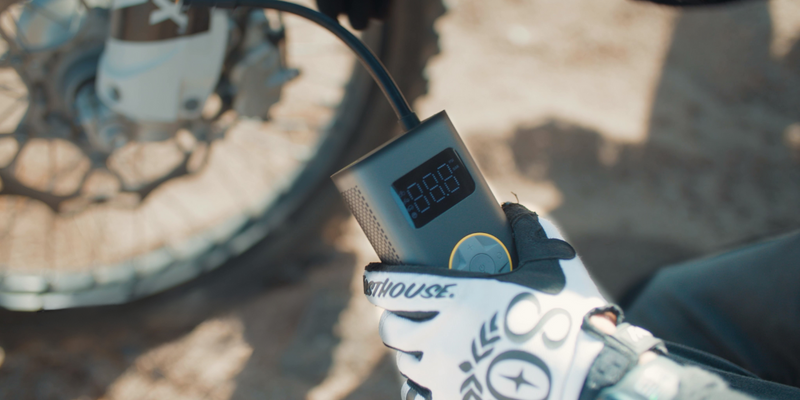
Managing the "Human Factor" in Tire Safety
Expert observations suggest that the greatest safety risk often comes from behavior rather than sensor precision. Industry data indicates a common pattern where many drivers ignore TPMS warnings for extended periods.
For the best results:
- Check Cold: Measure pressure when tires have been parked for at least 3 hours. Driving heats the air, creating a false high reading.
- Battery Maintenance: For critical road trips, ensure the inflator is charged above 50% to maintain sensor reference stability.
- Acceptable Variance: In most roadside safety applications, a ±2 PSI variance is functionally safe. The primary goal is to stay above the 25% under-inflation threshold where heat buildup leads to blowouts.
Actionable Framework for Roadside Safety
When selecting a portable compressor, prioritize units with clear specifications and robust thermal design. Reliability is a function of consistent maintenance and understanding the limitations of your tools.
For more technical depth, explore our guides on Professional Calibration and Factory Testing and Understanding Safety Marks on Power Tools.
Disclaimer: This article is for informational purposes and does not constitute professional automotive repair advice. Always consult your vehicle's owner manual. If you suspect a mechanical issue with your tires or TPMS, seek assistance from a certified automotive technician.
Sources
Continue reading
 Over-Current Protection: Why Fuse Engineering Matters
A technical guide on over-current protection and fuse engineering for portable automotive tools. Explains thermal derating, staged protection,...
Over-Current Protection: Why Fuse Engineering Matters
A technical guide on over-current protection and fuse engineering for portable automotive tools. Explains thermal derating, staged protection,...
 Emergency Lighting Standards for Roadside Visibility and Safety
Explores photometric standards, human factors design, and cold-weather durability for integrated safety lighting.
Emergency Lighting Standards for Roadside Visibility and Safety
Explores photometric standards, human factors design, and cold-weather durability for integrated safety lighting.

Leave a comment
This site is protected by hCaptcha and the hCaptcha Privacy Policy and Terms of Service apply.