



























The Evolution of Tool Interaction: Beyond the Mirror Image
Universal design is often misunderstood as simple symmetry. In the world of premium precision tools, the goal is not merely to create a tool that looks the same from both sides, but to engineer an interface that feels equally intuitive regardless of the user's hand dominance. For the design-conscious DIYer and the prosumer, a tool is an extension of the hand; any friction in that connection—whether a poorly placed switch or an imbalanced weight distribution—disrupts the "flow state" essential for high-quality work.
Neutral ergonomics are rapidly becoming the benchmark for modern essential gear. This shift is driven by a recognition that the "right-hand bias" of traditional tool design excludes approximately 10% of the global population and creates unnecessary fatigue for everyone else. According to the Canadian Centre for Occupational Health and Safety (CCOHS), proper tool design must account for hand size distributions and biomechanical neutral postures to prevent musculoskeletal disorders. At Fanttik, we view symmetry as the foundation of "Modern Self-Reliance," where tools are designed to be accessible, high-performing, and aesthetically integrated into a modern lifestyle.

The Hidden Friction of Hand Dominance
Traditional tool design is rarely "hand-neutral." Most power tools are engineered with a right-handed "default," placing safety interlocks, speed selectors, and battery indicators where they are most accessible to a right-handed thumb. For a left-handed user, this isn't just an inconvenience; it is a safety and performance barrier.
Research indicates that the stakes are higher than simple comfort. A 2023 study on industrial safety highlighted that left-handed workers often adopt unsafe "compensatory postures" when using right-biased tools, significantly increasing accident risk. Furthermore, a 2025 study published in Applied Sciences (MDPI) confirmed significant hand grip strength asymmetry favoring the dominant hand. For left-handed individuals, using a tool that forces an awkward grip means the weaker hand must work at a higher percentage of its maximum capacity, accelerating fatigue.
On our repair bench and through community feedback, we frequently observe that the most common "gotcha" in tool design is the placement of visual feedback. If a battery indicator or OLED screen is positioned on the left side of the tool body, a left-handed user is forced to rotate the tool away from the workpiece just to check the status. This micro-interruption breaks concentration and can lead to errors in precision tasks.
Engineering the Ambidextrous Interface
True universal design requires a holistic review of the user workflow. It’s about removing "directional bias" from every touchpoint. In our engineering process, we run "handedness tests," simulating common tasks with both hands to identify subtle biases in button actuation force or cable strain.
The 2mm Rule of Precision
One of the most critical, yet non-obvious, engineering details is chuck alignment. For rotary tools and precision drills, a perfectly centered chuck is non-negotiable. Even a 2mm offset from the longitudinal axis can cause noticeable ulnar or radial deviation in the wrist over extended use. This deviation, while small, creates a leverage disadvantage that the user must counteract with muscle tension.
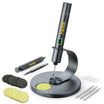
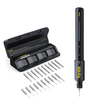
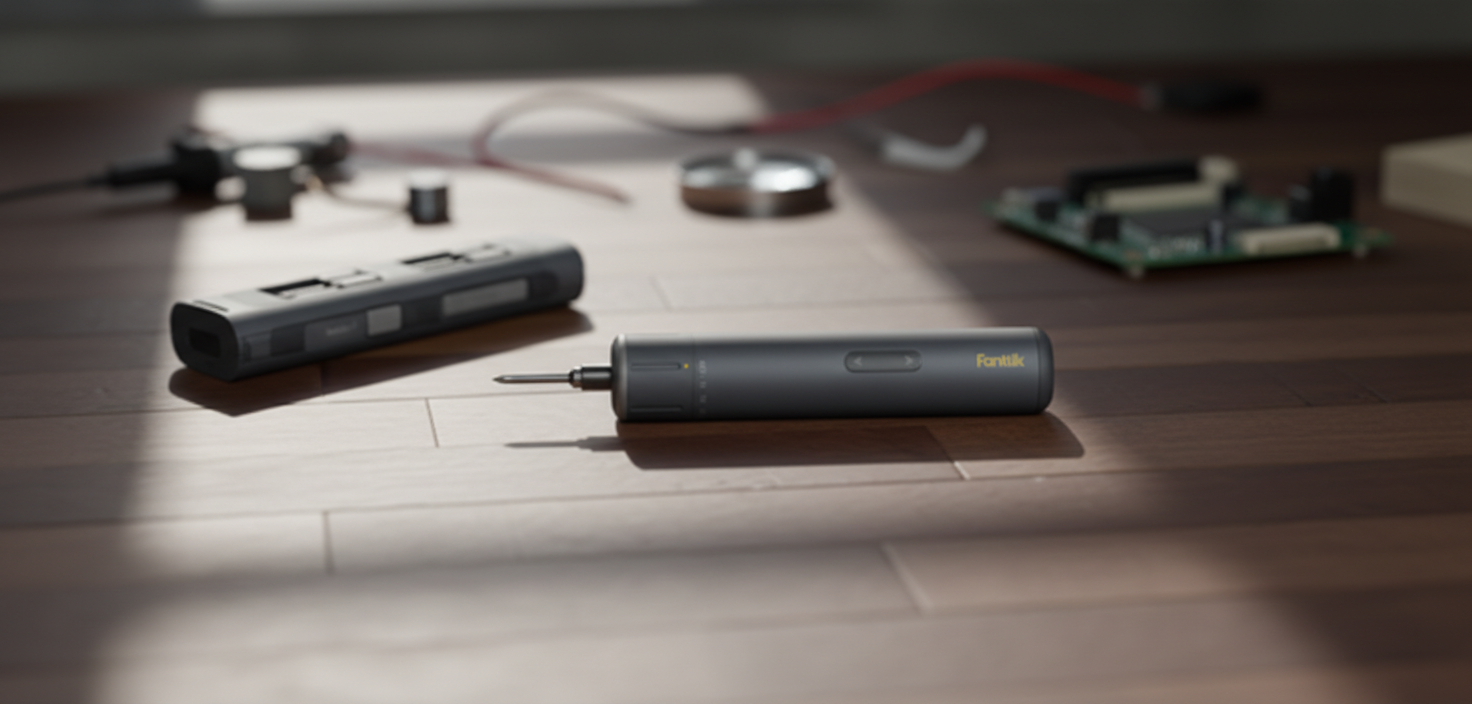
In the Fanttik F2 Master Cordless Rotary Tool Kit, we prioritize this axial symmetry. By centering the brushless motor and the Revostor Hub, the tool maintains a neutral center of gravity. This allows for a "pencil grip" that feels identical whether you are carving with your right hand or sanding with your left.
Logic Summary: Why Axial Symmetry Matters
Our engineering logic assumes that any deviation from the center axis forces the stabilizer muscles in the forearm to work harder.
- Mechanism: Axial alignment reduces the "moment arm" between the tool's tip and the wrist joint.
- Benefit: Lowered risk of "claw cramp" during long DIY sessions.
- Verification: Users can self-check by holding the tool in a loose grip; a balanced tool will not "roll" or tip to one side.
Modeling the Performance Gap: A Left-Handed Scenario
To quantify the value of symmetrical, powered design, we modeled a common DIY scenario: the assembly of a medium-sized flat-pack furniture kit (approximately 60 fasteners). We compared a left-handed user using a traditional right-biased manual screwdriver versus a symmetrically designed electric precision driver.
Method & Assumptions (Scenario Modeling)
This is a deterministic scenario model based on industrial engineering time-motion principles, not a controlled clinical trial.
- Persona: Left-handed DIY hobbyist.
- Task: Driving 60 screws into pre-drilled particleboard.
- Manual Penalty: We added a 20% time penalty to the manual task to account for the ergonomic friction of using a right-biased grip (slippage, regripping).
| Parameter | Manual (Right-Biased) | Symmetrical Electric | Unit | Rationale |
|---|---|---|---|---|
| Time per Screw | ~18 | ~4 | seconds | Includes positioning and driving |
| Total Task Time | ~18 | ~4 | minutes | (N * Time per screw) / 60 |
| Wrist Rotations | ~12 | ~0.5 | count | Repetitive supination/pronation |
| Total Rotations | 720 | 30 | count | Cumulative biomechanical load |
| Grip Stability | Low | High | qualitative | Based on neutral handle geometry |
Analysis: The symmetrical electric driver reduced assembly time by ~14 minutes (a 78% reduction). More importantly, it eliminated 690 repetitive wrist rotations. For a left-handed user, this isn't just about speed; it's about removing the "ergonomic tax" imposed by traditional tools.
The Precision Paradox: When Symmetry Meets Specialization
While symmetry is the gold standard for general-purpose tools, high-precision tasks—such as micro-soldering or delicate PCB repair—sometimes benefit from specialized "attack angles." The challenge for a universal design brand is to provide this specialization without forcing a "handed" choice.
We address this through modularity and adaptive interfaces. For instance, the Fanttik T1 Max Soldering Iron Kit features a symmetrical handle but pairs it with a 360° swivel stand. This allows the user to set the "resting angle" of the tool to match their natural reach, whether they approach the workpiece from the left or right.
In electronics repair, torque control is the ultimate safety feature. A left-handed user applying pressure with an asymmetrical tool is more likely to experience "cam-out" (the bit slipping out of the screw head) because the force vector isn't perfectly vertical. Using the Fanttik K2 Nano 3.7V Precision Power Drill or the Fanttik F2 PRO Cordless Rotary Tool Kit ensures that the drive force is always aligned with the tool's center, minimizing the risk of stripping delicate M1.2 or M2.0 screws.
Precision Torque Fit Check (Heuristic)
According to ISO 898-1 standards for mechanical fasteners, maintaining consistent torque is vital for joint integrity.
- Safe Range (M1.2 - M2.0): 0.02 Nm to 0.1 Nm.
- Symmetry Advantage: A neutral grip allows for more consistent downward pressure, which keeps the bit seated and ensures the motor's torque limit triggers accurately.
Tactile Identity: Materials and Longevity
A tool's "identity" is defined by how it feels in the hand over time. Symmetrical tools often simplify manufacturing, but a common oversight is the grip texture. A pattern that works for a right-handed "pull" motion might feel abrasive during a left-handed "push."
We utilize specific material compounds and depth testing to ensure our grips are effective for both dry and slightly oily hands. This design-conscious approach moves tools away from the "hidden in the garage" aesthetic toward products you are proud to display on a modern workbench.
Durability is also a function of symmetry. As noted in The 2026 Modern Essential Gear Industry Report: Engineering Trust in a Cordless World, building "Credibility Math" requires visible compliance and robust thermal design. Symmetrical internal layouts often lead to more even heat dissipation, extending the lifespan of the lithium-ion cells and the motor.
The Future of Fluid Interfaces
The transition from manual to electric tools is more than a productivity gain; it is an opportunity to redefine the relationship between the maker and their gear. By embracing universal design, we are not just making tools "easier" to use; we are making them more inclusive.
Whether you are a professional technician or a weekend hobbyist, the tool in your hand should never feel like a compromise. It should be a neutral, high-performance interface that allows your skill to take center stage. As we look toward the future, the standard for "premium" will be defined by how well a tool disappears into the user's workflow, regardless of which hand they choose to use.
Methodology Note: Modeling Transparency
The data presented in the "Performance Gap" section is derived from a deterministic scenario model.
- Key Assumption: Manual driving time includes a "handedness friction" factor of 1.2x for left-handed users on right-biased tools.
- Scope: This model estimates productivity and biomechanical load for common DIY tasks. It is not a clinical study on Repetitive Strain Injury (RSI).
- Parameter Table: See Section "Modeling the Performance Gap" for full inputs.
Disclaimer: This article is for informational purposes only and does not constitute professional ergonomic or medical advice. Users with pre-existing wrist or hand conditions should consult a qualified occupational therapist before starting intensive DIY projects.

Leave a comment
This site is protected by hCaptcha and the hCaptcha Privacy Policy and Terms of Service apply.