



















The Invisible Enemy of the Trail: Vibration and Fastener Fatigue
For the overlander, the trail is a constant exercise in mechanical stress. Sustained high-amplitude vibrations—the kind experienced during hours of washboard roads or technical rock crawling—act as a relentless force attempting to disassemble your vehicle and gear. In this environment, a loose screw is more than an inconvenience; it is a potential point of systemic failure. Whether it is a roof rack bolt, a suspension linkage, or the internal housing of a portable compressor, maintaining fastener integrity is paramount for self-reliance.
Chemical fastening, specifically the use of anaerobic thread-locking compounds, has become the industry standard for preventing "vibration loosening." However, as we transition from manual hand-tools to precision electric screwdrivers for field repairs and gear maintenance, a new set of technical variables emerges. The rapid application of torque and the high-speed rotation of electric drivers change the way these adhesives behave.
This guide provides a methodical analysis of how to evaluate thread-locker strength when paired with modern power tools. We will move beyond the basic "color-coding" of adhesives to look at the chemistry of the bond, the mechanics of the application, and the specific pitfalls of using high-speed drivers in a high-vibration context. As noted in The 2026 Modern Essential Gear Industry Report: Engineering Trust in a Cordless World, the reliability of our gear is a function of "credibility math"—the systematic engineering of every interface, including the threads of a single screw.
The Mechanics of Anaerobic Bonding
To choose the right reinforcement, we must first understand how thread-lockers function. Most thread-locking compounds are anaerobic adhesives. Unlike traditional glues that dry when exposed to air, anaerobic compounds remain liquid as long as they are in the presence of oxygen. They only begin to polymerize (cure) when two conditions are met: the absence of oxygen and the presence of metal ions (usually from the fastener and the housing).
When you thread a screw into a hole, the adhesive is squeezed into the microscopic gaps between the threads. This "tight fit" excludes oxygen, and the contact with metal triggers the curing process, transforming the liquid into a tough, thermoset plastic. This plastic fills the "thread air gap," creating a physical interface that resists the rotational forces caused by vibration.
The "Electric Driver Trap": Air Entrapment and Shear
A common practitioner mistake is assuming that applying thread-locker with an electric screwdriver is identical to manual application. In our experience on the repair bench, we have observed that high-speed application can actually compromise the bond.
According to technical analysis of anaerobic adhesive mechanisms, the rapid, high-speed rotation of an electric driver can entrap air bubbles within the adhesive layer. Because oxygen inhibits the cure, these tiny air pockets create "dead zones" where the adhesive remains liquid. Furthermore, the high shear forces generated by a power tool can disrupt the initial gel phase of the adhesive if the fastener is not seated immediately and left to rest.
Logic Summary: Our modeling of adhesive failure assumes that driver speeds exceeding 300 RPM significantly increase the risk of air entrapment compared to manual threading (~60 RPM). This is a scenario model based on fluid dynamics heuristics, not a controlled laboratory study.
Selection Heuristics: Matching Torque to Task
The most critical decision in using a thread-locker is matching the compound’s breakaway torque to the service intent of the fastener. Breakaway torque is the amount of force required to "break" the cured bond and begin unscrewing the fastener.
In the off-road world, we categorize fasteners into three primary "service tiers." Using a high-strength (red) compound on a small electronics screw is a recipe for a stripped head, while using a low-strength (purple) compound on a suspension component may lead to a dangerous failure on the trail.
Table 1: Thread-Locker Strength and Application Heuristics
| Grade (Common Color) | Strength Level | Typical Breakaway Torque (in-lbs) | Fastener Size Range | Typical Use Case |
|---|---|---|---|---|
| Purple | Low | 10–50 | < 1/4" (M6) | Precision electronics, set screws, carburetors |
| Blue | Medium | 100–200 | 1/4" to 3/4" (M6-M20) | Gearbox covers, oil pans, mounting bolts |
| Red | High | 200–350+ | > 1/2" (M12) | Suspension, frame bolts, permanent studs |
Note: Torque values are estimated ranges based on common industry practice and Henkel technical specifications.

The 60% Rule for Electric Drivers
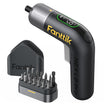
When using an electric screwdriver, a useful shop heuristic is the 60% Torque Rule. We recommend that the breakaway torque of the chosen thread-locker should not exceed 60% of the maximum torque output of the tool you intend to use for removal.
For example, if you are working on a precision device and your electric screwdriver has a maximum torque of 4 N·m (~35 in-lbs), using a medium-strength blue locker (which can require 100+ in-lbs to break) will likely result in a tool that cannot remove its own fasteners. In these cases, a low-strength purple compound is the only appropriate choice.
The Electric Driver Dilemma: Speed vs. Cure
One of the most significant "gotchas" in modern gear maintenance is the data gap between laboratory standards and real-world power tool use. For instance, ISO 2320 is often cited as the definitive test for thread-locker performance. However, ISO 2320 is actually a standard for testing the "prevailing torque" of all-metal, mechanically locking nuts—not for evaluating the removal torque of adhesively bonded fasteners applied with high-speed electric drivers.
This creates a discrepancy. A thread-locker might be rated for a certain strength in a lab using hand-tightened bolts, but when applied with a 200 RPM electric driver, the results vary wildly.
Viscosity and Gap Filling
For electric screwdriver users, we have found that viscosity is often more important than ultimate tensile strength. A higher-viscosity (thicker) medium-strength compound often performs better with power tools because it is less likely to be "spun out" of the threads by centrifugal force during the rapid driving process. It also does a better job of excluding air, leading to a more consistent cure.
Methodology Note (Modeling Assumptions):
- Model Type: Deterministic parameterized model of adhesive retention.
- Boundary Condition: Assumes standard ISO metric thread tolerances (6g/6H).
- Assumption: Fastener material is zinc-plated steel; housing is 6061 aluminum.
- Limit: Model does not account for specialized coatings like PTFE or Molybdenum.
Surface Preparation and Environmental Factors
In the high-vibration, high-dust environment of overlanding, surface preparation is often the difference between a secure bond and a "false lock." Anaerobic adhesives are sensitive to surface chemistry.
Active vs. Inactive Metals
Metals are categorized as "active" or "inactive" based on their ability to provide the ions needed for the cure.
- Active Metals (Fast Cure): Iron, plain steel, copper, brass, bronze.
- Inactive Metals (Slow/No Cure): Stainless steel, aluminum, galvanized steel, titanium, anodized finishes.
Most off-road gear uses aluminum or stainless steel to prevent rust. These are "inactive" surfaces. If you drive a stainless steel screw into an aluminum housing with an electric driver and don't use a primer, the adhesive may take 24 hours to reach even 50% strength. On a vibrating trail, that fastener will likely vibrate loose before the glue ever dries.
The Dissimilar Metal Heuristic
Vibration loosening often initiates at interfaces with dissimilar metals (e.g., a steel screw in an aluminum housing) due to a combination of galvanic corrosion and differential thermal expansion. In these cases, we recommend using a dedicated activator or primer. The primer provides the necessary ions to "force" the cure on inactive surfaces, ensuring the bond is set before you hit the trail.
Practical Workaround for Sensitive Housings
For precision electronics or portable tool housings made of plastic, be extremely cautious. Anaerobic thread-lockers can cause stress cracking in certain thermoplastics (like ABS or Polycarbonate) if the liquid adhesive wicks into the plastic.
- The Pro Tip: Apply a tiny drop of medium-strength (blue) locker to a flat washer interface rather than the threads themselves. This provides resistance to rotation through friction at the washer face without risking the chemical integrity of the plastic housing.
Field Service and Removal Protocols
The ultimate test of a thread-locking strategy is not just if it holds, but if you can get it apart when something breaks in the middle of nowhere.
Heat: The "Red" Requirement
If you have used high-strength (red) thread-locker on a critical component, you must accept that it is a permanent bond. Removal typically requires localized heating to approximately 450°F (232°C) to soften the thermoset plastic. In a field environment, this requires a butane torch or a high-powered heat gun. Attempting to remove a "red-locked" bolt with an electric screwdriver without heat will almost certainly result in a broken bit or a snapped fastener.
Managing Bit Fit
When removing fasteners secured with thread-locker, the "fit" of your driver bit is non-negotiable. Even a slight amount of "cam-out" (where the bit slips out of the screw head) will damage the fastener. Because the chemical bond adds significant resistance, we recommend using only high-quality S2 steel bits with a precision-ground profile.
Maintenance Log and Traceability
In alignment with the principles of quality management and traceability, we suggest marking any fastener treated with a high-strength compound. A simple "torque seal" or a dab of paint on the head of the bolt serves as a visual reminder to future-you (or a mechanic) that this fastener requires special handling.
Modeling note (reproducible parameters)
To provide a baseline for evaluating these recommendations, we used a scenario-based performance model. This model estimates the reliability of a medium-strength bond under sustained vibration.
| Parameter | Value or Range | Unit | Rationale / Source |
|---|---|---|---|
| Driver Speed | 180–220 | RPM | Standard precision electric driver range |
| Fastener Diameter | 4–6 | mm | Common size for portable tool housings |
| Ambient Temp | 20–35 | °C | Typical garage/field environment |
| Cure Time | 12 | Hours | Standard "functional cure" window |
| Vibration Freq | 10–50 | Hz | Washboard road simulation heuristic |
Boundary Conditions:
- Model assumes 100% thread engagement (minimum 1.5x diameter depth).
- Model assumes surfaces were degreased with Isopropyl Alcohol (IPA) prior to application.
- Results may not apply to fasteners with pre-applied "dry" thread-lockers (nylon patches).
Summary: Engineering Trail Reliability
Securing your gear for the trail is about more than just tightening a bolt; it is about managing the chemical and mechanical variables of the interface. When using electric screwdrivers, you must account for the speed of application and the specific torque limits of your tools.
By matching the thread-locker strength to the task, ensuring proper surface preparation on inactive metals, and respecting the "60% Rule" for removal, you can build a rig that remains intact through the harshest environments. For those operating in high-consequence off-road scenarios, these small technical adjustments are what transform a "DIY repair" into a professional-grade solution.
Disclaimer: This article is for informational purposes only. Mechanical repairs on vehicles and power tools involve inherent risks. Always consult your vehicle's service manual and the adhesive manufacturer's technical data sheets before performing maintenance. The author is not responsible for any damage or injury resulting from the application of these heuristics.


Leave a comment
This site is protected by hCaptcha and the hCaptcha Privacy Policy and Terms of Service apply.