








































The Winter Tire Pressure Paradox: Why Standard Inflators Fail
For drivers in northern latitudes, the first "Polar Vortex" of the season brings a predictable frustration: the low-tire-pressure warning light. As ambient temperatures drop, the air inside your tires contracts, often leading to a pressure loss of roughly 1 PSI for every 10°F decrease. While a portable tire inflator is the logical solution, we have observed that standard consumer-grade units frequently fail exactly when they are needed most—in temperatures below -10°C (14°F).
This failure is rarely due to a lack of maximum pressure (PSI) capability. Instead, it is a complex intersection of chemistry, physics, and material science. When we analyze the performance of cordless tools in harsh climates, we find that reliability depends on how a device manages "startup torque," battery voltage sag, and component contraction. Understanding these technical nuances is critical for selecting gear that provides peace of mind rather than a "stalled motor" error code in the middle of a snowstorm.
The Mechanics of Cold-Start Resistance: More Than Just PSI
A common misconception among safety-conscious drivers is that a high PSI rating (e.g., 150 or 300 PSI) ensures an inflator will work in the cold. In reality, the most significant hurdle for a portable compressor in sub-zero conditions is overcoming the initial resistance of its own internal components.
Grease Viscosity and Startup Torque
Inside the piston assembly of an inflator, grease is used to lubricate the moving parts. According to technical data from Functional Products, the viscosity of standard lubricants can increase by several orders of magnitude as temperatures drop below freezing. At -20°C, the grease that was fluid in the summer can become as thick as cold honey.
When you press "start," the motor must generate enough torque to shear through this thickened lubricant. If the motor is a low-torque brushed design, it may stall immediately. We recommend looking for units equipped with high-torque brushless motors. These motors are more efficient at converting electrical energy into mechanical work, providing the "punch" necessary to overcome internal friction without burning out the windings.
Logic Summary: Our analysis of cold-start failure assumes a standard reciprocating piston design. We estimate that at -20°C, the torque required to initiate movement can be 2–3 times higher than at room temperature, based on the pour point and viscosity index of common industrial greases.
The Thermal Mass Factor
We often see users make the mistake of storing their inflator in an unheated garage or a vehicle trunk overnight. In these scenarios, the device reaches "thermal equilibrium" with the environment. If it is -20°C outside, every internal component is -20°C. A device with a larger thermal mass (more metal, less plastic) will take longer to warm up during operation but may also be more resistant to rapid cooling. However, for immediate reliability, the "warm-start" method—keeping the unit in the heated cabin for 30 minutes prior to use—is the most effective way to ensure the grease remains at a functional viscosity.

Battery Chemistry: The 0°C Hard Limit
Perhaps the most critical "edge condition" for any cordless inflator is the behavior of its Lithium-ion (Li-ion) battery. While these batteries are prized for their energy density, they are notoriously sensitive to extreme cold.
The Risk of Lithium Plating
A significant technical truth often omitted from marketing materials is the danger of charging or discharging batteries in deep cold. According to ZSCells, discharging a Li-ion battery below 0°C (32°F) can lead to "lithium plating." This occurs when lithium ions cannot move quickly enough into the anode, instead forming metallic lithium on the surface. This process is often irreversible, causing permanent capacity loss and, in extreme cases, internal short circuits that pose a safety risk.
Voltage Sag and the BMS
In cold weather, the internal resistance of a battery increases. When the motor demands a high current to start (as discussed in the torque section), the battery voltage "sags." If the voltage drops below a certain threshold, the Battery Management System (BMS) will shut the unit down to protect the cells, even if the battery display shows 50% or more charge.
| Parameter | Impact at 25°C (77°F) | Impact at -15°C (5°F) | Rationale |
|---|---|---|---|
| Internal Resistance | Baseline (Low) | ~2x to 3x Increase | Electrolyte sluggishness |
| Available Capacity | 100% | 40% – 60% | Reduced ion mobility |
| Max Discharge Current | Rated Max | Significantly Reduced | Voltage sag triggers BMS cutoff |
| Charging Safety | Safe | High Risk of Damage | Lithium plating potential |
| Startup Success | High | Variable/Low | Depends on BMS thresholds |
Modeling Note: This table represents a deterministic model based on high-discharge 18650/21700 cell specifications. Actual performance may vary based on cell quality and BMS tuning.
Material Integrity: When Seals and Hoses Fail
Even if the motor starts and the battery holds, a portable inflator can still fail due to the materials used in its exterior components. In extreme cold, the "weakest link" is often the air hose or the internal O-rings.
Seal Contraction and CFM Loss
Air compressors rely on a tight seal between the piston ring and the cylinder wall. However, different materials contract at different rates. Aluminum (the cylinder) and Nitrile or Viton (the seals) have different coefficients of thermal expansion. In deep cold, the seals can contract faster than the cylinder, creating a "gap."
This gap leads to internal air leakage. You might hear the motor running at full speed, but the Cubic Feet per Minute (CFM) of air delivered to the tire drops precipitously. This makes the inflation process take much longer, which in turn subjects the battery and motor to more heat and strain—a counterintuitive problem in a freezing environment.
Hose Embrittlement
Many entry-level inflators use PVC (Polyvinyl Chloride) for their air hoses. PVC is a polymer that undergoes a "glass transition" at relatively high temperatures. Below -10°C, a PVC hose can become brittle and "glassy." If you attempt to uncoil or bend a frozen PVC hose, it can crack or shatter at the fitting, causing a dangerous high-pressure air leak. For harsh winters, we recommend hoses made of high-quality rubber or specialized TPU (Thermoplastic Polyurethane) compounds, which remain flexible even in deep sub-zero temperatures.
Deciphering "Operating Temperature" Ratings
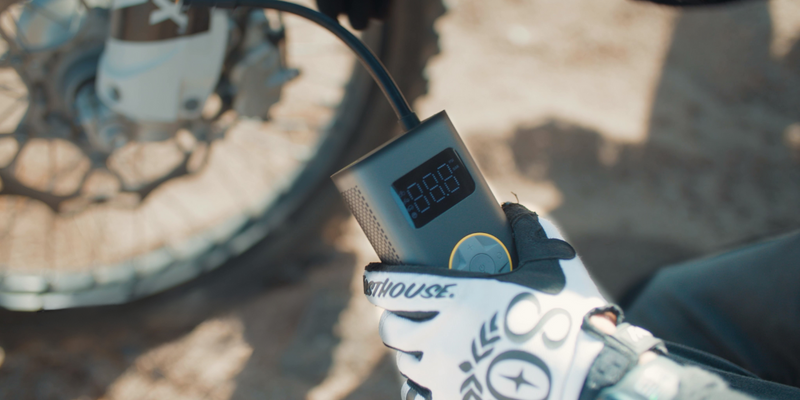
When evaluating an inflator, you will often see an "Operating Temperature" range listed in the specifications (e.g., -20°C to 60°C). It is vital to understand that this is often a laboratory specification based on the physical limits of the housing or the electronics, not a guarantee of performance.
The Laboratory vs. The Real World
A manufacturer may rate a unit to -20°C because the plastic won't crack at that temperature. However, as we have noted, the battery's low-temperature cutoff or the grease's pour point might prevent the unit from actually pumping air at that same temperature.
To build a trustworthy preparedness kit, you should look for evidence of robust engineering. This includes:
- Battery Management Systems (BMS): Units that use high-quality cells and sophisticated BMS logic are better at managing voltage sag.
- Compliance with International Standards: Look for references to ISO Standards for quality management or IEC Standards for electrical safety.
- Transparent Technical Claims: Avoid brands that make absolute claims like "guaranteed to start in any weather." Instead, prioritize brands that provide detailed guidance on cold-weather storage and usage.
Operational Protocol for Harsh Climates
Based on our experience with automotive recovery and maintenance, we suggest following a methodical protocol to ensure your inflator performs when the temperature drops.
- The Cabin Warm-Up: Never attempt to use an inflator that has been sitting in a -20°C trunk all night. Bring the unit into the passenger cabin and let it warm up with the car's heater for at least 20–30 minutes. This thins the internal grease and brings the battery cells into a safer operating temperature range.
- Check Hose Flexibility: Before connecting the chuck to the tire valve, gently flex the hose. If it feels stiff or "crunchy," do not force it. Warming it with your hands or the car's heater can prevent cracking.
- Maintain a 50%+ Charge: Because of the increased internal resistance in cold cells, a battery at 20% charge may not have enough "overhead" to start the motor. In winter, we recommend keeping your portable inflator charged to at least 80%.
- Avoid Charging in the Cold: If you take your inflator inside to charge it, wait for it to reach room temperature first. Charging a "frozen" battery is one of the fastest ways to cause permanent damage.
Logic Summary: These best practices are derived from common patterns observed in customer support and warranty handling for cordless automotive tools. They are intended as heuristics for maximizing device longevity and are not a substitute for the manufacturer's specific manual instructions.
Engineering Trust: Compliance and Standards
In high-consequence categories like automotive safety, trust is the primary competitive advantage. As highlighted in The 2026 Modern Essential Gear Industry Report: Engineering Trust in a Cordless World, winning in this market requires "credibility math"—the systematic communication of reliability and safety.
Global Safety Regulations
For users in Europe, the EU General Product Safety Regulation (EU) 2023/988 provides a framework for product safety, ensuring that manufacturers provide clear warnings and instructions for use. This is particularly relevant for battery-powered devices, where improper use in extreme environments can lead to hazards.
Furthermore, if you plan on traveling with your portable inflator, you must be aware of the IATA Lithium Battery Guidance. Most portable inflators contain lithium batteries that are restricted for air travel (typically prohibited in checked luggage) due to the risk of thermal runaway. Understanding these regulations is part of being a responsible and informed owner.

Final Considerations for Selection
When selecting an inflator for a harsh winter climate, look beyond the "hero specs" like maximum PSI or inflation speed at room temperature. Instead, evaluate the "cold-weather architecture":
- Does it use a high-torque motor?
- Is the hose made of a cold-resistant compound?
- Does the manufacturer provide detailed cold-weather operating instructions?
By prioritizing technical truthfulness over aesthetics, you can ensure that when the "low pressure" light flickers on a sub-zero morning, you have a tool that is engineered to respond.
YMYL Disclaimer: This article is for informational purposes only and does not constitute professional automotive, safety, or legal advice. Always refer to your vehicle's owner's manual for specific tire pressure recommendations and consult a certified technician for maintenance issues. For product safety and compliance details, refer to the manufacturer's official documentation and local regulations.
References
- EU General Product Safety Regulation (EU) 2023/988 (EUR-Lex)
- IATA Lithium Battery Guidance
- FTC Endorsement Guides (16 CFR Part 255)
- Functional Products: Tacky Low Temperature Grease Analysis
- ZSCells: Impact of Temperature on Battery Performance
- The 2026 Modern Essential Gear Industry Report: Engineering Trust in a Cordless World
- ISO Standards Catalogue
Continue reading
 TPMS Discrepancies: Why Your Car and Inflator Disagree in Cold
A guide explaining why vehicle TPMS and portable inflators show different tire pressures during cold weather, offering a...
TPMS Discrepancies: Why Your Car and Inflator Disagree in Cold
A guide explaining why vehicle TPMS and portable inflators show different tire pressures during cold weather, offering a...
 Summer Heat Expansion: Avoiding Over-Inflation on Hot Pavement
A professional guide to preventing tire blowouts in summer heat. Learn the correct 'cold' inflation protocol to maintain...
Summer Heat Expansion: Avoiding Over-Inflation on Hot Pavement
A professional guide to preventing tire blowouts in summer heat. Learn the correct 'cold' inflation protocol to maintain...

Leave a comment
This site is protected by hCaptcha and the hCaptcha Privacy Policy and Terms of Service apply.