










































To drill plastic without cracking it, use a sharp bit suited to that plastic, clamp the piece, support the back side, and ease off the pressure as the bit breaks through. Plastic tends to crack when the bit catches or the material flexes. Steady support and the right bit help more than extra force.
Start by finding out what plastic you have, because bit guidance differs between materials. The acrylic and polycarbonate sheet guidance below applies only when you know the sheet matches those products.
How to Drill Plastic Without Cracking It
This sequence covers the general practices for drilling plastic that reduce chipping and exit damage. Work through it in order, and adjust the bit choice once you know the material.
- Identify the plastic and the hole. Note what the material is, whether it is flat sheet or a molded part, and the hole size you need. These details decide which bit guidance applies. If you can't identify the plastic, don't assume a guide written for one named sheet product fits it.
- Use a sharp bit. A dull bit rubs and grabs instead of cutting cleanly. Curbell's plastic-drilling guidance states plainly that drills must be sharp. Pick the bit style recommended for your specific material when that guidance exists.
- Clamp the piece and support the back side. Curbell advises that the back side should be supported to prevent chipping, and that drilling into unsupported areas should be avoided. In practice, the spot where the bit will exit should sit on a solid surface, not over open air.
- Let the bit cut at a controlled feed. Feed means how fast the bit advances into the material, which mostly comes down to how hard you push. Use light, steady pressure rather than leaning on the drill.
- Ease off near breakthrough. Curbell recommends reducing feed near the exit as the drill gets close to coming out the far side. This is the moment when chips and blowout tend to happen, so lighten up before the tip pokes through.
- Peck-drill deep holes. For deep holes, Curbell calls for peck drilling: drill a short distance, pull the bit out, then continue. Its deep-hole peck-drilling guideline says depth should not exceed 3 to 4 times the drill diameter before you withdraw, which clears chips and lets heat escape.

If the exit side still chips, look at steps 3 and 5 first. Make sure the exit point is backed by a solid surface and that you are easing off earlier before breakthrough.
Which Drill Bit Should You Use for Acrylic or Polycarbonate?
The answer depends on which sheet you have, and the two documented examples don't share one rule. ACRYLITE acrylic sheet guidance generally calls for a 90° tip, while TUFFAK polycarbonate sheet guidance uses a 60° to 90° range tied to hole size.
The tip angle (also called point angle) is the angle formed by the cutting edges at the very end of the bit. It changes how aggressively the bit pushes through the sheet as it exits.
| Identified material | Bit guidance | Scope limit |
|---|---|---|
| ACRYLITE acrylic sheet | 90° tip angle for most drilling | ACRYLITE sheet only |
| TUFFAK polycarbonate sheet | Plastic-designed bit; 60° to 90° point angle by hole size | TUFFAK sheet only |
For acrylic, ACRYLITE's 90° tip guidance covers most drilling of its sheet. The same guide warns that larger tip angles can cause cracking and blowout as the bit exits. That means a bit with a wider, flatter point is the wrong pick for this material, even if it drills metal well.
For polycarbonate, TUFFAK's plastic-bit guidance says bits designed specifically for plastics give the greatest precision on its sheet. It describes those bits as having wide, polished flutes to reduce friction and spiral or helix designs that remove chips quickly. Flutes are the spiral grooves that carry chips out of the hole.
The TUFFAK guide also links angle to hole size. Use smaller angles for smaller holes and larger angles for larger holes, within the 60° to 90° range. So a small hole in TUFFAK sheet points toward the lower end, and a large hole toward the upper end.
Cooling has its own rule for this sheet. If the bit needs cooling, TUFFAK's cooling instructions call for cool forced air or a clean water mist and say not to use cutting fluids.
If your plastic is neither of these sheets, or you can't identify it, don't transfer either angle to it. Look for guidance from the maker of that material instead.
What Backing Works for ACRYLITE Acrylic Sheet?
For ACRYLITE acrylic sheet, the guide recommends clamping the sheet firmly and backing it with acrylic, another thermoplastic sheet, or MDF. It also calls for a slower feed at both entry and exit. These steps narrow the general support advice above to specific materials for this sheet.
- Clamp it down. The work should be held firmly or, preferably, solidly clamped to the worktable to help keep the sheet from lifting or shifting when the bit grabs.
- Choose a backing board. ACRYLITE's backing recommendations name acrylic, other thermoplastic sheet, or medium density fiberboard (MDF) as backup under the piece. Place the backing directly under the hole location so the exit side stays supported.
- Slow down at both ends. ACRYLITE's entry-and-exit feed guidance advises a slow feed rate when starting the hole and again as the bit exits the bottom surface. The guide describes feed rate here, not a specific drill RPM.
Keep these backing choices tied to ACRYLITE sheet. For other plastics, the general rule of supporting the exit side still applies, but the specific backing materials come from this acrylic guide.
FAQs
What counts as a deep hole when drilling plastic?
Curbell's guideline uses drill diameter as the yardstick: withdraw before the depth goes past 3 to 4 times the diameter. As an illustrative example, with a 1/4-inch bit, 3 to 4 times the diameter is 3/4 inch to 1 inch. Pull the bit out by about that depth to clear chips, then continue.

What drill speed should I use for plastic?
The guidance cited here focuses on feed, meaning how fast you push the bit into the material, rather than a set RPM. It calls for reducing feed as the bit nears the exit, and the ACRYLITE guide also slows feed at the start. If you need a speed setting, look for one from the maker of your specific plastic instead of borrowing a number from another material.
Can I use cutting oil when drilling polycarbonate?
For TUFFAK polycarbonate sheet, no. Its guide says not to use cutting fluids and recommends cool forced air or a clean water mist if the bit needs cooling. For other polycarbonate products, check that maker's fabrication guidance before using any fluid.
Why does plastic chip or blow out on the back side?
The exit side is where the bit pushes through the last thin layer of material. Curbell links back-side support to preventing chipping and advises reducing feed as the drill nears the exit. For ACRYLITE sheet, the guide adds that larger tip angles can cause cracking and blowout at exit, so the bit's point angle matters too.
Continue reading
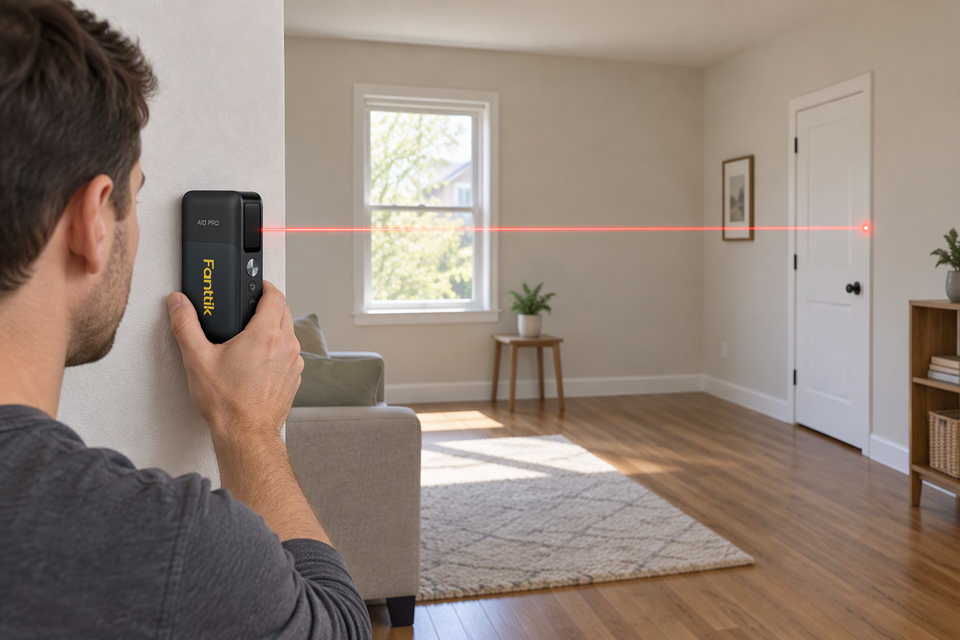 Where Should a Laser Measure Start From: Front, Back, or a Fixed Reference?
Front or rear reference? Match the meter's documented origin to your starting surface, then keep it consistent so...
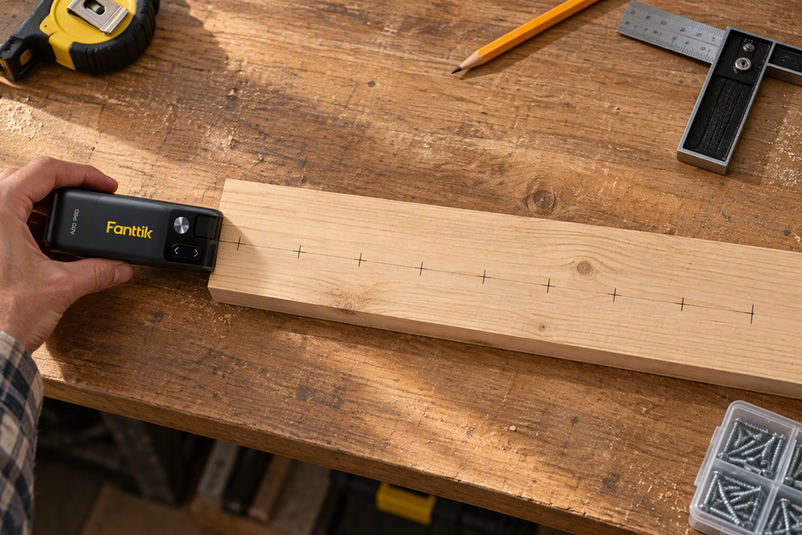 How to Lay Out Evenly Spaced Holes With a Laser Measure and Drill
A step-by-step method for marking a straight row of holes: set one reference edge, compute centers, use a...

Leave a comment
This site is protected by hCaptcha and the hCaptcha Privacy Policy and Terms of Service apply.