








































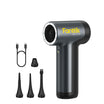



Before you use a heat gun, check four groups of material: the coatings and hidden layers on the workpiece, any wiring or electrical parts in or behind the heat path, lithium-ion batteries nearby, and flammable liquids or other combustibles in the workspace. The spot you plan to heat is only part of the job. Any of these other materials can set the real limit for the task.
These groups don't share one safe temperature or distance. Some have a clear, sourced rule, like lead paint or a lithium-ion pack. Others call for you to identify the material or change the setup before you pull the trigger.
Which Materials Should You Check Before Using a Heat Gun?
Scan the workpiece, what sits behind it, and what sits beside it. Each group of heat gun materials below needs its own decision:
- Surface coatings and hidden layers. Paint, finishes, adhesives, and the layers under them can't be identified by looks alone. If the job is lead-safe renovation work, EPA prohibits heat guns above 1,100°F. That rule covers lead paint only, so don't treat it as a setting for other jobs.
- Wiring and electrical components. Look for exposed wires and think about routing you can't see. Before you heat near them, you need to know where they are.
- Lithium-ion batteries. Phones, cordless tool packs, and battery-powered gadgets on the bench count. OSHA lists excessive heat as a thermal runaway trigger, so move packs out of the heat path.
- Combustibles and flammable liquids. Rags, sawdust, solvents, and open containers each need their own check. University of Delaware EHS advises removing flammable liquids or keeping only small amounts around equipment that can ignite them.
What Can Coatings and Hidden Layers Change?
A visible finish tells you what the top layer looks like, not what it's made of or how much heat the layers beneath can take. An old door, trim board, or piece of furniture may carry several coats of paint, a primer, a sealer, or an adhesive. Each one may be from a different decade.

Lead paint is the case with a firm number. In its lead-safe renovation booklet, EPA's lead-safe renovation heat-gun restriction puts heat-gun use above 1,100°F on its list of prohibited practices, next to open-flame burning. This restriction is specifically written for lead-safe renovation work in pre-1978 housing and child-occupied facilities where lead-based paint may be disturbed.
That figure is not a safe ceiling for every other coating. A modern finish, a glued laminate, or a plastic part has its own limits. You'll find those in the product's label, technical data sheet, or safety data sheet (SDS), not in the lead rule. If you're weighing lead and VOC risks on tools and coatings used around the house, our guide to evaluating coating material safety explains how to read those labels.
What Should You Do About Nearby Wiring?
Identify wiring before heating near a work surface. Cables run out of sight inside walls, vehicle dashboards, or appliance housings where airflow can reach them. If you cannot confirm whether wiring runs directly behind a workpiece, do not direct heat at that surface.
Can a Lithium-Ion Battery Stay in the Heat Path?
No. Move lithium-ion packs and battery-powered tools completely out of the hot air path before starting, because OSHA identifies excessive heat as a possible thermal runaway trigger. Safety guidance does not set a universal safe distance or temperature threshold, so packs should stay off the bench and away from the nozzle stream.
Check any lithium-ion battery that was near the work before you use it again. USFA's lithium-ion battery warning signs say to stop using the battery if you notice:
- an odor
- a change in color
- too much heat
- a change in shape, such as swelling
- leaking
- odd noises
This guidance applies to lithium-ion batteries only. For a specific pack's limits, the battery maker's documentation is the source to use. Our explainer on operating versus storage temperature ratings shows how to read those two numbers. If you keep cordless tools and spare packs together, our guide to protective cases for thermal buffering covers storing them away from heat sources.
How Should Nearby Flammable Liquids Change the Setup?
Remove flammable liquids from the work area or limit them to the smallest needed amount. University of Delaware EHS documented a case where a recently used, still-hot heat gun ignited an extremely flammable liquid after being set nearby. The university advises removing or limiting flammable liquids around any equipment capable of igniting them.
Because heat-gun nozzles remain hot after shutting off, the surface where the tool rests requires the same clearance as the active work zone.
What If You Cannot Identify or Move a Material?
An unknown material is not a safe one. Work through these steps in order:
- Identify it where you can. Read the label, SDS, or maker's documentation for the coating, adhesive, or part. Use EPA's lead-safe rules only when the work is lead-safe renovation, such as possible lead paint in pre-1978 housing.
- Move what can be moved. Take lithium-ion packs out of the heat path. Remove flammable liquids or cut them down to a small amount, as described above.
- Change the setup for what stays. If a material can't be moved, take the workpiece out so you can heat it somewhere else, or narrow and redirect the heated area so the fixed material is out of the airflow.
- Stop when the unknown is the job. If you'd have to heat toward unconfirmed wiring, a battery showing USFA's warning signs, or a coating you can't identify, do not proceed with the heat gun until the materials and their boundaries are verified.

FAQs
If my paint isn't lead-based, can I run the heat gun at any temperature?
No. EPA's 1,100°F figure is a lead-safe renovation rule. It isn't a sign that anything below it, or anything above it on other paints, is fine. Each coating, substrate, and plastic has its own heat tolerance. Use the product's data sheet or SDS, and the heat gun maker's instructions for that tool.
Where can I safely set a heat gun down between passes?
Choose a spot clear of flammable liquids and loose combustibles, because the nozzle stays hot after use. In the University of Delaware incident, the ignition happened after the tool was set down, not while it was blowing air. Follow your heat gun's manual for any built-in stand or cool-down instructions.
Does the lithium-ion warning apply to other battery types?
The OSHA and USFA guidance in this article is written for lithium-ion batteries. For alkaline, lead-acid, or nickel-based batteries, check that battery maker's documentation for heat and handling limits. Don't assume the same warning signs or triggers apply.
What should I do if a battery near my work area starts showing warning signs?
Stop using it. Don't keep heating near it or charge it to "test" it. USFA's battery fire safety page also covers what to do next with a damaged battery, including disposal and recycling.

Leave a comment
This site is protected by hCaptcha and the hCaptcha Privacy Policy and Terms of Service apply.