












































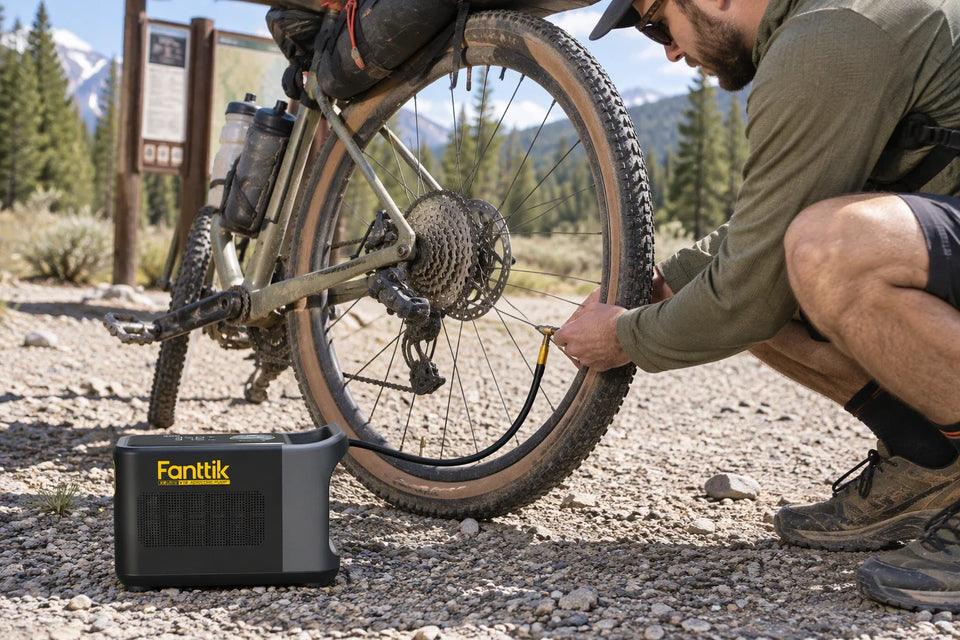
Start with two things that either pass or fail. The pump has to fit your valve, and its pressure range has to reach your tire's target. After that, compare how much pump you're willing to carry with how many top-ups you expect on the route.
Peak PSI won't tell you whether an electric bike pump is ready for the trail. Battery size won't either. Trust inflation results only when the test tire and pressure change look like your own. And remember that a pump puts air back in a tire. It doesn't fix the puncture.
How to Match Pump Size to Expected Top-Ups
Weigh carry burden and expected inflation work together, but only after the pump passes the compatibility check. A lighter pump makes sense when you care most about carried weight and expect few top-ups. If you expect more or bigger top-ups, ask for capacity evidence before you accept a heavier pump.
- Pass the compatibility screen first. If the valve connection or pressure ceiling doesn't fit your setup, size and battery don't matter.
- Describe your route honestly. Estimate how many top-ups you might need and how much weight and pocket or bag space you'll give up. On a light-carry ride with few expected top-ups, the smaller pump is the more relevant choice.
- Ask for evidence that matches your task. A bigger battery is one input, not a top-up count. Before you count on a pump for a heavy top-up day, look for an inflation test on a tire size and pressure change close to yours. If no test like that exists, the pump's gravel capacity is unknown.

Our own listings show the tradeoff. One mini pump is listed at 0.26 lb with a 3.70 Wh battery. A larger model is listed at 0.97 lb with an 18 Wh battery. Those figures help you compare weight against stored energy. They don't tell you how many gravel-tire top-ups either pump will deliver.

What Pump Specs Reveal—and What They Don't
Specs separate weight, battery, maximum pressure and inflation time. Each one answers a different question. The table shows our product-listing values, including the conditions of each listed test.
| Listed model | Weight and battery | Max pressure and 700×23c, 0–100 PSI time |
|---|---|---|
| X10 Ace Mini | 0.26 lb, 3.70 Wh | 120 PSI; listed as 65 s and as 80 s |
| X9 Ace | 0.97 lb, 18 Wh | 150 PSI; 92 s |
The model with the higher ceiling doesn't have a faster listed time, so maximum PSI is not a speed measure. Our X10 records give two different times for the same test. Because of that, treat any speed comparison between the two as unsettled.
Both tests used a narrow 700×23c road tire filled from 0 to 100 PSI. A wider gravel tire at lower pressure is a different job. We also list the X9 as filling eight tires per charge, but that claim doesn't state a tire size or pressure, so it isn't a gravel top-up count. For more context on spec trade-offs, see our X10 versus X11 comparison and this mini air pump features guide.
Check Valve Fit and Tire Pressure Separately
Valve fit, tire target pressure and pump ceiling are three separate checks. Run them in order:
- Identify your valve. Most bikes use Presta or Schrader. Make sure the pump explicitly lists that connection. Our X10 listing names Presta and Schrader, and the X9 hose combines both. The X9 Ace setup manual covers valve checks before inflating.
- Get your tire target. Use guidance that applies to your actual tire and setup, such as the tire maker's information. The pump's maximum is not a recommended tire pressure.
- Compare the target with the ceiling. The pump's listed maximum, such as 120 or 150 PSI, has to reach your target. Reaching it doesn't mean the pump fills that tire quickly.
- Judge inflation performance on its own. Read the tire size and the starting and ending pressures behind any time claim before you apply it to your gravel tires.
A Pump Won't Repair a Puncture
A pump only supplies air; it does not repair a puncture. Park Tool's on-ride guidance treats repair or replacement supplies as separate from inflation, so carry what fits your setup—such as a spare tube or patches for an inner-tube system, or a tubeless repair kit for tubeless tires—along with your pump. Reinstate air only after the leak is dealt with: carry separate repair or replacement supplies and then use the pump to reinflate.
FAQs
Is a pump better than a CO2 cartridge on a long ride?
They behave differently. Park Tool notes that cartridges can be very fast, sometimes too fast if the bead isn't seated. Some are single-shot and can't partly inflate a tube for inspection. A pump lets you add some air, spin the wheel, check it, then add more.
Does a bigger battery mean more top-ups?
Not on its own. Battery capacity is stored energy. How many top-ups you get also depends on tire volume and the pressure change, and listed tests may not match gravel tires.
Can one pump work with both Presta and Schrader valves?
Yes, if it's documented. Our X10 listing names both valve types, and the X9 uses a hose that combines both. For any other pump, look for that explicit listing rather than assuming.
How long can the X9 run continuously?
We list the X9 cooling system as allowing 25 minutes of continuous operation. That's a duty-time spec, not a count of how many tires it can fill.
Continue reading
 Removing Pet Hair from a Fabric Sofa with a Handheld Vacuum
A step-by-step method for vacuuming loose pet hair off fabric couches, loosening hair stuck in seams safely, and...
 Pitching an Instant Tent on a Campsite with Limited Flat Ground
A step-by-step fit test for small campsites: compare your tent's documented footprint with usable level ground, check drainage...
Leave a comment
This site is protected by hCaptcha and the hCaptcha Privacy Policy and Terms of Service apply.