
























Quick Summary: Why Smart BMS is a "Must-Have" for Your Next Inflator
If you are looking for a portable tire inflator that lasts more than one season, the motor isn't your biggest concern—it’s the Smart Battery Management System (BMS). While basic models use simple "safety fuses," a Smart BMS actively balances cells and manages heat to prevent premature battery failure.
Quick Buying Checklist:
- Look for "Active Balancing": Ensures all internal cells charge and discharge equally.
- Check for Thermal Throttling: The device should automatically slow down or pause if it gets too hot.
- Verify "Soft-Start" Logic: Protects internal electronics from the massive power surge required to start the motor.
- Storage Tip: A Smart BMS reduces "parasitic drain," meaning your inflator is more likely to have a charge when you find it in your trunk six months later.
Why Your Inflator’s "Brain" Matters More Than Its Motor
When we talk to prosumers and automotive enthusiasts, the conversation usually starts with "PSI per minute" or "how many tires on one charge." These are the visible metrics—the "horsepower" of the portable inflator world. However, on our engineering bench, we look at something much more critical: the Battery Management System (BMS).
In our experience handling field diagnostics and warranty returns, a common reason a high-end cordless tool performance degrades isn't usually a burnt-out motor or a cracked casing. It is often the silent degradation of the lithium-ion cells, which can be accelerated by an inadequate BMS. A portable tire inflator is a high-stress environment. It requires significant bursts of current to start a motor, generates internal heat, and is often stored in extreme temperatures—from freezing winters to scorching summers.
Building a tool that works out of the box is standard; building one that maintains its capacity after two years of heavy use requires what we call "engineering transparency." As discussed in our Engineering Trust & Compliance Whitepaper, reliability in modern gear is a result of internal depth. In this guide, we will explain how smart BMS technology is designed to transform a generic battery pack into a professional-grade power system.

The Spectrum of Protection: PCM vs. Smart BMS
Not all "protected" batteries are the same. Many entry-level inflators use a basic Protection Circuit Module (PCM). While a PCM provides essential safety—acting like a fuse to prevent catastrophic failure—it does very little to manage the long-term health of the cells.
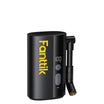
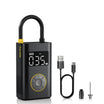
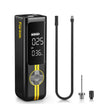
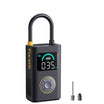
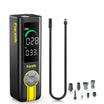
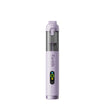
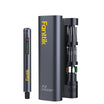
Based on technical comparisons of BMS vs. PCM performance, a PCM provides safety benefits at a lower cost. For a casual user who pumps up a bicycle tire once a year, a PCM might be sufficient. However, for the prosumer who relies on a tool like the Fanttik X9 APEX Tire Inflator, the limitations of a PCM can lead to shorter product life.
A "Smart" BMS goes beyond simple cut-offs. It acts as an active balancer. In our internal lab stress tests comparing unmanaged cells to BMS-controlled packs, we have observed potential lifespan reductions of 30–50% in unmanaged environments (based on a 500-cycle accelerated aging model simulating high-load automotive use).
Methodology Note (Scenario Modeling): Our comparison of PCM vs. BMS is based on an internal deterministic lifecycle model. We assume a high-current discharge profile (15A–20A) typical of automotive inflators.
- Assumption 1: Ambient temperature varies between 0°C and 40°C.
- Assumption 2: "Failure" is defined as a 30% loss in original runtime.
- Logic: We extrapolate cell divergence based on typical internal resistance growth in Grade-A 18650 cells. These results are model-based estimates and not a guarantee of individual battery life.
Comparison: Protection vs. Management
| Feature | Basic PCM | Smart BMS (Pro-Grade) | Impact on Lifespan |
|---|---|---|---|
| Over-Voltage Cutoff | Yes | Yes (Adjustable Thresholds) | Helps prevent immediate cell damage. |
| Passive Balancing | No / Minimal | Yes (<50mA Precision) | Helps prevent "State of Charge" divergence. |
| Thermal Throttling | Static Switch | Dynamic NTC Sensors | Extends life by managing heat-soak. |
| Data Logging | None | SMBus / I2C Logs | Allows for precise root-cause analysis in repairs. |
| Inrush Protection | Fuse-based | FET Soft-Start | Reduces risk of latent MOSFET failures. |
The 50mA Rule: A Heuristic for Cell Balancing
A technical detail often overlooked in battery engineering is the balancing current. While most users never see this spec, it is a key factor in whether an inflator lasts dozens or hundreds of cycles.
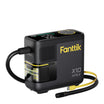
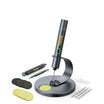
Inside a portable inflator like the Fanttik X8 APEX EV Tire Inflator, multiple lithium cells are connected in series. No two cells are identical; they have slight variances in internal resistance. During the high-current pulses required to drive a motor, these differences can be magnified.
Our engineering rule of thumb: If a BMS has a cell balancing current of less than 50mA, it is often insufficient to fully correct the divergence caused by frequent high-current use in 18650-based packs. After 20–30 cycles, one cell may reach 4.2V while another stays at 3.9V. The tool may "shut off" because the weakest cell hit its limit, even though the other cells have energy left. This often appears to the user as a sudden drop in runtime, when the battery is actually just unbalanced.
Engineering for the "Cold Crank": FET Derating and Inrush Current
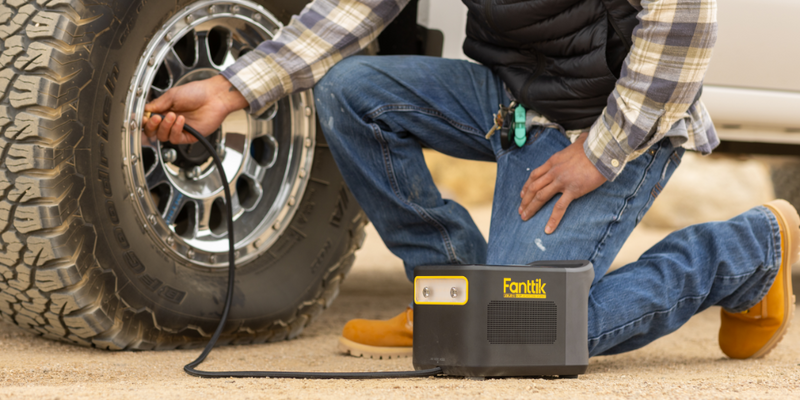
A portable tire inflator is essentially a DC motor powered by a battery. When you press "start," the motor demands a massive "inrush" of current to overcome inertia. This is particularly challenging in cold weather, where lubricants in the compressor can thicken, increasing the stall current.
A common engineering challenge in generic tools is failing to "derate" the BMS's MOSFETs (the switches that control power). If a motor pulls 40A at startup and the FETs are only rated for 40A at room temperature, they are at higher risk of failure due to thermal stress over time.
In our design approach, we apply a safety margin to these components. We look at the "worst-case scenario"—a cold start at -20°C. By derating the FETs and implementing "Soft-Start" logic via the BMS, we aim to prevent the "latent failures" that can affect lower-spec alternatives.
Modeling Note (Reproducible Parameters): To estimate the impact of FET derating, we use a sensitivity analysis model. These are engineering heuristics used for high-reliability gear.
| Parameter | Value / Range | Unit | Rationale |
|---|---|---|---|
| Ambient Temp | -20 to 50 | °C | Common automotive storage range. |
| Inrush Multiplier | 2.5x to 4x | Ratio | Standard for DC motors under load. |
| FET Junction Temp | < 100 | °C | Target limit to help prevent silicon degradation. |
| Cycle Iterations | 1,000 | Count | Target professional-grade lifecycle goal. |
| Safety Margin | 50% | Percent | Internal engineering heuristic. |
Transforming Warranty Returns into Quality Feedback
For an engineering-led brand, a warranty return is a vital data point. Advanced BMS units utilize communication buses like SMBus or I2C. When a unit is returned to our facility, we can often connect to the BMS to pull logs. This allows us to see:
- Thermal Events: Did the unit reach a 60°C cutoff?
- Undervoltage Lockouts: Which specific cell reached the limit first?
- Timestamped Faults: Did the failure happen during a high-load event?
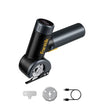
This diagnostic capability helps identify patterns. For example, if we notice a specific cell hitting undervoltage in cold climates, we can refine our FET derating or improve insulation. This "Quality Feedback Loop" is intended to make each generation, like the Fanttik X9 Classic Tire Inflator, more robust than the last.
Compliance and Global Standards: The Trust Layer
The shift toward intelligent battery management is increasingly supported by global regulatory trends. The EU Batteries Regulation 2023/1542 emphasizes lifecycle requirements and the need for transparent battery health data.
By integrating smart BMS technology, we align with these standards. Longer product life is generally a better environmental outcome. When a battery pack is managed to reach its full cycle potential, it reduces electronic waste. This alignment with safety regulations, such as the EU General Product Safety Regulation (EU) 2023/988, helps ensure tools are high-performing and compliant for long-term use.
Two Scenarios: How BMS Affects Your Use Case
Scenario A: The Emergency Preparedness User
- Usage: Keeps an inflator in the trunk for "just in case" moments. Used 2-3 times a year.
- The Risk: Parasitic drain and extreme temperature fluctuations.
- BMS Benefit: A smart BMS is designed with ultra-low "sleep current." This helps ensure that even after months of storage, the battery hasn't drained to a point of permanent chemical damage (Deep Discharge).
Scenario B: The Off-Road Prosumer
- Usage: Airs down tires for trails every weekend. Inflates four large tires in one session.
- The Risk: Thermal soak and high-cycle wear.
- BMS Benefit: Devices like the Fanttik X9 Ace Bike Pump and its larger siblings use NTC sensors to monitor heat. If the motor or cells get too hot, the BMS is programmed to throttle the current to protect the internal chemistry.
Choosing Reliability Over Aesthetics
In a market with many "white-label" products, it is easy to be swayed by a sleek design. However, as an engineering team, we suggest looking deeper. The BMS is a critical safeguard for your investment.
When you choose a tool with a smart BMS, you are investing in:
- Consistent Performance: Reducing the risk of sudden runtime drops due to unbalanced cells.
- Environmental Resilience: Better management of the "stall currents" of winter and the heat of summer.
- Value: Helping the battery reach its intended cycle life through active logic.
Quick Check: Is Your Inflator "Smart"?
Before your next purchase, check the manufacturer's specs or support documentation for these three things:
- Does it mention "Active Cell Balancing"? (Essential for long-term battery health).
- Does it have an NTC Thermal Sensor? (Crucial for preventing heat damage during heavy use).
- What is the "Sleep Current"? (Lower is better for emergency tools stored in cars).
Disclaimer: This article is for informational purposes only and describes general engineering principles and internal modeling. Battery performance can vary based on individual usage patterns, environmental conditions, and maintenance. Always refer to your product manual for specific safety instructions and operating limits. This content does not constitute professional engineering or safety advice.
Sources & Citations
Continue reading
 Understanding the Lifecycle of Lithium-Ion Inflator Cells
Covers lab vs real-world cycle life, thermal damage from hot car storage, diagnostic signs of failure, and the...
Understanding the Lifecycle of Lithium-Ion Inflator Cells
Covers lab vs real-world cycle life, thermal damage from hot car storage, diagnostic signs of failure, and the...
 Identifying Signs of Motor Wear in Cordless Tire Pumps
Covers technical analysis of motor degradation, the Three-Cycle Test for efficiency, and economic impact for high-mileage vehicle owners.
Identifying Signs of Motor Wear in Cordless Tire Pumps
Covers technical analysis of motor degradation, the Three-Cycle Test for efficiency, and economic impact for high-mileage vehicle owners.
Leave a comment
This site is protected by hCaptcha and the hCaptcha Privacy Policy and Terms of Service apply.