










































In auto care, polish and wax serve separate roles: abrasive polishing processes are designed to level very fine surface defects by removing a thin slice of clear coat, whereas wax provides a sacrificial protective layer over the paint without removing defects. In the car polish vs wax decision, polishing is used to target very light swirls, water spots, or oxidation on sound clear coat, while wax protects a finish that is already clean and intact.
A buffer polisher does not bypass the limits of the product or the paint. Because it mechanically moves a pad, it cannot repair paint peeling from the substrate or remove a scratch that extends past the clear coat. Assessing the defect first keeps you from attempting machine correction on damage that requires repainting.
Car Polish vs. Wax: What Does Each Do?
Polish corrects and wax protects. That is the whole point of car polish vs wax, and it decides which product goes on first.
A detailing shop, Shine My Ride, explains that wax protects but does not remove defects. It describes wax as a sacrificial layer applied on top of clean, prepped paint that removes nothing from it. Polishing, in that shop's process, uses a fine abrasive and a soft pad to remove the top few microns of clear coat. That is enough to level very light swirl marks, water spots, and oxidation.
Product labels don't always make this clear, so look at what the product actually does. The International Detailing Association glossary notes that paint cleaners remove minor imperfections but offer little or no protection. The same glossary calls a paint sealant a protective product that coats and seals the surface. If a bottle contains an abrasive, it is a correction step. If it coats and seals, it is a protection step.
A mark that looks better is not always gone. In PPG's automotive refinish guidance, polish residue can make sand scratches appear removed by filling them in. PPG advises cleaning between polishing steps to reveal whether those sand scratches remain. When working on your car, wiping the surface clean between passes helps verify whether a defect was actually leveled or simply masked by compound residue.
When you need both treatments, the order follows from what each one does. Correct first, then protect, because wax belongs on clean, prepped paint. A good wash and a scratch-free dry, like the methods in our touchless car drying guide, get the surface ready for either step.
Assess the Paint Before You Choose a Treatment
What you see on the paint decides whether you need correction, protection, or a repair that neither product can do. No reliable look-only test tells you how deep a mark goes, so sort the defect by its type and the condition of the finish:
- Swirl-like marks or haze on intact paint. In professional refinish guidance, PPG's description of swirl-pattern polishing marks defines them as curved or swirling microgrooves or smears. PPG lists re-polishing as one correction option, though sanding and refinishing may be required depending on defect severity. A visible swirl pattern does not guarantee a simple polish-only fix.
- A scratch that may go below the clear coat. Shine My Ride says deep scratches below the clear coat are outside what polishing removes and need touch-up or a respray. If you can't tell whether a scratch is that deep, have the paint assessed before you polish. Guessing wrong means removing clear coat for no gain.
- Peeling or flaking paint. Stop here: polish and wax are not the fix. PPG's definition of peeling paint is a loss of adhesion between the finish and the surface under it. Its correction is removing the affected material, sanding a slightly larger area, and refinishing as needed. Take the car to a paint or body shop.
- Intact paint you just want to protect. Wax is the right job. It adds a protective layer and leaves the paint underneath unchanged, so any small marks you already have will still be there.
What a Buffer Polisher Can and Can't Do
A buffer polisher controls how the pad moves, while the product applied determines whether the step is intended for defect correction or surface protection. A machine cannot alter the basic chemistry or abrasive limits of whatever compound or wax is on the pad.
The tool category itself points to protection as much as correction. The IDA glossary describes an orbital buffer as a tool used when waxing, with a pad that travels in ellipses to mimic the motion of a hand. That shows a buffer is a common way to put on wax. It doesn't make the buffer a correction tool by itself.

Correction happens only when the process uses an abrasive. The light polishing process Shine My Ride describes pairs a fine abrasive with a soft pad to address very light swirls, water spots, and oxidation, distinguishing that mild cleanup from multi-stage paint correction. That shop-described boundary illustrates what fine abrasives are meant to tackle on intact paint, but it does not expand the mechanical capability of an entry-level buffer.

What a buffer can't do comes from the same limits that apply to polish. It won't reach a scratch below the clear coat, and it won't reattach peeling paint. Remember that every polishing pass removes some clear coat. If a mark returns after you wipe off the residue, don't keep adding passes. Get the paint assessed, because the defect may need touch-up or refinishing instead.
FAQs
Does wax remove scratches?
No. Wax sits on top of the paint as a protective layer and doesn't remove any material, so a scratch under it is still there. If you want the mark gone, it needs an abrasive correction step first, and only if it is a very light defect.
Is a paint cleaner the same thing as wax?
No. The International Detailing Association defines a paint cleaner as a mildly abrasive product for light oxidation, scratches, and minor imperfections that usually offers little or no protection. Wax and sealants are the protective products. A cleaner can be a correction step, but it doesn't replace protection.
Should I protect the paint after polishing?
Yes, plan on it. OCDCarCare's consumer glossary says that after a one-step paint correction, the surface requires wax, paint sealant, or a ceramic coating for protection. Polishing removes a thin layer of clear coat, and the polish itself isn't meant to be the protective coat.
Can polishing fix paint chips or key scratches?
Not by polishing alone. OCDCarCare's glossary lists paint chipping, clear coat failure, and extremely deep scratches such as key marks as conditions that paint correction can't fix by itself. Those usually call for touch-up paint or refinishing, so polish and wax are the wrong tools for that kind of damage.
Continue reading
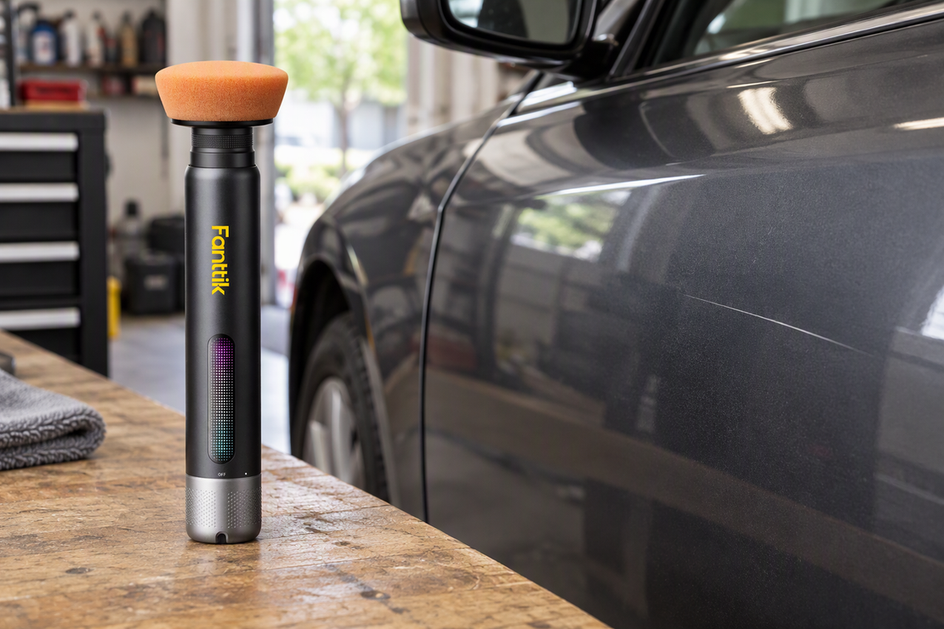 Can a Mini Buffer Polisher Fix This Scratch—or Is It Too Deep?
A practical look at which paint scratches a mini buffer might improve, which depth clues to trust, and...
 How to Fit a Camping Tent Into a Crowded Trunk
A step-by-step method for testing whether a packed tent fits your trunk opening, arranging gear by arrival order,...
Leave a comment
This site is protected by hCaptcha and the hCaptcha Privacy Policy and Terms of Service apply.