










































Sometimes, but only when two things are true. The ash has to be completely cold. Your exact vacuum's instructions also have to allow fine debris like ash.
If you can't confirm both, don't use that vacuum on the ash. A small handheld size tells you nothing about whether the motor and filter were built for fine particles, so the decision comes from the ash and the manual, not the tool's shape.
The Two Verification Checkpoints
Treat heat safety and device clearance as an all-or-nothing sequence: failing either test stops the job immediately. A vacuum motor draws air across collected waste, which means unverified embers pose a fire hazard, while fine particles can bypass standard filters to reach the motor or exhaust straight back into the vehicle cabin.
Why Ash Must Be Completely Cold Before Vacuuming
Ash that looks dead can still hold enough heat to start a fire. For campfire ash, the U.S. Forest Service advises dousing and stirring until the ashes are cool enough to touch, and notes that fire is still possible without visible flames. Its rule is simple: if it's too hot to touch, it's too hot to leave.
That guidance is written for campfire and grill ash, not for vacuums or cars. Still, it points to a sensible rule for car ash cleanup. If the ash came from a fire, cigarette, or anything that was burning, and you can't confirm it's fully cold, don't vacuum it. A vacuum pulls air through the debris and packs it into a closed bin next to a motor, and that's a bad place for something that may still be smoldering.

There is no fixed cooling time that guarantees safety. Don't start until you're confident the ash is cold all the way through.
How to Check Whether Your Vacuum Supports Fine Debris
Your own model's documentation is the only reliable answer. Suction ratings, a compact body, or good results on crumbs and sand don't prove a vacuum can handle ash. Use this check:
- Find the exact model. Look for the model number on the label, the box, or your order record. A similar model from the same brand doesn't count.
- Open that model's official manual or support page. Look in the safety warnings and the "intended use" section.
- Search for ash and fine dust. Some manuals forbid vacuuming anything that has burned or smoked, including ash that seems to be out. Others list fine dust and filter limits.
- Check the filter guidance. Note what the manual says about fine particles, filter cleaning, and running with the filter installed.
- Read the result. If the manual clearly allows fine debris and doesn't forbid ash, the device gate passes. If it prohibits ash, says nothing, or is vague, treat that vacuum as not cleared for this job.

If ash isn't the problem and you're dealing with beach sand instead, our guide on vacuuming sand from car carpet covers that separate job.
What If Either Condition Is Unclear?
Pause the cleanup and leave that vacuum turned off. If cooling cannot be verified or documentation is silent on fine particles, let the material rest or use a dedicated ash-safe disposal method instead.
FAQs
Does a HEPA filter mean a handheld vacuum can pick up ash?
Not by itself. A filter type is one feature. What counts is whether that model's instructions allow ash or fine debris. Some vacuum manuals forbid ash even when the vacuum has a fine dust filter.
Can I vacuum cigarette ash from my car's ashtray or floor?
Only if it's completely cold and your vacuum's manual allows it. The Forest Service lists cigarette ash with other ashes that shouldn't be dumped carelessly, and some vacuum manuals specifically ban cigarettes and smoking debris.
Is cleaning up sand the same as cleaning up ash?
No. Sand doesn't carry a leftover fire risk, and a vacuum that does well on grit may still not be approved for ash. Our post on beach sand and saltwater cleanup covers sand specifically. It doesn't cover ash.
What if I can't find a manual for my vacuum?
Treat the vacuum as not cleared for ash. Without the manufacturer's instructions, you can't confirm the device gate, so don't use that vacuum for this material.
Continue reading
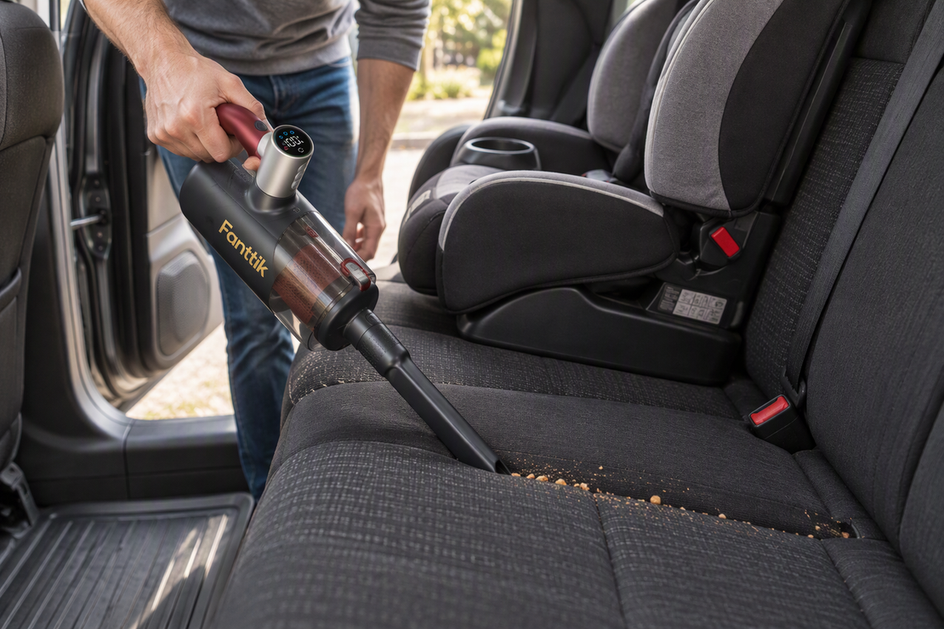 How to Vacuum Around Car-Seat Anchors Without Snagging Straps
A step-by-step way to lift crumbs near child-seat anchors and seat-belt webbing, keep the nozzle from grabbing straps,...
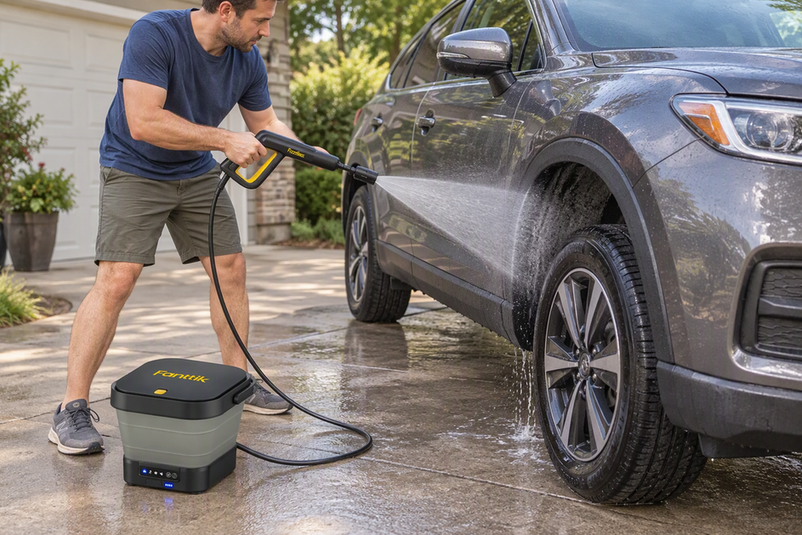 How to Pressure Wash Wheel Wells Without Blasting Sensitive Areas
A step-by-step guide to cleaning wheel wells with a pressure washer: check your vehicle's instructions, pick a wide...
Leave a comment
This site is protected by hCaptcha and the hCaptcha Privacy Policy and Terms of Service apply.