











































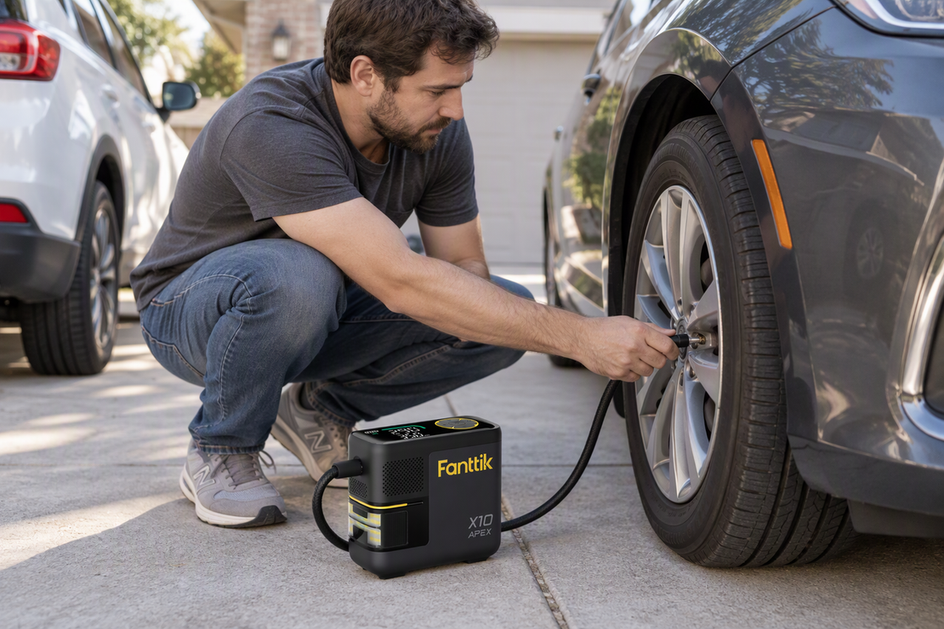
Use your portable inflator's built-in display when you're already topping up a tire. Reach for a separate tire pressure gauge when you want a routine check or an independent second reading. Neither tool is automatically the more accurate one, so a consistent method matters more than which display you trust.

Whichever tool you use, the target is the same. It's your vehicle manufacturer's recommended pressure, checked on cold tires. It is not whatever number a device shows, and it is not the inflator's maximum PSI rating.
Portable Inflator or Separate Gauge: Which Should You Use?
Pick based on what you're doing at that moment. Both tools show a reading, but they fit different steps of tire care.

- You're adding air right now: Use the inflator's display. It's already hooked to the valve, so you can watch pressure rise without stopping to swap tools. That convenience doesn't make the number exact. It just saves a step.
- You're doing a routine check or want a second opinion: Use a separate accurate gauge. NHTSA recommends monthly tire inspections with an accurate gauge, and a standalone gauge lets you take that reading without running the pump. It gives you another measurement. It doesn't prove the gauge is right and the inflator is wrong.
Repeatability, meaning getting the same reading again under the same conditions, comes from how you check, not from the tool category. Keep three numbers separate:
- the reading, which is what a device shows;
- the target, which is your vehicle's recommended pressure;
- the maximum PSI rating, which is the highest pressure the inflator can produce. It is not a setting for your car.
If you're shopping for an inflator, fill time and battery matter more than that headline maximum. Our guide on how to choose a portable inflator covers those factors.
How to Check Tire PSI Consistently
A check is only useful when you compare a cold reading against the right target. Follow the same sequence every time:
- Find your target pressure. NHTSA explains where to find the vehicle's recommended pressure: on the Tire and Loading Information label on the driver's side door edge or post, or in the owner's manual. The number molded on the tire is not your target. Front and rear pressures can differ, so write both down.
- Check cold. Under NHTSA's three-hour cold-check condition, a tire is cold when it hasn't been driven on for at least three hours. Measure cold, or account for the extra pressure in warm tires. A reading taken right after a drive isn't comparable to a cold one.
- Use the same tool and approach. For routine checks, use the same gauge and seat it on the valve the same way each time. That makes week-to-week readings easier to compare, even though it doesn't make that gauge exact.
- Compare the reading to the target. If a tire is low, the gap between your reading and the label number is how much air to add. If it's high, release air in short bursts and measure again.
- Check every tire, including the spare. NHTSA's steps include the spare.
Your dashboard warning light doesn't replace this check. Our explainer on how TPMS warnings work shows what the system can and can't tell you.
What If the Inflator and Gauge Still Disagree?
Don't average the two readings, and don't assume either one is correct. Start by redoing the check under matching conditions: measure after parking for at least three hours, test both tools back-to-back on the same valve stem, and seat each tool firmly to prevent leaks. If the numbers still differ, use an accurate separate gauge as your consistent reference for later checks so observed changes come from the tire rather than switching tools.
If you can't settle the mismatch, a tire shop can check the pressure with its own equipment. Make that visit a priority if the tire keeps losing air. NHTSA's advice when a tire will not maintain pressure, or when you notice noise or vibration, is to consult a tire service professional. At that point, more readings won't fix the problem.
FAQs
Should I use the PSI printed on the tire sidewall?
No. NHTSA says the correct pressure is the one your vehicle manufacturer lists, not the number on the tire. Use the door-edge label or your owner's manual.
Do I need more pressure when the car is fully loaded?
There's no universal extra-PSI rule for heavier loads. Always follow the pressure specified on your vehicle's Tire and Loading Information placard or owner's manual. Our guide to loaded vehicle tire pressure walks through setting it from your placard.
How often should I check tire pressure?
NHTSA recommends inspecting tires monthly with an accurate gauge. A check before a long trip is also a sensible habit.
Does gauge accuracy matter for high-pressure trailer tires?
Yes. Gauge accuracy is essential because high-PSI tires operate under tighter safety margins and higher working loads, where a few PSI of underinflation or overinflation significantly affects stability and heat buildup.
Continue reading
 How to Decide Whether a Car Vacuum Needs a Filter Clean or a Part Replacement
A practical way to tell whether your car vacuum filter needs a wash or a new part. It...
 Where Can Car-Wash Runoff Go When Using a Cordless Pressure Washer?
How to trace washwater from your driveway or yard, how storm drains, lawns, and managed collection compare, and...
Leave a comment
This site is protected by hCaptcha and the hCaptcha Privacy Policy and Terms of Service apply.