











































To keep a jump starter ready for a car you rarely drive, follow a routine based on that exact model's instructions. Put its documented top-up schedule on your calendar and check the charge and clamps each time. Store the starter somewhere that stays within that model's stated limits.
Before you count on it, compare the starter's rating with your car's owner's manual. A jump starter sitting in an unused car can go flat just as easily as the car's own battery.
Build a Readiness Routine From the Exact Model's Instructions
Every step below starts with knowing which model you own. One starter's schedule may not fit another. If you need vehicle documentation, resources like the Toyota Owner's Manuals directory provide direct access for Toyota models, while other drivers should consult their respective manufacturer's portal.
- Find the model number. On our jump starters, it's printed on a label on the unit. Look on the underside or along the rear housing seam. If you can't find the label, check the top and side panels of the box. Then use the manual for that exact model. Don't borrow the schedule from a similar-looking unit.
- Set a recurring reminder from that manual. For the T8 APEX, we recommend topping it up to full every 90 days when it's stored in a trunk. We also recommend not storing it below 50% charge for more than one month. Those numbers apply to the T8 APEX only. Use your own model's interval if you have a different starter.
- Check the charge level at each reminder. Read the charge indicator using the meanings listed in your model's manual. If you're not sure what a light means, don't guess.
- Inspect the clamps. For the T8 APEX, wipe the clamp jaws and store the starter with the rubber boots on. Corrosion on the clamp tips reduces conductivity. If you see fraying near a jaw, replace the clamp cables before you rely on the unit.
- Treat any uncertainty as "not ready." If the charge status or the starter's condition is unclear, recharge it following the manual. If something still seems off, contact Fanttik support for help with your exact model. Recharging alone doesn't prove every fault is fixed.

If the second car gets more gear over time, our guide to rotating gear to secondary vehicles explains how to keep that kit organized. Before a long drive, the pre-trip tool readiness check adds one last battery check.
Check the Starter Against the Second Car's Documentation
A starter that is charged but too small for the engine still won't do the job. Confirm the match on paper before you need it.
- Identify both exact models. Write down the car's year, make, model, engine type, and displacement. Then note the starter's exact model number.
- Read the starter's stated ratings. For example, we rate the T8 APEX for gasoline engines up to 8.5L and diesel engines up to 6.0L. Compare those numbers with the engine type and displacement listed in your owner's manual.
- Record whether the documents agree. An engine-size rating is one comparison point. It isn't a complete compatibility list, so note any other requirement either manual lists.
- Escalate an unclear result. If a document is missing or the match isn't clear, don't treat the starter as compatible. Ask the vehicle maker, the starter maker, or an authorized service provider to confirm.
Choose Storage Within the Model's Stated Limits
The right place for the starter is wherever it stays within its model's documented storage conditions. Don't assume every trunk or cabin works for every starter. Check where the unit will actually sit, through the hottest and coldest parts of your year.

For the T8 APEX, we recommend keeping the unit in the cabin during winter storage if you can. Cells lose capacity faster when they're stored cold and empty. A cold trunk works against a starter that already sits a long time between top-ups. Summer brings a different stress. Our article on how high heat affects cranking amps covers that side.
FAQs
Does the T8 APEX's 90-day top-up schedule apply to every jump starter?
No. The 90-day top-up interval is specific to storing the T8 APEX in a trunk. Storing the unit above 50% charge is also a model-specific requirement for the T8 APEX, regardless of whether it sits in a trunk or elsewhere. Always consult your specific model's manual for its designated maintenance schedule.
Can I use an operating-temperature rating as a storage-temperature limit?
No. The T8 APEX's 5°F threshold applies to attempting a boost, not to storage damage. Its maintenance guidance doesn't give a complete storage-temperature limit, so the operating number shouldn't be treated as one.
How do I find the right Fanttik jump-starter manual?
Find the model number on the unit's label or on the box. Fanttik jump starters carry T-series names, such as T8 APEX. If you lost the manual or can't match your model, our support team can email you a PDF for current and discontinued models.
Continue reading
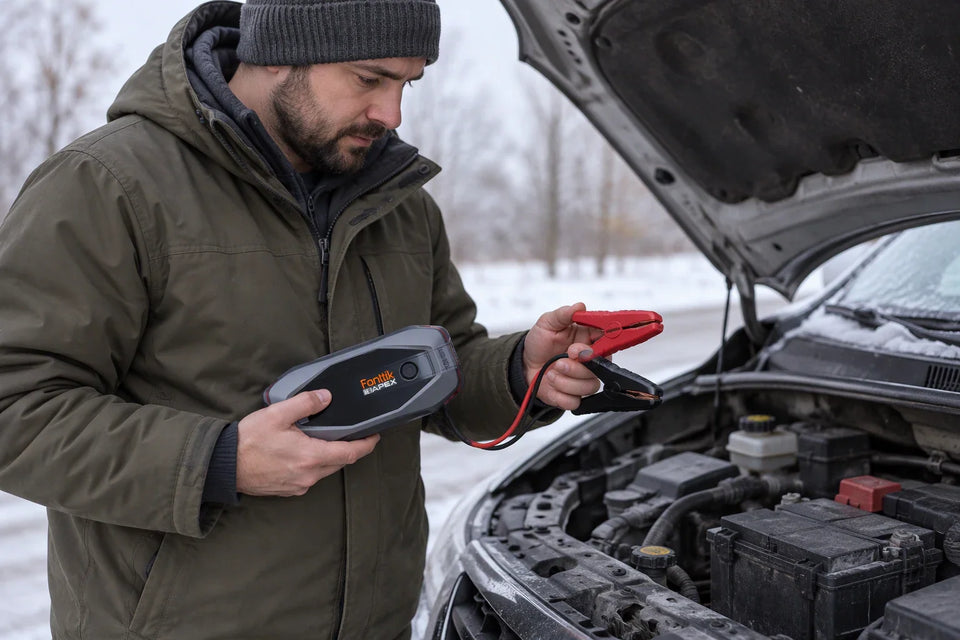 Cold-Morning No-Start: When a Jump Starter Is—and Isn't—the Next Step
A cold no-start isn't proof you need a boost. Read the symptom clues, battery no-go signs, and voltage...
 Vacuuming a Car Headliner: Remove Loose Dust Without Pulling the Fabric
How to lift loose dust off a car's roof lining with almost no contact, the signs that should...

Leave a comment
This site is protected by hCaptcha and the hCaptcha Privacy Policy and Terms of Service apply.