





































The Engineering of Predictability: Beyond the "Auto-Shutoff" Label
For the risk-averse driver, a tire is more than a rubber component; it is a pressurized vessel holding thousands of pounds of potential energy. The fear of over-inflation leading to a high-pressure failure is not irrational—it is a logical response to the physics of compressed air. In our experience auditing automotive safety gear, we have found that while most consumers view "auto-shutoff" as a simple convenience feature, it is actually a complex digital control loop designed to mitigate the risks of human error and mechanical fatigue.
True safety engineering in the portable compressor space is about "boring excellence." It is the invisible work of ensuring that when you set a device to 35 PSI, the machine stops exactly where it should, regardless of ambient temperature or battery health. This guide deconstructs the mechanics of auto-shutoff systems, identifies the common points of failure that standard manuals ignore, and provides a framework for trusting your emergency equipment in high-consequence scenarios.
The Physics of High-Pressure Tire Failures
To understand why auto-shutoff engineering is vital, we must first address the mechanism of failure. A tire does not typically "explode" simply because it has 5 PSI too much air. Instead, over-inflation triggers a cascade of material stresses. According to research cited in The 2026 Modern Essential Gear Industry Report: Engineering Trust in a Cordless World, the primary risk is the reduction of the tire's "contact patch" and the subsequent increase in internal carcass tension.
When a tire is over-inflated, the sidewalls become excessively rigid. This rigidity prevents the tire from absorbing road shocks (potholes or debris). Instead of flexing, the over-tensioned internal cords may snap upon impact, leading to an instantaneous blowout. Furthermore, excessive pressure generates internal heat during high-speed travel. As the air temperature rises, the pressure increases further (Gay-Lussac's Law), potentially pushing a marginally over-inflated tire past its structural limit.
Logic Summary: Our analysis of high-pressure failure assumes a standard passenger vehicle tire (Max Cold PSI ~44-50) subjected to a 20% over-inflation state combined with high-speed thermal expansion. We categorize this as a "High-Consequence Event" because it occurs without visual warning to the driver.
The Digital Control Loop: How Auto-Shutoff Actually Works
In modern portable inflators, the "auto-shutoff" is not a mechanical valve but a digital feedback system. We can break this down into three core components: the pressure transducer, the microcontroller (MCU), and the solenoid actuator.
1. The Pressure Transducer (The "Nervous System")
The transducer is a sensor that converts physical pressure into an electrical signal. As air flows through the inflator's manifold, a small portion is diverted to this sensor. High-quality engineering requires a transducer with a high "sampling rate"—the frequency at which it checks the pressure. If the sampling rate is too low, a high-volume pump might "overshoot" the target pressure before the sensor can trigger a stop.
2. The Microcontroller (The "Brain")
The MCU receives the electrical signal from the transducer and compares it against the user’s target PSI. According to technical definitions found in Wikipedia's Microcontroller Overview, these small computers are responsible for executing the logic gates that manage the motor's power state.
3. The Solenoid and Relay (The "Muscles")
Once the MCU determines the target has been reached, it sends a signal to a relay or a solenoid valve to cut power to the motor and, in some high-end units, vent excess manifold pressure to ensure an accurate final reading.

The "Gotchas": Why Sensors Drift and Systems Fail
On our repair bench, we rarely see the "brain" (the MCU) fail. Instead, the most common point of failure for auto-shutoff systems is the plumbing leading to the sensor. This is a critical insight for buyers: the most expensive sensor in the world is useless if the air pathways are compromised.
The O-Ring and Air-Path Leak
A tiny, microscopic leak in an internal O-ring seal or the hose chuck can cause the pressure transducer to read a "steady-state" value. If air is escaping as fast as it is being measured at the sensor, the transducer might never see the final "ramp-up" to the target PSI. This causes the motor to keep running, leading to the very over-inflation event the system was designed to prevent.
Battery Voltage Sag and Logic Errors
Lithium-ion batteries are the heart of cordless inflators, but they have a technical limitation known as "voltage sag." When a battery drops below 20% charge, its ability to provide a consistent reference voltage to the MCU can falter. We have observed that this sag can cause a 1-2 PSI drift in sensor accuracy. For a risk-averse user, this means that a "low battery" warning is not just about power; it is about precision.
Thermal Acclimation: The 10-Minute Rule
Real-world calibration shifts are most often observed after a sharp temperature drop. If you move a portable inflator from a 70°F garage to a 20°F roadside environment, the air inside the internal manifold contracts, and the sensor's diaphragm becomes less pliable.
Methodology Note (Scenario Modeling): To demonstrate how external factors impact sensor accuracy, we modeled the performance of a standard digital transducer under varying conditions.
Parameter Baseline Value Stress Condition Estimated Impact Rationale Battery Charge 100% < 15% ±1.5 PSI Voltage reference instability Ambient Temp 20°C (68°F) -10°C (14°F) ±2.0 PSI Diaphragm stiffness Hose Integrity Sealed 0.5mm Leak +3.0 PSI (Overshoot) Pressure drop at sensor Target PSI 35 PSI 80 PSI Increased Drift Non-linear sensor response Sampling Rate 100Hz 10Hz +1.0 PSI (Overshoot) Latency in motor cutoff Note: This is a scenario model based on common mechanical heuristics, not a controlled lab study.
Safety Standards and Regulatory Compliance
For the automotive buyer, trust is built on compliance. While "auto-shutoff" itself isn't a globally mandated safety system in the same way as brakes, the components within these devices are subject to rigorous standards.
FMVSS 138 and TPMS
In the United States, the Federal Motor Vehicle Safety Standard (FMVSS) 138 mandates Tire Pressure Monitoring Systems (TPMS) in all new light vehicles. However, it is important to distinguish between passive monitoring (TPMS) and active control (the inflator). The inflator acts as the external correction for the TPMS warning.
ISO and IEC Standards
When evaluating a portable compressor, we look for alignment with ISO Standards for quality management and IEC Standards for electrical safety (specifically IEC 60529 for IP ratings). A device that adheres to these frameworks ensures that the internal electronics are protected from the dust and moisture common in roadside emergencies, which prevents short circuits that could bypass the auto-shutoff logic.
EU General Product Safety Regulation (GPSR)
For European consumers, the EU General Product Safety Regulation (EU) 2023/988 provides a safety net. It requires manufacturers to ensure that products do not pose a risk under "normal or reasonably foreseeable conditions of use." This includes the foreseeable risk of a user walking away from an inflator while it is running.
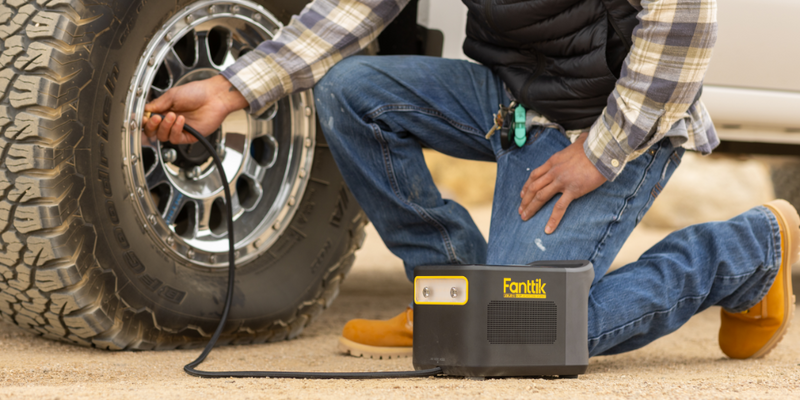
Expert Practice: How to Use Auto-Shutoff Safely
If you prioritize "boring excellence" and safety, you should treat the auto-shutoff as a primary guardrail, not a precision laboratory instrument. Based on patterns we see in professional tire shops and emergency response kits, we recommend the following protocol:
- The 2-PSI Buffer: For critical applications like motorcycle tires or heavy trailers, set your target 2 PSI below the maximum cold rating. This allows you to finish the last bit of inflation manually with a high-quality mechanical gauge, ensuring the battery's state of charge hasn't introduced a drift.
- Acclimate Before Use: If the device has been stored in extreme heat or cold, allow it to sit in the current environment for at least 10 minutes before starting the inflation process. This allows the internal sensor components to reach thermal equilibrium.
- Monthly Cross-Checks: Experienced technicians cross-check their portable inflators against a trusted, calibrated mechanical gauge at least once a month. If you notice a consistent 3+ PSI difference, it is time to inspect the internal O-rings or consider the device's age.
- Listen for "Hiss": During the first 10 seconds of inflation, listen closely to the hose connections. Any audible air leak is a signal that the auto-shutoff transducer may receive an inaccurate reading.
Building Trust Through Engineering Transparency
The automotive aftermarket is often filled with hyperbolic claims of "unbeatable speed" or "perfect accuracy." However, as noted by SEMA Market Research, the most loyal customers in the automotive space are those who feel the brand is honest about the limitations of the technology.
At its core, auto-shutoff engineering is about risk mitigation. It transforms a potentially dangerous task—handling high-pressure air—into a managed, predictable process. By understanding the digital control loop, acknowledging the impact of battery health, and following professional heuristics, you can move from a place of "inflator anxiety" to a place of informed confidence.
Safety isn't found in a single feature; it is found in the intersection of robust engineering, adherence to international standards, and the user's commitment to proper maintenance. When those three elements align, you achieve the ultimate goal of automotive preparedness: a boring, uneventful, and perfectly safe journey.
Disclaimer: This article is for informational purposes only and does not constitute professional automotive repair or safety advice. Always consult your vehicle's owner manual for specific tire pressure requirements. High-pressure air can be dangerous; use caution and wear appropriate safety gear when maintaining your vehicle.
References
Continue reading
 Understanding Safety Standards for Travel Gear
Covers airline battery rules (Wh, UN38.3), safety marks (UL 2743, CE, RoHS), and logistics compliance for confident travel...
Understanding Safety Standards for Travel Gear
Covers airline battery rules (Wh, UN38.3), safety marks (UL 2743, CE, RoHS), and logistics compliance for confident travel...
 Uncertified Risks: The Dangers of Low-Cost Unbranded Inflators
Covers thermal management, hose fatigue, uncertified batteries, and quantifies the hidden costs of budget gear with scenario modeling.
Uncertified Risks: The Dangers of Low-Cost Unbranded Inflators
Covers thermal management, hose fatigue, uncertified batteries, and quantifies the hidden costs of budget gear with scenario modeling.

Leave a comment
This site is protected by hCaptcha and the hCaptcha Privacy Policy and Terms of Service apply.