










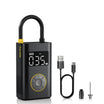
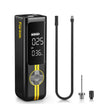


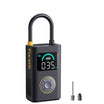
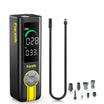
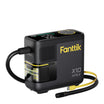










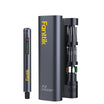
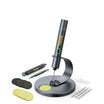
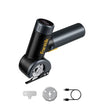

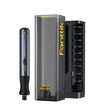

A motorcycle battery that sat all winter often reads under 8V at the terminals. Plug the Fanttik T8 APEX in, attach the clamps, and the unit refuses to boost — the auto-detect circuit will not arm below the safe-clamp threshold. This is a deliberate safety feature, and there is a documented manual override path that lets you boost a deeply discharged battery without disabling the unit's protections.
Symptom Quick Check
- Multimeter reads 6V to 7.5V on the motorcycle battery — too low for auto-detect, but recoverable with manual override.
- Multimeter reads under 4V — usually too low to recover; battery may need a benchtop trickle charger first.
- Multimeter reads above 8V — the auto-detect should arm; if it does not, check clamp polarity before assuming an override is needed.
- T8 APEX shows red blink with clamps on — polarity reversed or battery below auto threshold.
Most Common Cause
Lithium jump starters refuse to clamp on to a battery below a safe threshold (typically 8V) because the auto-detect circuit cannot distinguish a deeply discharged battery from a reversed connection or a short. The default behavior is to lock the boost output until the unit sees a clear voltage signature. Motorcycle batteries are small enough that a single bad winter drops them well below the threshold. Without a manual override, a perfectly recoverable motorcycle battery would be unjumpable with a lithium booster.
Step-by-Step Fix
- Verify clamp polarity first. Red to positive, black to a chassis ground or to the negative terminal on a sealed motorcycle battery. A reversed connection looks identical to a low-voltage lockout.
- With the clamps still attached, locate the manual override button on the T8 APEX. The exact button position is documented in the printed quick-start guide that ships with the unit; the Fanttik support page mirrors the spec.
- Hold the manual override button until the indicator changes color. The change confirms the override is armed.
- Attempt the boost within 30 seconds of arming. The override window times out to prevent accidental boosts to a shorted or reversed battery.
- If the motorcycle starts on the first attempt, run the engine for 15 minutes before disconnecting. The motorcycle's alternator needs time to bring the battery surface voltage back above 12V.
- If the first boost fails, wait 30 seconds, re-arm the override, and try once more. Three failed attempts in succession means the battery is too far gone for a lithium booster to recover.
When to Contact Support / Warranty
Open a warranty ticket only if:
- The manual override sequence does not change the indicator color even with the unit fully charged.
- The override arms, but no boost current is delivered to a known-good 12V load.
- The override times out faster than 10 seconds, which would indicate a circuit fault.
For batteries below 4V, no warranty action is needed on the T8 APEX — the battery itself is past the recovery threshold for any portable lithium booster. Contact Fanttik support only for the symptoms above.
Related Issues
- T8 APEX central support hub — clamp polarity, maintenance, and the full issue index.
- T8 APEX charger reads 18V — frequently asked alongside this question when owners are debugging a "won't jump" event.
FAQ
Q: Is manual override safe for a sealed AGM motorcycle battery?
A: Yes, with proper polarity. The override raises the auto-detect threshold but does not bypass the short-circuit protection.
Q: What is the lowest motorcycle battery voltage the T8 APEX can recover?
A: With manual override, roughly 4V on the battery terminals. Below that the cell chemistry is usually past recovery.
Q: Does manual override work for car batteries too?
A: Yes. The same circuit applies to any 12V lead-acid or AGM battery. Car batteries rarely drop below 8V before going flat, so the override is more often used on motorcycles and ATVs.
Q: Will the manual override damage the T8 APEX battery?
A: No. The boost cycle is still time-limited and current-limited internally. The override only bypasses the surface-voltage auto-detect, not the higher-level protections.

Leave a comment
This site is protected by hCaptcha and the hCaptcha Privacy Policy and Terms of Service apply.