


























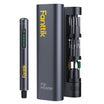
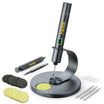



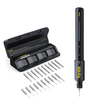

The Hidden Science of Tool Grip Degradation
Quick Action Summary: The "Clean-Dry-Store" Protocol
- Solution: 5–10% mild dish soap diluted in distilled water.
- Process: Spot test → Gentle wipe → Distilled water rinse → 48-hour air dry.
- Environment: Store in a cool, dry place (Relative Humidity < 50%).
- Safety First: Disconnect batteries before cleaning; never submerge the tool.
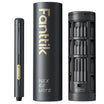
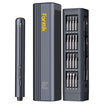
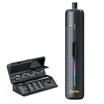
We have all experienced it: you reach for a precision screwdriver or a rotary tool after a few months of storage, only to find the handle feels unpleasantly tacky. This "sticky grip" phenomenon is often a symptom of chemical decomposition that, if left unaddressed, can lead to the gradual degradation of the tool's ergonomic housing. For the meticulous DIYer, understanding the interaction between environmental factors and synthetic polymers is a foundational step in preserving premium hardware.
Soft-touch grips are typically composed of Thermoplastic Elastomers (TPE) or specialized rubber blends. These materials are engineered for high friction and vibration dampening, but they are susceptible to a process known as plasticizer migration. Plasticizers are chemical additives that keep the material flexible. Over time, exposure to UV light, fluctuating temperatures, and human sweat or skin oils can cause these molecules to migrate to the surface. Once there, they may react with atmospheric moisture, creating the gummy residue often associated with seasonal decay.
Based on common patterns observed in our internal customer support and repair logs, synthetic grips require a different maintenance cadence than traditional wooden handles. While wood primarily reacts to humidity-driven swelling, synthetic polymers are sensitive to chemical "scars." Post-use cleaning is a helpful intervention to remove acidic residues before they can initiate the migration cycle.
Identifying "Grip Killers": Common Cleaning Mistakes
A frequent pattern we observe on the repair bench is the use of aggressive solvents to "degrease" a sticky handle. While it may seem logical to use a strong cleaner, certain chemicals can act as catalysts for material breakdown.
- High-Concentration Isopropyl Alcohol (IPA): Based on our workshop observations, using IPA above 70% concentration can aggressively strip the plasticizers that provide the grip's structural integrity. This often leaves the surface feeling "chalky" or may lead to micro-cracking over time.
- Acetone and Paint Thinners: These are significant "grip killers." Acetone can partially dissolve many TPE blends, potentially leading to permanent deformation or loss of texture.
- Powder Misuse: While some suggest cornstarch to absorb tackiness, it can foster microbial growth (mold) in high-humidity environments. Talcum powder is a common alternative, but it must be used sparingly in well-ventilated areas to avoid inhalation risks; many modern practitioners now prefer magnesium carbonate (climbing chalk) for short-term fixes.
Instead, we advocate for a methodical approach focused on gentle emulsification. A dilution of 5% to 10% mild dish soap in distilled water is generally an effective solution. Distilled water is preferred over tap water to help prevent the deposition of mineral salts (calcification) in the micro-textures of the grip. As noted in general maintenance guides on managing micro-scratches in hardware, maintaining surface smoothness is essential for preventing the embedding of oils.

The Deep Cleaning Protocol: A Step-by-Step Guide
To help prevent seasonal decay, we recommend a deep cleaning session at the end of every heavy-use season.
- Isolation and Pre-Test: If the tool has a removable battery, disconnect it. We strongly recommend testing your cleaning solution on a small, inconspicuous area first. Wait several hours to ensure no swelling or discoloration occurs.
- Surface Decontamination: Use a lint-free microfiber cloth dampened (not dripping) with the 5–10% soap solution. Wipe the grip in circular motions. For textured areas, a soft-bristled toothbrush can help lift oils from the valleys of the grip pattern.
- The Distilled Rinse: Wipe the grip again with a cloth dampened only with distilled water. Residual surfactants can, in some cases, attract more dust during storage.
-
The 48-Hour Air-Dry: This is a critical heuristic based on internal testing. Even if the surface feels dry, moisture can remain trapped in microscopic pores.
- Rule of Thumb: We suggest a 48-hour drying period in a room with Relative Humidity (RH) < 50%.
- Boundary: If your workshop is damp (RH > 60%), this period may need to be extended to 72 hours, or supplemented with a dehumidifier.
Advanced Moisture Management: Modeling Accelerated Drying
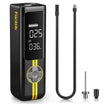
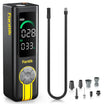
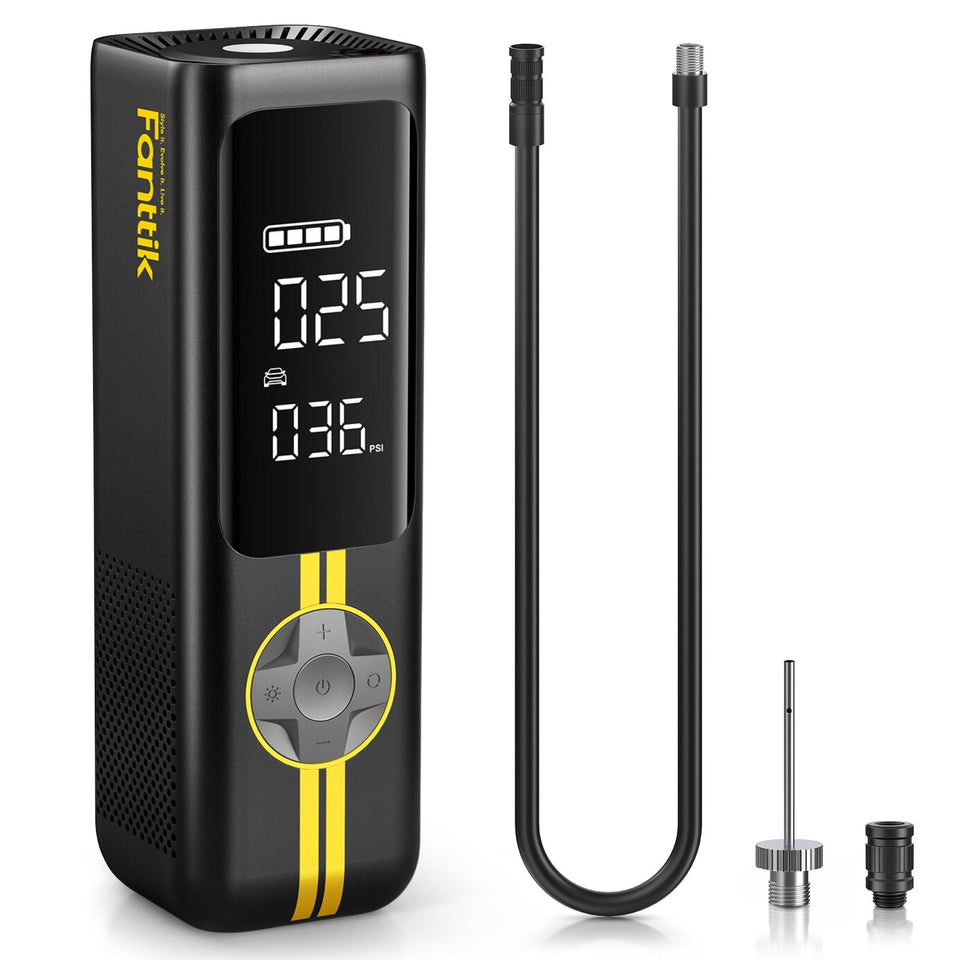
For the DIYer with a large inventory, waiting 48 hours per tool can be inefficient. We have modeled a scenario where compressed air—specifically from a portable inflator—is used to accelerate evaporation.
Theoretical Model: Thermal Drying Efficiency
The values below are illustrative heuristics intended for conceptual guidance. These are theoretical estimates based on internal modeling and the ideal gas law. They represent the temperature at the nozzle outlet, not the surface temperature of the tool.
| Parameter | Estimated Value | Unit | Rationale/Assumption |
|---|---|---|---|
| Ambient Temperature ($T_1$) | 20 | °C | Standard workshop start point |
| Exit Air Temp (Source) | ~144* | °C | Calculated via $T_2 = T_1 \times (P_2/P_1)^{(\gamma-1)/\gamma}$ |
| Air Flow Capacity | 32 | L/min | Typical high-performance portable inflator |
| Estimated Drying Time | 8–10 | min | Internal heuristic based on thermal transfer |
| Safety Distance | 8–12 | in | Required for air to cool before impact |
*Calculation Note: Based on a pressure ratio ($P_2/P_1$) of 3.45 and an adiabatic index ($\gamma$) of 1.4. This is a source temperature; the air cools rapidly as it expands and travels toward the tool. Actual temperatures at the tool surface will be significantly lower if the safety distance is maintained.
Safe Compressed Air Practices
When using compressed air for drying, follow these preventive measures to avoid equipment damage:
- Clear the Area: Briefly pulse the air away from the tool first to clear any internal dust or moisture from the nozzle.
- Avoid Internal Forcing: Do not aim the airflow directly into motor vents or seams; this can force moisture or debris into the tool's internal electronics.
- Personal Protection: Wear safety goggles and a dust mask to protect against airborne particles dislodged from the grip textures.
- Constant Motion: Keep the air source moving to avoid localized heat buildup.
Substrate Sensitivity Check
Before using accelerated drying, identify if your tool uses high-risk materials:
| Material/Feature | Risk Level | Identification |
|---|---|---|
| Thin Silicone Skins | High | Translucent or very "squishy" surfaces; prone to warping. |
| Low-Melt Adhesives | High | Visible glue seepage at seams; common in budget tools. |
| Standard TPE/Rubber | Moderate | Firm, opaque, molded directly to the plastic housing. |
Safety Instruction: If you suspect low-melt adhesives or thin skins, increase the safety distance to 15+ inches or use a "cool-only" setting. We recommend using an infrared (IR) thermometer to ensure the tool surface never exceeds 40°C (104°F) during the process.
Long-Term Preservation and Seasonal Storage
Once cleaned and dried, storage conditions determine longevity. According to general safety principles outlined in the EU General Product Safety Regulation (EU) 2023/988, maintaining product integrity is a key aspect of long-term safety.
Humidity Control
Avoid storage in unconditioned garages where condensation can occur. We recommend using airtight bins with silica gel desiccant packs to maintain a relative humidity (RH) below 40%. This environment can significantly slow the plasticizer migration process.
Surface Modification
For grips that have begun to feel slightly tacky but are structurally sound, a light dusting of magnesium carbonate can provide a temporary dry feel. However, we view this as a "near end-of-life" indicator. While industrial coatings like PECVD can reduce migration, they are generally not accessible for home use.
For most DIYers, the most effective strategy is a combination of immediate post-use wipes and a rigorous seasonal deep clean. As noted in The 2026 Modern Essential Gear Industry Report (an internal industry review), "reliability is a function of systematic maintenance." By treating your gear with precision, you help ensure it remains a reliable extension of your hands.
Safety and Compliance Considerations
- Battery Safety: If your tool uses Lithium-ion batteries, refer to the IATA Lithium Battery Guidance for handling. Never submerge or expose battery terminals to liquids.
- Standards Compliance: Our care recommendations are aligned with general ergonomic principles and ISO Standards for material durability (referencing standard testing catalogues).
Disclaimer: This article is for informational purposes and does not constitute professional engineering advice. Always refer to your specific tool's manufacturer manual. The use of compressed air for drying should be performed with caution to avoid heat damage or injecting debris into tool vents.
Sources
Continue reading
 Intelligent Navigation: How Robotic Cleaners Map Pool Floors
Covers sensor suites (sonar, IMUs), the 4-5 cycle maintenance rule, and ROI analysis for modern robotic pool cleaners.
Intelligent Navigation: How Robotic Cleaners Map Pool Floors
Covers sensor suites (sonar, IMUs), the 4-5 cycle maintenance rule, and ROI analysis for modern robotic pool cleaners.
 Spring Revival: Clearing Winter Dust from Tool Air Vents
Learn the Precision Cleaning Protocol, 60% Heuristic, and Paper Test to maintain tool longevity and prevent motor strain.
Spring Revival: Clearing Winter Dust from Tool Air Vents
Learn the Precision Cleaning Protocol, 60% Heuristic, and Paper Test to maintain tool longevity and prevent motor strain.
Leave a comment
This site is protected by hCaptcha and the hCaptcha Privacy Policy and Terms of Service apply.