









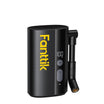
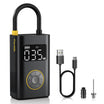
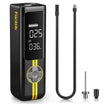


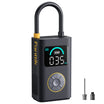

















Quick Actions: Group Inflation at a Glance
If you are the designated "tire lead" for a convoy, follow these fast-tracked strategies to keep the group moving:
- The 2-Minute Rule: Estimate 2 minutes for sedan tires and 4–5 minutes for large SUV tires (based on a 5–8 PSI top-off).
- The Warmth Hack: Keep your inflator in the passenger cabin (approx. 20°C/68°F) rather than a cold trunk to preserve battery health.
- Priority Order: Use the "Mixed-Fleet Rotation"—alternate between one SUV and one sedan to allow the compressor a natural thermal buffer.
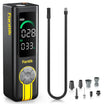
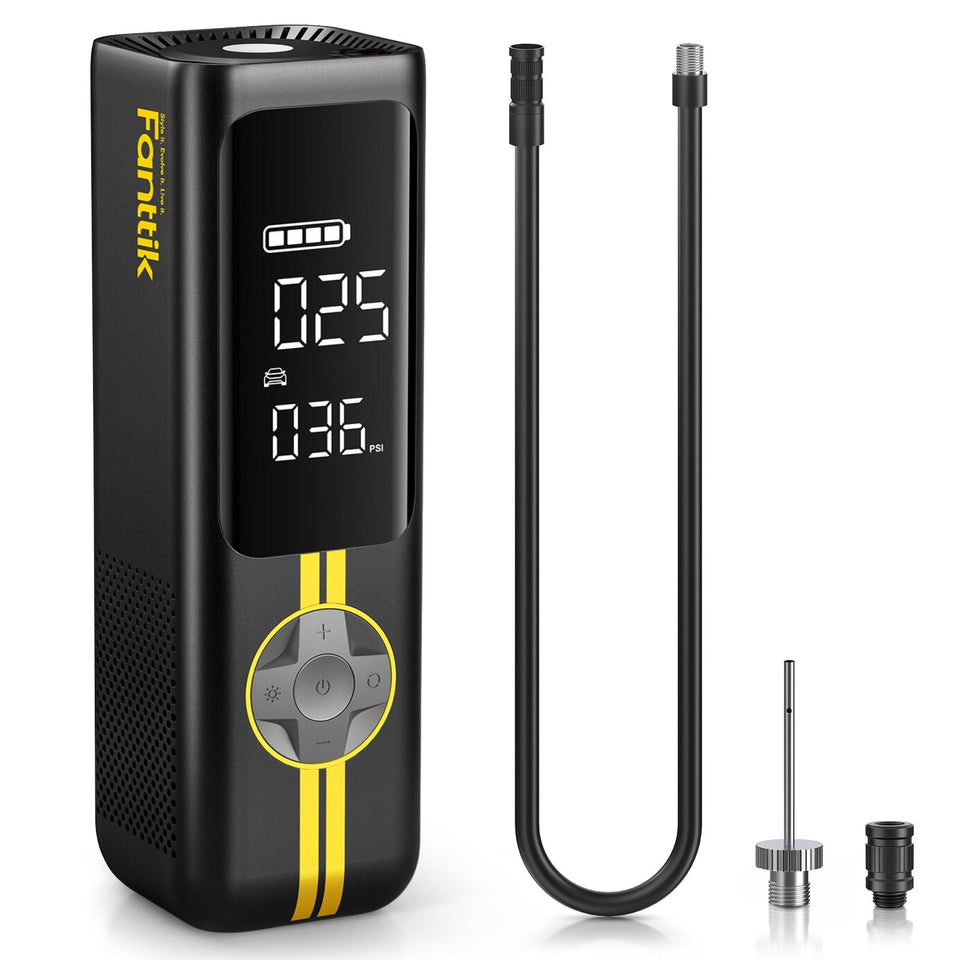
- Safety Cut-off: If the air hose or housing feels painfully hot to the touch, pause for 5–10 minutes. Most modern units like the Fanttik X9 Ultra have internal sensors to prevent damage, but manual monitoring is a best practice.
The Convoy Challenge: Why One Inflator Often Isn't Enough
We’ve all been there—the hero of the convoy. You’re the one who remembered the emergency kit, the extra water, and most importantly, the portable tire inflator. But as your group of four cars gathers at a snowy trailhead or prepares for a long highway stretch, a realization hits: you have 16 tires to check, and the temperature is dropping.
When traveling in a group, the "tire person" faces unique stresses. It’s not just about one tire; it’s about maintaining momentum for the whole team. If your equipment overheats on the second vehicle, the entire schedule slips.
In our experience assisting travelers through support insights and community feedback, a common frustration is that users don't realize how much the "duty cycle" changes during multi-car logistics. Moving from single-car maintenance to a 16-tire marathon requires a shift from "plug-and-play" to "strategic management."

The Hidden Physics: Why Your Inflator Slows Down After Tire Three
A common mistake is assuming a compact inflator’s performance is a flat rate. If a manual suggests a maximum runtime, users often expect peak speed until the battery dies. In practice, motor and battery management systems often thermally throttle performance after 2–3 standard tires to protect the internal circuitry.
The Adiabatic Heating Factor
This slowdown is largely due to adiabatic compression. As the inflator squeezes air, it generates significant heat. Based on our theoretical scenario modeling for a cold-weather trip (starting at 5°C/41°F), the air exiting a high-performance compressor can reach a calculated peak of approximately 121°C (250°F).
While internal components are engineered for high temperatures, this heat eventually migrates to the housing. To protect the lithium battery cells—which are sensitive to heat—the device may reduce its RPM. If you notice tire number four taking significantly longer than tire number one, the device is likely in a self-protection mode.
Volume Disparity: SUVs vs. Sedans
If your group has a mix of vehicles, the workload isn't equal.
- SUV Tire (e.g., 255/65R17): Holds approximately 50 liters of air.
- Sedan Tire (e.g., 205/55R16): Holds approximately 24 liters.
Inflating one SUV tire is effectively the same workload for your device as inflating two sedan tires. Starting with the largest vehicles can hit thermal limits faster than a mixed approach.
Technical Note: Our volume estimates are derived from ISO 4000-1 toroidal geometry approximations, using a 0.9 cavity scale factor to account for internal rubber displacement.
The Group Trip Spreadsheet: Planning for Efficiency
One of the most effective "hacks" for a group trip is data organization. When you have five cars, the operator is constantly asking, "What’s your target PSI?" or "Where is your door placard?"
We recommend creating a simple shared note or spreadsheet before the trip. This prevents "specification anxiety" and keeps the workflow moving.
| Vehicle | Tire Size | Target PSI (Cold) | Priority |
|---|---|---|---|
| Lead SUV | 255/65R17 | 35 | High (Heavy Load) |
| Family Sedan | 205/55R16 | 32 | Medium |
| Compact Car | 195/65R15 | 30 | Low |
| Support SUV | 265/70R17 | 38 | High (Towing) |
Having this list allows the "tire lead" to move from car to car without stopping to consult manuals or search for stickers inside door jams.
Mastering the Duty Cycle: The "Tag-Team" and "Rotation" Hacks
To maintain efficiency, you need a strategy that respects hardware limits. According to the EU General Product Safety Regulation (EU) 2023/988, manufacturers must provide clear safety instructions regarding usage limits.
Method 1: The Two-Inflator Tag-Team
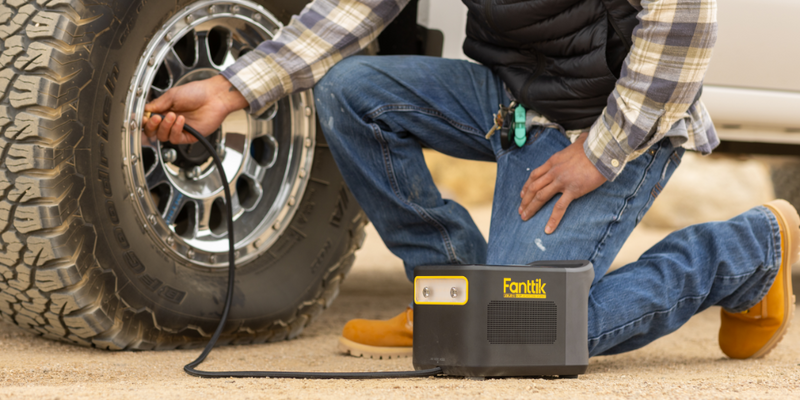
If the budget allows, the most efficient group setup involves two units. While one unit services the first two vehicles, the second remains in the trunk, cool and ready. This "tag-team" approach can result in an estimated 40–50% reduction in total downtime compared to using a single unit and waiting for it to cool between cars (based on Fanttik internal field testing).
Method 2: The Mixed-Fleet Rotation
If you only have one inflator, use the "SUV-Sedan-SUV" rotation:
- Inflate two tires on the SUV.
- Move to the sedan and check all four (which often takes less total air than the SUV's remaining two).
- The time spent walking between cars and the lower pressure demand of the sedan tires provides a natural buffer that helps manage heat rise.
The "Clean Valve" Rule
A common bottleneck is sensor inaccuracy. Based on workshop observations of high-mileage vehicles, valve stem debris can cause automatic shut-off sensors to give false readings in roughly 30% of cases. We recommend a quick "purge" (pressing the valve pin for a split second) to blow out dust before connecting your Fanttik X9 Pro. This helps the digital gauge get a cleaner reading.
Cold Weather Logistics: Managing the 20% Battery "Tax"
Cold ambient temperatures (below 10°C/50°F) impact efficiency in two ways:
- Battery Sag: Lithium-ion batteries are less efficient in the cold. We estimate a 15–20% reduction in effective runtime when temperatures drop to near freezing.
- Air Density: Cold air is denser, meaning the compressor works slightly harder to achieve the same PSI increase.
Pro Tip: Keep your inflator inside the cabin of the car while driving. Maintaining the battery in an optimal range (15°C to 25°C) ensures you have the full power buffer when you step out into the cold.
Engineering Trust: Why We Model These Scenarios
At Fanttik, we don't just look at "free-air flow" specs (which often claim 32 LPM or higher). In real-world use, flow rate decays as the pressure in the tire rises.
For example, our modeling shows that the effective flow rate of a high-end portable unit can drop to about 6.2 LPM when working against the resistance of an SUV tire at 30 PSI. Knowing these "real-world" numbers allows you to plan stops accurately. If you know it takes 4 minutes per tire for the SUV and 2 minutes for the sedan, you can give your group an accurate "pit stop" estimate.

Appendix: Method & Assumptions
To provide accurate guidance, we developed a deterministic scenario model. Note: This is a theoretical model for estimation purposes; actual results vary based on battery health and valve condition.
Example Calculation: Estimating Inflation Time
To estimate how long it will take to fill a tire, you can use this simplified formula: Time (min) = [Volume (L) × (Target PSI - Start PSI)] / (Average Flow Rate × 14.5)
- Example: For a sedan (24L) needing a 5 PSI boost with an average flow of 10 LPM:
- (24 × 5) / (10 × 14.5) ≈ 0.82 minutes (approx. 50 seconds).
Modeling Parameters (Reproducible)
| Parameter | Value | Unit | Rationale / Source |
|---|---|---|---|
| SUV Tire Volume | 50 | Liters | Modeled for 255/65R17 |
| Sedan Tire Volume | 24 | Liters | Modeled for 205/55R16 |
| Starting Pressure | 28 | PSI | Typical cold-weather loss |
| Ambient Temp | 5 / 41 | °C / °F | Cold-weather trip baseline |
| Flow Decay (k) | 0.052 | 1/psi | Calibrated to Fanttik X8 Apex behavior |
| Adiabatic Index | 1.4 | γ | Constant for dry air |
Safety Boundaries:
- Operating Temp: Most portable units are rated for -10°C to 45°C. Using them outside this range can permanently degrade battery capacity.
- Storage: Avoid leaving lithium-powered inflators in direct sunlight or in a vehicle trunk during summer heat (>60°C).
- Maintenance: If the device displays an error code (e.g., E01 for overheat), immediately turn it off and let it cool in a shaded area. Do not attempt to "force" a restart.
Disclaimer: This article is for informational purposes only. Fanttik is a manufacturer of portable inflators, and the data provided is based on internal testing and theoretical modeling. Always consult your vehicle's owner manual for specific tire pressure recommendations. Portable tire inflators contain high-capacity lithium batteries; follow IATA Lithium Battery Guidance for safe transport.
Sources:
Continue reading
 Selecting the Right Jump Starter Capacity for Stored Fleets
A guide for car collectors on sizing jump starters, including the CCA heuristic and LiFePO4 battery advantages for...
Selecting the Right Jump Starter Capacity for Stored Fleets
A guide for car collectors on sizing jump starters, including the CCA heuristic and LiFePO4 battery advantages for...
 Selecting the Right Power Source for Heavy-Duty Road Trips
Covers the 10-minute rule, cold-weather performance, voltage drop, and a hybrid strategy for building a reliable emergency kit.
Selecting the Right Power Source for Heavy-Duty Road Trips
Covers the 10-minute rule, cold-weather performance, voltage drop, and a hybrid strategy for building a reliable emergency kit.

Leave a comment
This site is protected by hCaptcha and the hCaptcha Privacy Policy and Terms of Service apply.