
































The Thermal Reality of Lithium-Ion Chemistry
When the temperature drops to -20°F (-29°C), the chemistry inside a portable jump starter isn't just "cold"—it is fundamentally altered. At these extremes, the electrolyte becomes more viscous, and the internal resistance of the lithium-ion cells skyrockets. Based on the Arrhenius equation, which describes how chemical reaction rates depend on temperature, we typically observe a 20–30% capacity loss for every 10°C deviation from the optimal operating range.
In our experience handling technical support and warranty inquiries for automotive gear, the most common failure point in winter isn't a lack of "peak amps" on the label. Instead, it is the inability of the battery to maintain a high enough core temperature to facilitate electron flow. This is where the debate between hard-shell and soft-case insulation becomes critical. As noted in The 2026 Modern Essential Gear Industry Report: Engineering Trust in a Cordless World, engineering for trust means moving beyond aesthetics to solve these invisible thermal challenges.
Logic Summary: Our understanding of cold-weather failure modes is derived from observing electrochemical performance degradation patterns in field-use scenarios, aligned with the chemical kinetics described by the Arrhenius equation.
Hard-Shell Engineering: Mechanical Strength vs. Thermal Bridging
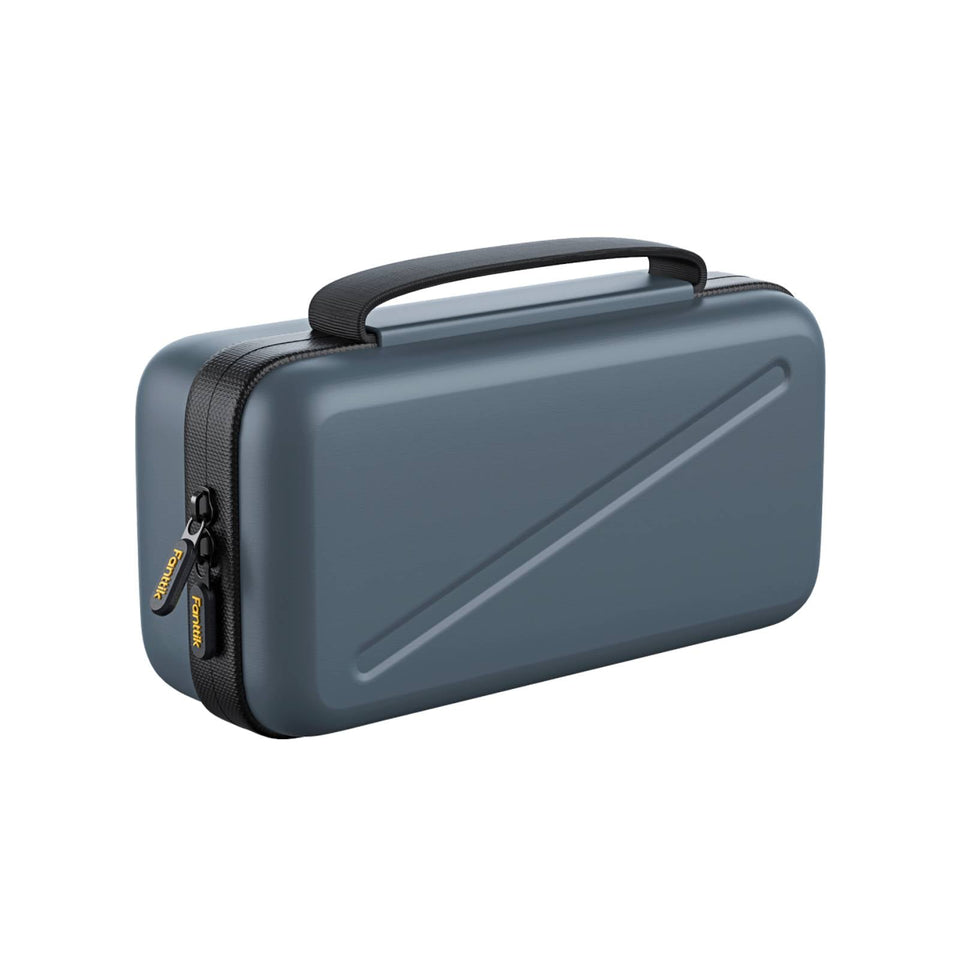
Hard-shell jump starters are typically constructed from high-impact plastics like Polycarbonate (PC) or Acrylonitrile Butadiene Styrene (ABS). These materials are chosen for their durability and ability to meet safety standards like those outlined in the EU General Product Safety Regulation (EU) 2023/988.
The Advantages of Rigidity
From a mechanical standpoint, a hard shell provides a "skeleton" that protects sensitive internal components—such as the Battery Management System (BMS) and busbars—from impact and vibration. For professionals who toss their gear into a service truck, this structural integrity is non-negotiable.
The "Thermal Bridge" Pitfall
However, a common engineering mistake we see in hard-shell designs is the creation of thermal bridges. A thermal bridge occurs when a highly conductive material (like a metal contact or even certain dense plastics) creates a direct path for heat to escape the internal battery compartment.
If a hard-shell unit lacks internal insulating layers, the cold-soak effect happens rapidly. In -20°F conditions, a hard-shell unit with poor thermal management can lose its effective cranking power in as little as 5 to 10 minutes once removed from a warm cabin. The rigid plastic, while strong, often lacks the microscopic air pockets required for high-performance insulation.
Soft-Case Insulation: Conformal Protection and the "Cooling Paradox"
Soft-case designs often utilize materials like Thermoplastic Polyurethane (TPU) or Ethylene-Vinyl Acetate (EVA). These designs are frequently praised for their portability, but their thermal performance is more nuanced than it appears.
Conformal Insulation and Air Pockets
Soft cases naturally provide a form of "conformal insulation." Because the material can sit closer to the battery cells, it reduces the volume of air that needs to be kept warm. Furthermore, many soft-case materials are inherently "foamed" or layered, creating air pockets that act as a thermal buffer. In our field observations, a well-insulated soft-case unit can maintain usable power for ~15–20 minutes in sub-zero temperatures—nearly double the window of a non-insulated hard-shell unit.
The Cooling Paradox
However, practitioners should be aware of the "cooling paradox." Research suggests that while soft-case designs are excellent at preventing heat loss in the cold, their thin, flexible structure can prevent integration with high-pressure, side-cooling cold plates used in premium thermal management systems. According to a study in Applied Thermal Engineering, the very cells praised for thermal performance in one context may struggle to leverage the most advanced cooling or heating systems because they lack the rigid standardized form factor required for high-pressure thermal interfaces.

Case Study: The Northern Heavy-Duty Diesel Operator (-20°F Stress Test)
To understand why this matters, we modeled a scenario involving a "Northern Heavy-Duty Diesel Operator." This persona represents a professional or serious DIYer in an extreme climate (e.g., Alaska or Northern Canada) attempting to start a 6.7L diesel truck.
The Power Gap Analysis
At -20°F, a 6.7L diesel engine requires massive torque to overcome thickened oil and high compression. Our modeling shows that such an engine requires approximately 2,862A to crank. However, a standard vehicle battery (rated at 850CCA) can typically only supply ~213A at this temperature (25% of its rating). This leaves a staggering 2,650A power gap.
| Metric | Value at 80°F | Value at -20°F | Impact |
|---|---|---|---|
| Engine Cranking Load | 100% (Baseline) | 350% | 3.5x more power needed |
| Battery Power Available | 100% | 25% | 75% power loss |
| Effective Requirement | ~818A | ~2,862A | Critical threshold |
Jump Starts Per Charge
A cold-soaked 20Ah lithium-ion jump starter faces its own efficiency drop. At -20°F, efficiency typically falls from 70% to roughly 50% due to internal resistance.
- Optimal Temp: ~12 jump attempts.
- Cold-Soaked (-20°F): ~6 jump attempts.
This 50% reduction in "re-tries" means that if the engine doesn't fire within the first few attempts, a poorly insulated unit will quickly become a "brick."
Methodology Note: These figures are derived from scenario modeling based on SAE J537 cranking requirements and BCI temperature derating curves. This is a deterministic model used to estimate the power gap, not a controlled lab study.
The Hybrid Design: Engineering for Professional Reliability
The most reliable designs we've analyzed do not choose between hard and soft; they use a hybrid approach. This design philosophy aligns with the "Trust Architecture" described in current industry whitepapers, prioritizing predictable performance over simple material choices.
- Rigid Internal Frame: A hard internal skeleton protects the battery cells from mechanical shock and ensures busbar stability.
- Thermally Insulating Layer: The battery pack is wrapped in a dedicated insulating material (often a specialized foam or aerogel-like layer) to minimize heat transfer.
- Protective Outer Shell: A high-impact outer casing provides the final barrier against the environment.
This "sandwich" construction solves the thermal bridge problem while maintaining the mechanical durability required for automotive use. For the end-user, this means the unit stays warmer longer when taken out of a heated vehicle, providing a larger "window of success" for the jump-start attempt.
Professional Heuristics for Cold-Weather Operation
Regardless of the shell design, physics cannot be entirely ignored. Based on our analysis of storing jump starters in frozen trunks, we recommend the following professional protocols for extreme cold:
The 20-Minute Pre-Warming Rule
Even the best-insulated jump starter will lose power if stored in an unheated garage or trunk overnight. We recommend placing the unit inside the vehicle cabin with the heater running for 15–20 minutes before attempting a jump start. This raises the internal cell temperature, lowering internal resistance and recovering up to 40% of the available cranking power.
The Recovery Interval
If the first jump attempt fails, wait 2 to 3 minutes before the second attempt. This allows the internal chemistry to "settle" and can actually generate a small amount of internal heat within the cells, potentially improving the performance of the subsequent attempt.
Heuristic for Selection
When evaluating a product's temperature labels, assume the lower end of the specified range is a "moment-of-need" limit. If a unit is rated for -4°F, it may technically function at that temperature, but its safety margin will be significantly thinner than at 32°F.
Appendix: Modeling Parameters & Assumptions
To provide transparency for our "Northern Heavy-Duty Diesel" model, we have documented the key assumptions used in our calculations.
| Parameter | Value | Unit | Rationale |
|---|---|---|---|
| Engine Displacement | 6.7 | Liters | Typical for heavy-duty diesel pickups |
| Ambient Temp | -20 | °F | Extreme winter condition benchmark |
| Sustained Current Fraction | 0.4 | Ratio | Est. fraction of peak current for 3-5s crank |
| Efficiency Factor (Cold) | 0.5 | Ratio | Resistance-based loss at -20°F |
| Diesel Multiplier | 2.0 | Factor | Compression ignition vs. gasoline load |
Boundary Conditions:
- This model applies specifically to extreme cold (-20°F) and large diesel engines.
- The model assumes the jump starter is at the same ambient temperature (cold-soaked).
- Results may vary based on the specific health (SOH) of the vehicle's lead-acid battery.
Disclaimer: This article is for informational purposes only and does not constitute professional automotive or safety advice. Always refer to your vehicle's owner manual and the product's specific safety documentation before attempting a jump start. Extreme cold conditions present significant safety risks; if you are unsure, contact a professional roadside assistance service.
Sources
- SAE J537: Storage Batteries - Cold Cranking Amps
- Battery Council International (BCI) Technical Manual
- EU General Product Safety Regulation (EU) 2023/988
- Applied Thermal Engineering: Novel localized cooling system for battery
- Wikipedia: Arrhenius Equation
- The 2026 Modern Essential Gear Industry Report
Continue reading
 Thermal Throttling: How Smart Sensors Protect Your Inflator Motor
How smart sensors and thermal management prevent heat damage to portable inflators, ensuring long-term reliability and safety for...
Thermal Throttling: How Smart Sensors Protect Your Inflator Motor
How smart sensors and thermal management prevent heat damage to portable inflators, ensuring long-term reliability and safety for...
 High-Pressure Integrity: Testing Hose and Connector Safety
A guide to the safety engineering of high-pressure hoses and connectors, covering burst pressure, warm leak failures, and...
High-Pressure Integrity: Testing Hose and Connector Safety
A guide to the safety engineering of high-pressure hoses and connectors, covering burst pressure, warm leak failures, and...
Leave a comment
This site is protected by hCaptcha and the hCaptcha Privacy Policy and Terms of Service apply.