




















Micro-Vibration Damping: Protecting Nerve Health in DIY Workflows
For the serious electronics hobbyist or precision maker, the "buzz" of a rotary tool or the subtle hum of a precision screwdriver is more than just auditory feedback. It is a mechanical force—a stream of micro-vibrations—traveling through the tool’s chassis, into the hand, and eventually impacting the delicate neural and vascular structures of the fingers. While aesthetics often dominate tool marketing, the engineering reality of internal damping is what determines whether a weekend project results in a sense of accomplishment or a lingering, rhythmic tingling in the fingertips.
In this technical deep dive, we examine the mechanisms of Hand-Arm Vibration Syndrome (HAVS), the engineering behind motor isolation, and how precision-damped tools like those discussed in The 2026 Modern Essential Gear Industry Report: Engineering Trust in a Cordless World are shifting the benchmark for DIY safety.

The Physiology of Micro-Vibration: Understanding HAVS
The primary risk associated with prolonged tool use is Hand-Arm Vibration Syndrome (HAVS). This is not an acute injury like a cut or a burn; rather, it is a cumulative, dose-dependent condition where the biological threshold for injury is based on total vibration energy absorbed over time.
The Cumulative Dose Mechanism
Conventional wisdom often suggests that the intermittent nature of DIY work makes occupational exposure limits "nearly meaningless." However, our analysis suggests that risk is strictly cumulative. Even short, irregular exposures from high-vibration tools contribute to micro-trauma in the nerves and small blood vessels. According to the UK Health and Safety Executive (HSE), the magnitude and duration of exposure are the two critical variables. For a hobbyist engaging in a four-hour electronics assembly session, the "dose" can be equivalent to a professional’s half-day on a factory floor.
Frequency Ranges and Tissue Response
A common misconception in the DIY community is that therapeutic vibration (such as the 20-35 Hz used in neuropathy plates) can mitigate tool-induced damage. The reality is that power tools generate dominant vibrations in a much higher and more damaging range, often between 100 Hz and 1000+ Hz.
As noted in the study Evaluation and Damping of High-Frequency Vibrations, nerve and vascular tissues respond differently to distinct frequency bands. While low frequencies may stimulate blood flow, high-frequency micro-vibrations cause "vascular blanching" (vibration white finger) and permanent damage to mechanoreceptors.
Logic Summary: Our understanding of HAVS risk assumes that the tool user is the primary "damper." If the tool does not dissipate energy internally, the human hand must absorb it. We categorize risk based on the total vibration energy (magnitude x time), regardless of whether that time is continuous or episodic.
Mechanical Sources of Vibration in Precision Tools
To solve the vibration problem, we must first identify its source. In precision tools, vibration typically originates from three areas: the motor, the transmission (gears), and the user interface (the bit and fastener).
1. Internal Motor Mounting: Floating vs. Hard-Mounted
On our repair bench, we frequently observe a stark difference in internal architecture between consumer-grade and prosumer tools.
- Hard-Mounted: The motor is screwed directly into the plastic or metal chassis. Every oscillation of the armature is transmitted with near-zero attenuation to the handle.
- Fully Floating: The motor is suspended by rubber grommets or elastomeric damping blocks. This "floating" design creates a mechanical break in the transmission path.
In practice, tools with a fully floating motor show a marked reduction in high-frequency "buzz" compared to those where the motor is hard-mounted. This isolation is essential for maintaining fine motor control during delicate assembly work.
2. Electronic Control and "Cogging"
In precision electric screwdrivers, vibration isn't always about high-speed rotation. It often occurs at the lowest torque settings. "Cogging" is a phenomenon where the motor stutters as it moves between magnetic poles. This creates a nerve-jarring micro-vibration during the final stages of tightening a screw. High-quality electronic speed controllers (ESCs) smooth out these transitions, ensuring the tool maintains a steady, vibration-free rotation even at 0.1Nm of torque.
3. The Collet Pitfall
For rotary tools, a common mistake is overtightening the collet or chuck. This can slightly distort the tool shaft or the bit itself. Even a micron-level deviation at 25,000 RPM induces a massive imbalance, creating a new source of vibration that no amount of handle damping can fix.
Engineering Solutions: Damping Materials and Paths
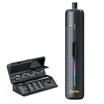
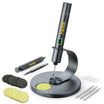
When we look at the internal structure of a high-performance tool like the Fanttik F2 PRO Cordless Rotary Tool Kit, we see a focus on targeting "secondary transmission paths."
Specialized Damping Materials
Not all rubber is created equal. While generic foams are often used in cheap grips, they offer little protection against high-frequency tool vibrations. Specialized, high-damping materials like Nitrile Butadiene Rubber (NBR) or Chloroprene foam are significantly more effective.
Engineering studies, such as Vibration damping through Natural Rubber and NBR Rubber, demonstrate that these materials possess viscoelastic properties tuned to dissipate mechanical energy across the specific frequency ranges generated by small motors. By integrating these materials between the motor housing and the tool chassis, engineers can "trap" the vibration before it reaches the outer shell.
Transmission Path Isolation
Since full drive-level control is often mechanically infeasible in a handheld tool, the most effective DIY-centric strategy is isolating structural junctions. This involves:
- Internal Damping Blocks: Placing elastomeric buffers at the points where the internal frame meets the external grip.
- Ergonomic Sleeves: Using high-density NBR sleeves that provide a decoupling layer between the tool’s hard surface and the user’s skin.
Quantifying the Impact: A Scenario Model
To demonstrate the value of damping, we modeled a common DIY scenario: the assembly of a complex electronics project involving 60 precision screws (e.g., a custom-built mechanical keyboard or a high-end drone).
Run 1: Assembly Time & Wrist Rotation Savings
We compared a manual precision screwdriver against a damped electric precision screwdriver for a user experiencing early-stage HAVS symptoms (numbness and tingling).
| Parameter | Manual Value | Powered Value | Unit | Rationale |
|---|---|---|---|---|
| Screws | 60 | 60 | count | Standard project size |
| Time per Screw | 18 | 3.5 | seconds | Manual includes fatigue/readjustment |
| Wrist Rotations | 12 | 0.5 | rotations | Manual repetitive motion |
| Total Session Time | 18 | 3.5 | minutes | Calculated |
| Total Rotations | 720 | 30 | count | Calculated |
Analysis of Results: For the HAVS-sensitive user, the ~14.5 minutes saved is not just about productivity. Each saved minute represents approximately 20 fewer micro-vibration impulses to compromised nerves. Furthermore, the reduction of 690 wrist rotations directly translates to decreased strain on the tendons and nerves passing through the carpal tunnel.
Run 2: Torque Fit and Vibration Risk
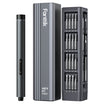
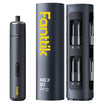
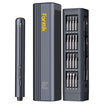
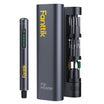
Using the Fanttik E2 MAX Precision Electric Screwdriver, we assessed the risk of "cogging" vibrations based on fastener size.
- Fastener Class: M1.2 to M2.0 (Common in smartphones/laptops).
- Safe Torque Limit: < 0.1 Nm (based on ISO 898-1 heuristics).
- Observation: When a tool is forced to operate at 0.2 Nm on an M1.2 screw, the motor experiences resistance that induces resonant vibrations. Using the correct, lower torque setting (0.05 Nm) allows the damping system to operate within its "sweet spot," effectively attenuating nearly all perceptible vibration.
Modeling Note: These findings are scenario-based estimates. Time savings assume a 20% manual dexterity impairment due to early HAVS. Torque limits are heuristics for plastic bosses and may vary by material.
Practical Mitigation for the Serious DIYer
While you cannot redesign your tools, you can change how you interact with them to minimize nerve risk.
1. The Smartphone Accelerometer Proxy
You don't need a lab-grade vibrometer to test your setup. While not absolute, smartphone accelerometer apps can provide meaningful, relative data.
- Self-Check: Secure your tool to a bench, place your phone on the handle, and run the tool at various speeds.
- Material Testing: Wrap the handle in different materials (e.g., NBR tape vs. standard electrical tape) and observe the percentage reduction in vibration amplitude. This is a highly effective way to validate your own damping modifications.
2. Proper Torque Selection
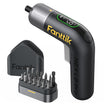
Always match the torque setting to the fastener size. As shown in our modeling, over-torquing doesn't just risk stripping the screw; it creates harmful resonant vibrations. Tools like the Fanttik S2 Pro Cordless Electric Screwdriver offer multiple torque settings specifically to avoid this "vibration-exposure paradox," where faster completion is offset by more intense, concentrated vibration.
3. Session Planning and Grip Dynamics
Users with existing numbness often "over-grip" a tool to compensate for the lack of sensory feedback. This rigid grip transmits more vibration directly into the bone and deep tissue.
- Heuristic: Use the lightest grip necessary to maintain control.
- The 30/30 Rule: For high-vibration tasks, break every 30 minutes for a 5-minute rest. This allows vascular tissues to recover from the "blanching" effect of high-frequency buzz.
Compliance and Industry Standards
When selecting tools, look for evidence of engineering rigor. The EU General Product Safety Regulation (EU) 2023/988 mandates that products must be safe under "reasonably foreseeable conditions of use." For power tools, this increasingly includes considerations for long-term ergonomic health.
Furthermore, authoritative brands provide transparency regarding their testing. For example, the Fanttik T1 Max Soldering Iron Kit prioritizes thermal isolation and grip stability, which are indirect but vital components of the broader ergonomic ecosystem. While a soldering iron doesn't vibrate, the "pen-grip" dynamics required for its use are the same as those for precision screwdrivers, making grip diameter and weight distribution critical for preventing fine motor fatigue.
Summary of Best Practices for Nerve Protection
- Prioritize Internal Damping: Choose tools with floating motor mounts or internal elastomeric buffers.
- Use Specialized Materials: If adding a grip, use NBR or chloroprene rather than standard foam.
- Avoid the "Cogging" Zone: Use tools with high-quality electronic speed control and select the appropriate torque for the fastener.
- Monitor Cumulative Exposure: Treat vibration like a "dose" and use faster, electric tools to reduce the total time your hands are under stress.
- Listen to Your Hands: Tingling, "pins and needles," or white fingertips are not signs of a hard day's work; they are physiological warnings of nerve and vascular distress.
By shifting the focus from external aesthetics to internal engineering, DIYers can ensure their passion for making doesn't come at the cost of their long-term health. The goal of modern precision tools is to bridge the gap between high performance and human-centric design, making "engineering trust" a tangible reality on every workbench.
Disclaimer: This article is for informational purposes only and does not constitute professional medical advice. Hand-Arm Vibration Syndrome (HAVS) is a serious medical condition. If you experience persistent numbness, tingling, or loss of grip strength, consult a qualified medical professional or occupational therapist immediately.

Leave a comment
This site is protected by hCaptcha and the hCaptcha Privacy Policy and Terms of Service apply.