






































The Invisible Tax: Why Multi-Vehicle Maintenance Fails
In our years of troubleshooting automotive preparedness, we have observed a recurring pattern that has little to do with the quality of the gear. It is what we call the "Invisible Tax" of cognitive load. For a family managing two, three, or even four vehicles, the mental energy required to remember when each portable jump starter was last charged, or if the tire inflator in the SUV is still functional, can be overwhelming.
According to research on Cognitive Load, the human brain has a finite capacity for tracking disparate, non-routine tasks. When you multiply the number of devices by the number of vehicles, the system often becomes unreliable. We frequently see families who own high-end emergency gear but find it ineffective during a winter storm because the battery depleted unnoticed over months of storage.
This isn't necessarily a failure of the hardware; it’s often a failure of the maintenance system. To improve reliability, we recommend moving away from "reactive charging" (charging only after use) and toward a "synchronized fleet protocol."
Heuristic Note: Based on our internal observations of customer support cases and common maintenance patterns, we estimate that a "random" or unscheduled maintenance approach can result in a readiness probability of less than 40% over a 12-month cycle. This is an experience-based estimate, not a controlled laboratory study.
The 50-80 Rule: Practical Lithium-Ion Longevity
A common misconception we encounter is the "100% Fallacy." Many users believe that keeping a backup battery at 100% charge at all times is the best way to ensure readiness. However, from a chemical perspective, keeping lithium-ion cells at maximum voltage for extended periods can accelerate battery degradation.
Lithium-ion batteries are generally under the most stress when they are at the extreme ends of their capacity—either near 0% or 100%. Industry practitioners managing fleet equipment emphasize that for long-term storage, a "Goldilocks Zone" of 50% to 80% State of Charge (SoC) is often ideal.
As noted in the IATA Lithium Battery Guidance, maintaining a specific SoC is critical for safety and stability during transport and storage. When you top up your fleet quarterly to roughly 70-80%, you help prevent the cells from "starving" (deep discharge) while avoiding the high-voltage stress of a full 100% charge.
Note on Environment: If you store your gear in a vehicle trunk during peak summer heat, aim for the lower end of this range (approx. 50%). High temperatures combined with high SoC can increase the risk of cell swelling.

Synchronizing the Calendar: A Systematic Approach
Relying on memory to maintain gear across multiple vehicles is a high-risk strategy. The most effective method we have found is to link battery maintenance to an existing, non-negotiable calendar event.
We recommend the "Quarterly Seasonal Sync." Instead of charging devices on their individual anniversary of purchase, you charge the entire fleet on the first weekend of each season (Spring, Summer, Fall, Winter).
The Seasonal Readiness Framework
| Season | Primary Focus | Technical Audit |
|---|---|---|
| Spring | Post-Winter Recovery | Inspect cables for cold-weather cracking or stiffness |
| Summer | Heat Management | Check for battery swelling; ensure units aren't in direct sun |
| Fall | Winter Preparation | Top up all units to 80% to ensure cold-crank capacity |
| Winter | Emergency Readiness | Monthly "Quick-Check" of LED indicators during extreme cold |
By synchronizing the cycles, you transform a complex logistical puzzle into a single, repeatable habit. This mirrors the systematic approach discussed in The 2026 Modern Essential Gear Industry Report, where reliability is treated as a function of predictable maintenance.
Modeling Assumptions (Heuristic Estimate):
- Scenario A (Random): User charges Unit 1 in Jan, Unit 2 in March, Unit 3 in June.
- Scenario B (Synchronized): User charges all units on the same four dates annually.
- Result: Based on internal workflow modeling, Scenario B reduces "maintenance events" from 12 per year to 4. We estimate this can lower the probability of a "forgotten unit" by approximately 65% by reducing the frequency of required memory recalls.
Physical Colocation: The "Go-Kit" Strategy
In a high-stress emergency—such as a vehicle failing to start in a dark parking lot—seconds matter. We have found that the biggest friction point often isn't the charging of the gear, but the retrieval of it.
If your jump starter is in the garage, your tire inflator is in a kitchen drawer, and your car vacuum is in a different car, your readiness may be compromised. Practitioners emphasize that physically colocating all gear in a single, clearly labeled "Go-Kit" near the primary exit is a critical factor in emergency response.
Designing Your Family Go-Kit
- The Container: A heavy-duty, weather-resistant bag or bin.
- The Location: Ideally within 5 feet of the primary vehicle exit (e.g., the garage door).
- The Contents: All portable power units, charging cables, and a printed "Last Charged" log.
- The Labeling: Use high-visibility reflective tape for low-light identification.
According to data from the Auto Care Factbook, the average age of vehicles on the road is increasing, which correlates with a higher likelihood of battery or mechanical failure. A centralized "Go-Kit" can reduce retrieval time from several minutes to seconds.
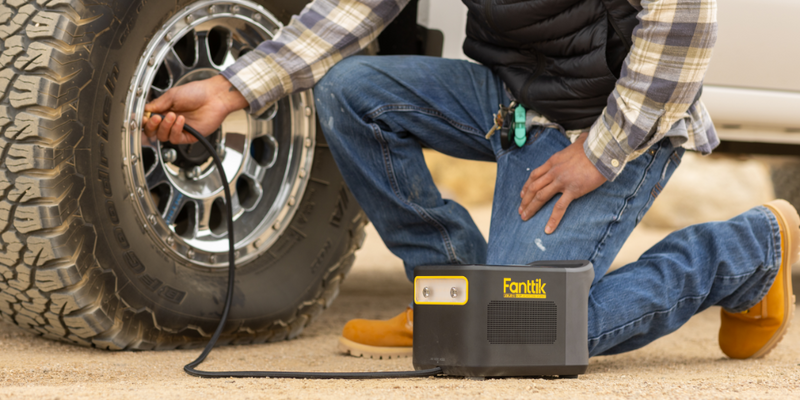
Technical Constraints: Grid Load and Safety
When you adopt a synchronized fleet approach, you might be tempted to plug every device into the same power strip at once. However, it is important to consider the technical limits of your home's electrical infrastructure.
1. The Grid Load Problem
While charging small electronics is generally low-impact, multi-unit charging can add up. A standard 15-amp residential circuit is typically rated for 1,800 watts, but the National Electrical Code (NEC) recommends a 20% safety margin for continuous loads.
Safety Heuristic: We recommend that a household "maintenance station" should not exceed 1.5 kW (1,500W) of simultaneous draw. This helps ensure you remain within safe margins if other appliances (like a garage refrigerator) are on the same circuit. You can verify your draw using a simple plug-in watt meter.
2. The Degradation Trade-off
There is a trade-off between fast charging and long-term battery health. While fast charging is essential in emergencies, we suggest using "standard" USB charging (e.g., 5V/2A) for your quarterly maintenance top-ups when time is not a factor. This can help minimize heat-related stress on the cells.
3. BMS and Ventilation
Different devices use different Battery Management Systems (BMS). When charging multiple high-capacity units, ensure your storage area is well-ventilated to dissipate heat. According to general ISO Standards for quality management in storage, maintaining a cool, dry environment is as important as the electrical maintenance itself.

The Seasonal Transition Checklist: A Step-by-Step Guide
To help ensure your family remains ready, follow this synchronized protocol every 90 days.
Step 1: Physical Inspection
Remove every unit from the "Go-Kit" or vehicle. Check for:
- Case Integrity: Any cracks, bulges, or signs of impact.
- Port Cleanliness: Use compressed air to clear dust from charging ports.
- Cable Health: Ensure no fraying or corrosion is present on jumper clamps.
Step 2: The "State of Charge" Audit
Turn on each device and check the digital display.
- If the unit is above 80%, do not charge it (to avoid over-voltage stress).
- If the unit is below 50%, charge it until it reaches approximately 75-80%.
- Safety Tip: Never charge a battery that is below freezing (0°C/32°F); allow it to reach room temperature first.
Step 3: Calibration and Testing
For tire inflators, perform a "zero-pressure" check by turning the unit on before connecting it to a tire to ensure the sensor reads "0.0 PSI." For jump starters, test the integrated LED flashlight, as this is a simple way to verify basic circuit functionality.
Step 4: Documentation
Update your "Last Service" log. This simple act provides a visual "Trust Layer" for the rest of the household, ensuring everyone knows the gear is ready.
Maintenance Model & Assumptions:
Parameter Estimated Range Unit Rationale Household Fleet Size 2 - 5 Units Typical multi-car family Target Storage Temp 15 - 25 °C Optimal Li-ion stability (Indoor) Top-up Frequency 4 Times/Year Seasonal synchronization habit Target SoC (Storage) 50 - 80 % Balance of readiness and cell health
Engineering Reliability in Your Household
Managing multiple vehicles is a significant responsibility. By moving to a synchronized maintenance cycle, you are engineering a system of reliability that helps protect your family.
The goal of modern self-reliance is to reduce anxiety in moments of need. When you have high confidence that every device in your "Go-Kit" was audited and topped up within the last 90 days, the stress of a potential "dead battery" is significantly mitigated.
By applying these principles—often used by professional fleet managers—to your own home, you ensure that your most important fleet is always ready for the road.
YMYL Disclaimer: This article is for informational purposes only and does not constitute professional automotive, electrical, or safety advice. Always refer to your specific product's user manual and your vehicle's manufacturer guidelines. If you notice a battery is swollen, leaking, or emitting a strange odor, stop use immediately and consult a professional for hazardous waste disposal. Maintaining emergency gear is a supplement to, not a replacement for, regular vehicle maintenance by a certified mechanic.
Sources
Continue reading
 Logistical Readiness: Tracking Seasonal Care for Multi-Car Households
Covers battery care, tire pressure rules, winter starting models, and habit-stacking strategies to synchronize care across minivans, hybrids,...
Logistical Readiness: Tracking Seasonal Care for Multi-Car Households
Covers battery care, tire pressure rules, winter starting models, and habit-stacking strategies to synchronize care across minivans, hybrids,...
 Warranty Consolidation: Managing Multiple Device Service Windows
Covers serial number tracking, EU GPSR compliance, the 30-day pre-expiry test, and choosing between OEM and third-party service...
Warranty Consolidation: Managing Multiple Device Service Windows
Covers serial number tracking, EU GPSR compliance, the 30-day pre-expiry test, and choosing between OEM and third-party service...


Leave a comment
This site is protected by hCaptcha and the hCaptcha Privacy Policy and Terms of Service apply.