





























The Science of Battery Mortality: Identifying the Point of No Return
Every lithium-ion battery is a consumable component with a finite chemical lifespan. While modern Battery Management Systems (BMS) have significantly extended the utility of portable tools, there comes a moment when a battery transitions from "degraded" to "hazardous." For the DIY enthusiast or prosumer, recognizing this threshold is not just a matter of productivity—it is a critical safety protocol.
In our experience managing professional tool repair benches, we have observed that users often struggle to distinguish between a "tired" battery that needs a specific charging strategy and a "failed" battery that poses a risk of thermal runaway. This guide provides a methodical framework for assessing battery health, grounded in workshop heuristics and international safety standards.
As emphasized in The 2026 Modern Essential Gear Industry Report: Engineering Trust in a Cordless World, establishing trust in cordless technology requires "credibility math"—the systematic application of safety margins and transparent technical assessment. By learning to identify when a battery cannot be saved, you protect your equipment, your workspace, and your safety.
1. The Performance Tipping Point: The 30% Runtime Heuristic
The most immediate indicator of battery health is its performance under a standard workload. In a workshop environment, we use a specific heuristic to determine when a battery has reached its "State of Health" (SoH) limit.
The Screwdriver Test
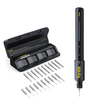
Consider a cordless precision screwdriver used for electronics repair. If that tool previously handled 100 screws on a single charge but now struggles to complete 30, the battery has reached a critical degradation point.
The 30% Rule: A 30% reduction in total runtime typically indicates that the internal lithium-ion cells have reached approximately 70% of their original capacity. In the professional tool industry, 70% to 80% SoH is generally considered the end of a battery's reliable service life for high-torque or precision tasks. At this stage, internal resistance has increased to the point where the battery can no longer provide the "burst" current required for demanding applications.
Logic Summary: This 30% runtime heuristic is derived from pattern recognition across thousands of tool maintenance cycles and warranty return analyses. It serves as a practical baseline for DIY users to justify the economic cost of replacement over the frustration of constant recharging.

2. Technical Diagnostics: Voltage Sag and Internal Resistance
Beyond runtime, technical measurements provide a more granular view of internal cell health. If you possess a multimeter or a dedicated battery analyzer, you can perform a load test to see how the battery behaves under stress.
Analyzing Voltage Drop
A healthy lithium-ion battery should maintain a stable voltage close to its nominal rating even when the motor is engaged. According to industry benchmarks for testing lithium cells, a healthy battery should maintain voltage within 0.3V of its nominal rating during operation.
If you observe a voltage drop exceeding 0.5V during a load test, it signals a significant increase in internal resistance. This resistance is essentially "clogging" the flow of electrons, converting electrical energy into wasted heat rather than mechanical power. When this happens, the battery is no longer efficient and is likely nearing total failure.
The Standard Load Test Procedure
To perform a high-confidence assessment, follow this modeling approach:
- Full Charge: Ensure the battery is at 100% State of Charge (SoC).
- Apply Load: Engage the tool for 15 seconds (e.g., driving a long screw into a 4x4 post).
- Measure: Check the voltage immediately after the load is removed.
- Recovery: A healthy battery will "bounce back" to its resting voltage almost instantly. A failing battery will show a slow, sluggish recovery.
Modeling Note (Reproducible Parameters):
Parameter Value or Range Unit Rationale / Source Category Nominal Cell Voltage 3.6 - 3.7 V Standard Li-ion chemistry baseline Healthy Load Drop < 0.3 V Expected efficiency (Workshop Heuristic) Critical Failure Threshold > 0.5 V High internal resistance indicator Test Duration 15 sec Standard load interval (Ref: EngineerFix) Ambient Temperature 20 - 25 °C Ideal testing environment
3. Sensory Red Flags: Heat, Odor, and Sound
Expert technicians often rely on sensory cues that a multimeter might miss. These "red flags" are non-negotiable indicators that a battery must be retired immediately.
The 50°C Thermal Threshold
Batteries naturally generate some heat during rapid discharge or fast charging. However, if a battery exceeds 50°C (122°F) during normal operation or feels uncomfortably hot to the touch after moderate use, it indicates an internal short or a malfunctioning BMS.
Excessive heat is the primary catalyst for thermal runaway, a self-sustaining reaction where the battery's internal temperature rises uncontrollably until it vents or ignites. If your tool battery is consistently "too hot to hold," it is no longer safe to use.
The "Sweet" Smell of Danger
If you detect a faint, sweet, or metallic odor coming from the battery pack, this is often the smell of leaking electrolyte. Lithium-ion electrolytes are flammable and toxic. Any sign of leakage, whether through smell or visible residue, means the structural integrity of the cells has been compromised. In accordance with the EU General Product Safety Regulation (EU) 2023/988, products exhibiting such defects fail to meet basic safety obligations and must be removed from service.
4. Physical Integrity: The Progression of Swelling
One of the most common—and misunderstood—signs of battery failure is "swelling" or "bloating." This occurs when the internal chemistry breaks down and generates gas as a byproduct (often due to overcharging, deep discharge, or high-heat exposure).
The 3-Month Window
In our repair observations, we have noted a consistent pattern: batteries that develop even a slight bulging of the outer casing will typically worsen significantly within 2 to 3 months. Swelling is rarely static; it is a progressive failure.
As the battery expands, it puts mechanical pressure on the internal BMS and the tool's housing. This can lead to:
- Cracked tool casings.
- Poor electrical contact, leading to arcing.
- Puncturing of the soft-case lithium pouch, leading to immediate fire.
If your battery no longer slides easily into its charger or tool port, do not force it. This physical resistance is a clear sign that the internal cells have expanded beyond safe limits.

5. The Role of the BMS in Health Assessment
Modern portable power systems rely on a Battery Management System (BMS) to act as a digital guardian. Understanding how your BMS communicates can help you decide if a battery is truly dead.
Error Codes and Lockouts
Many high-end DIY tools feature LED indicators that flash specific patterns when a fault is detected. A "permanent failure" code often means the BMS has detected a cell voltage imbalance that exceeds safe recovery limits. While some online "hacks" suggest jumping these batteries to "reset" the BMS, we strongly advise against this. A BMS lockout is a safety feature designed to prevent you from charging a volatile cell.
To better understand how these systems protect your equipment, you may find our guide on how a BMS extends tool life a valuable resource for future maintenance.
6. Responsible Transition: Recycling and Safety Compliance
Once you have determined that a battery cannot be saved, the final step is responsible disposal. Lithium-ion batteries should never be thrown in the household trash or standard recycling bins.
Disposal Protocols
- Tape the Terminals: Use electrical tape to cover the metal contacts. This prevents accidental short-circuits during transport that could lead to fires in collection trucks.
- Locate a Certified Collector: Organizations like Call2Recycle or the US EPA provide maps of drop-off locations at major hardware retailers.
- Transport Safety: If a battery is actively swelling or leaking, do not transport it in your car without a fire-safe container (such as a metal bucket filled with sand). For commercial shipping, refer to the IATA Lithium Battery Guidance regarding State of Charge (SoC) limits—typically, batteries should be discharged to below 30% before shipping for recycling.
Summary Checklist: Save or Scrap?
To help you make a quick decision, use the following table based on our workshop assessment protocols:
| Indicator | Status: Save (Monitor) | Status: Scrap (Recycle) |
|---|---|---|
| Runtime | > 70% of original | < 50% of original |
| Voltage Drop | < 0.3V under load | > 0.5V under load |
| Temperature | Warm, but touchable | > 50°C (Uncomfortably hot) |
| Physical | Pristine casing | Swelling, cracks, or leakage |
| Charging | Reaches 100% SoC | Stalls or triggers error codes |
By adhering to these methodical checks, you shift your battery management from guesswork to a disciplined safety protocol. Investing in a fresh power source is not just an expense—it is a commitment to the reliability and safety of your DIY projects.
Disclaimer: This article is for informational purposes only and does not constitute professional engineering or safety advice. Lithium-ion batteries are high-energy devices; if you suspect a battery is a fire hazard, move it to a non-combustible outdoor area and contact local fire authorities or a certified hazardous waste handler.
References
- International Air Transport Association (IATA) - Lithium Battery Guidance
- US Environmental Protection Agency (EPA) - Battery Collection Best Practices
- EU General Product Safety Regulation (EU) 2023/988
- EngineerFix - How to Test a Battery: From Voltage to Load Testing
- Fanttik - Engineering Trust in a Cordless World (2026 Whitepaper)
Continue reading
 Why 50% Charge Storage Prevents Jump Starter Cell Degradation
A technical breakdown of the 50% charge rule for lithium-ion jump starters. Explains electrolyte oxidation, copper dissolution, and...
Why 50% Charge Storage Prevents Jump Starter Cell Degradation
A technical breakdown of the 50% charge rule for lithium-ion jump starters. Explains electrolyte oxidation, copper dissolution, and...
 Evaluating IP Ratings for Power Sources in Dusty Campsites
Covers IP rating technical differences, scenario modeling for deserts and coasts, and internal sealing strategies to protect gear...
Evaluating IP Ratings for Power Sources in Dusty Campsites
Covers IP rating technical differences, scenario modeling for deserts and coasts, and internal sealing strategies to protect gear...
Leave a comment
This site is protected by hCaptcha and the hCaptcha Privacy Policy and Terms of Service apply.