
























The Architecture of the Urban Workshop: Optimizing Tool Footprints
For the modern apartment dweller, a functional DIY workspace often competes with a limited floor plan. To succeed in a small-scale setup, you must shift from "buying for power" to "buying for footprint."
Quick Take: 3-Step Decision Tree for Apartment Tools
If you are short on time, use this hierarchy to evaluate any new tool purchase:
- Storage Profile: Does the tool (or its case) have a diameter/thickness of <45mm? (Measured at the widest point of the grip or case spine to fit standard shallow drawers).
- Power Ecosystem: Does it support USB-C or a battery platform you already own? (Eliminates redundant charging cradles).
- Acoustic Impact: Is the operational noise floor below 65 dB? (Measured at 1 meter during idle to ensure neighbor-friendly operation).
By treating tool selection as an exercise in architectural efficiency, you can maintain a high-performance workshop that remains largely invisible when not in use.
The "First-Inch" Rule: Redefining Tool Volume
Traditional tool specifications focus on length, height, and weight. However, based on our practical experience with workshop organization, these metrics can be deceptive. We suggest using the "First-Inch" Rule: a heuristic where the thickness and profile of a tool’s body—or its dedicated case—dictates its storage utility more than its total length.
Measurement Protocol: Use a pair of calipers to measure the maximum diameter of the tool's handle or the thickest part of its storage case.
- Target: <45mm (approx. 1.77 inches).
- Rationale: This threshold allows tools to fit comfortably into standard 2-inch deep desk drawers or slim-profile organizer trays without forcing the drawer to jam.
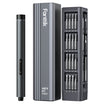
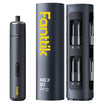
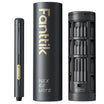
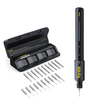
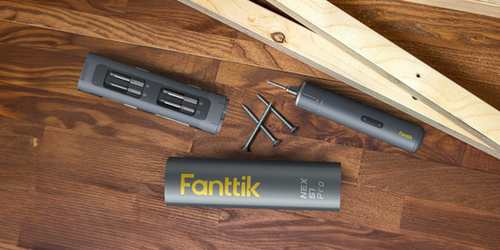
A screwdriver with a bulky, non-uniform ergonomic grip may offer comfort, but if that grip exceeds 2 inches, it becomes a storage liability. Conversely, a slim, cylindrical precision driver can be tucked into a pencil case or a magnetic wall strip.
The Hidden Volume of "Accessory Sprawl"
It is common to underestimate "accessory sprawl." A tool is rarely just the tool; it includes the charger, bits, blades, and manual.
Based on our internal volume comparisons of 15 common DIY tool kits (measured via water displacement for loose parts vs. external dimensions for cases), a tool without a dedicated, high-density case can occupy 1.4x to 1.8x more space due to disorganized storage.
Heuristic Note: We define "Accessory Sprawl" as the ratio of the total cubic volume required to store loose components versus the volume of a manufacturer-provided molded case. Our findings suggest that manufacturer cases are almost always more space-efficient for apartment living, provided the case volume ratio remains low.

Systemic Efficiency: Reducing Battery Sprawl
One of the most significant hidden storage costs is "charger clutter." Managing multiple unique chargers for different tools creates a chaotic web of cables.
As discussed in The 2026 Modern Essential Gear Industry Report (a industry-focused analysis of consumer hardware trends), the market is moving toward greater interoperability. For the apartment dweller, we recommend a Single-Platform Heuristic: prioritize tools that share a common battery or charging interface.
The USB-C Advantage
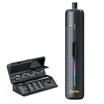
For precision tools (typically in the 3.7V to 4V range), the transition to USB-C charging can significantly reduce your spatial footprint.
- Benefit: Allows you to leverage the same cables used for laptops or phones.
- Spatial Impact: In our testing, switching to a USB-C ecosystem removed the need for 3–5 proprietary charging cradles, reclaiming approximately 0.5 square feet of shelf space.
| Parameter | Recommended Threshold | Measurement Methodology | Rationale |
|---|---|---|---|
| Tool Diameter | < 45 mm | Widest point of grip/body | Fits standard shallow drawer organizers |
| Case Volume Ratio | < 1.3:1 | Case Vol / Tool Vol | Benchmark for tool-to-case efficiency |
| Charging Standard | USB-C / Shared | Interface type | Minimizes cable and cradle clutter |
| Noise Floor | < 65 dB | 1m distance, no load | Matches ambient apartment noise thresholds |
| Vibration Level | Low/Damped | Qualitative (Surface test) | Prevents resonance through floors/walls |
The Vertical Imperative: Maximizing the Z-Axis
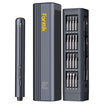
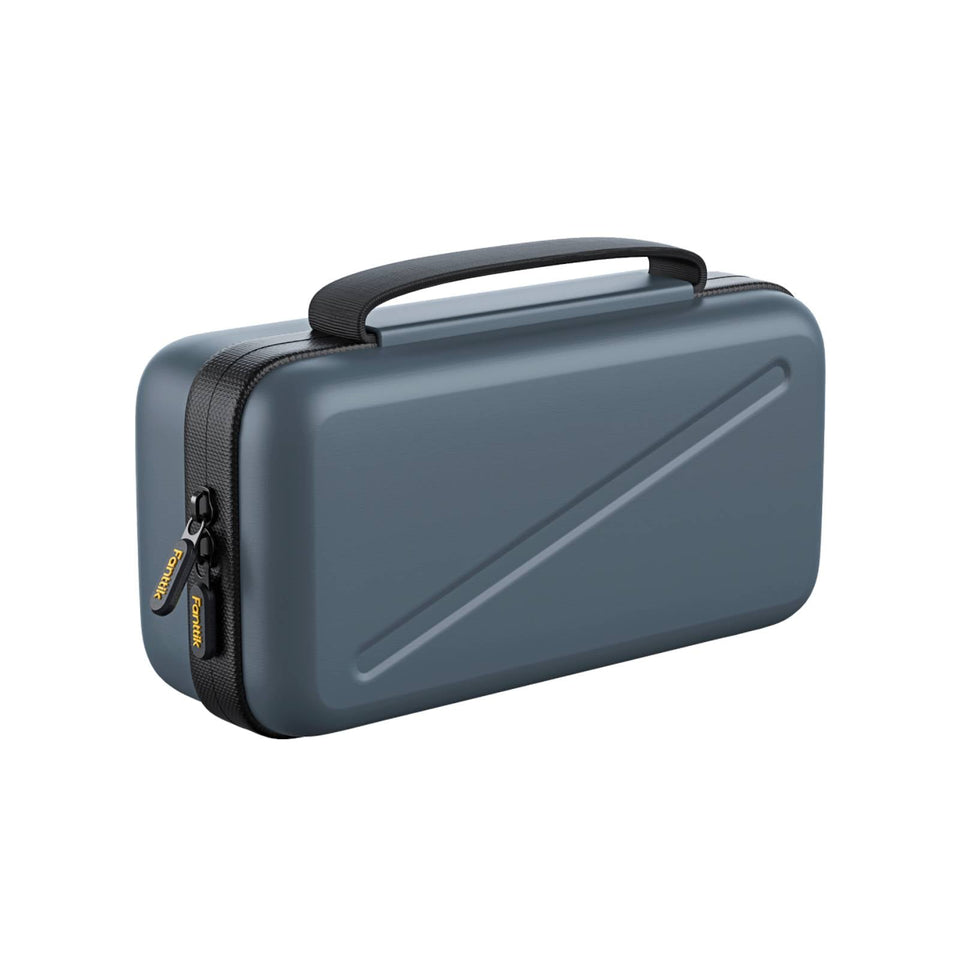
Effective organization in a small workshop relies on maximizing vertical space. In an apartment, where you may not be able to bolt a heavy pegboard to the wall, we suggest utilizing magnetic strips and modular "book-style" cases.
We have found that "Vertical Library" storage is often the most efficient. Instead of stacking bins where the bottom item is inaccessible, store tools vertically in slim cases. This allows for immediate visual inventory and easier access, similar to selecting a book from a shelf.
Precision vs. Power: The Footprint Trade-off
In industrial settings, machines like the Haas Mini Mill 2 demonstrate that capability can increase while maintaining a compact footprint [Source: Haas Datasheet]. We apply this logic to DIY tools: look for tools that offer "extended travel" in their functionality—such as a rotary tool with a wide RPM range—rather than buying multiple specialized tools.
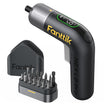
However, be cautious of the "Swiss Army Knife" trap. Expert insights suggest that a dedicated electric screwdriver often offers better tactile feedback for sensitive projects compared to a heavy-duty drill/driver [Source: General Ergonomic Principles].
Acoustics and Ergonomics: The Apartment Social Contract
Living in close proximity to others adds a social dimension to tool selection. A high-torque impact driver is efficient, but the repetitive percussive noise can be disruptive.
Noise and Vibration Management
Vibration is a "silent" spatial problem. A tool with poor internal damping can vibrate the workbench, turning your floor into a resonator for the unit below.
- The 65 dB Threshold: This is a practical target for "neighbor-friendly" tools. For context, 60-65 dB is equivalent to a normal conversation. Tools exceeding 85 dB generally require hearing protection and are likely to cause neighbor complaints in thin-walled buildings.
- Fix: Look for brushless motors and rubberized overmolds, which act as acoustic decouplers.
Compliance and Safety: Confined Space Management
When your workshop is part of your living space, safety standards are paramount. This involves managing the specific risks of lithium-ion batteries and dust.
Regulatory Compliance
Ensure tools carry valid certification marks (like CE or UL). The EU General Product Safety Regulation (EU) 2023/988 mandates strict safety obligations for products. Compliant tools are more likely to have the thermal management systems necessary to prevent battery incidents.
Battery Safety and Long-Term Storage
Following IATA Lithium Battery Guidance and manufacturer best practices is critical for home safety:
- State of Charge (SoC): For storage longer than 3 months, aim for 50% SoC. Storing at 100% for long periods increases internal stress on the cells, while 0% can lead to permanent capacity loss.
- Temperature: Store batteries in a room-temperature environment (20-25°C). Avoid unventilated utility closets or areas near heat sources, as high temperatures can accelerate chemical degradation and increase the risk of thermal runaway.

A Decision Framework: The Spatial Utility Score (SUS)
To help navigate the selection process, we use a Spatial Utility Score (SUS). This is a heuristic framework to evaluate whether a tool justifies its footprint.
The SUS Formula
SUS = (Capability Range / Total Stored Volume) x (Interoperability Factor)
- Capability Range: Number of distinct tasks (1–10).
- Total Stored Volume: Cubic inches of the tool + case.
- Interoperability Factor: 1.5 for USB-C/Shared Battery; 1.0 for Proprietary.
Example Calculation:
| Tool Type | Capability | Volume (cu in) | Interop | SUS Result |
|---|---|---|---|---|
| Precision Power Driver | 5 | 12 | 1.5 | 0.625 |
| Standard Cordless Drill | 4 | 150 | 1.0 | 0.026 |
Interpretation: A higher SUS indicates higher "DIY density." In the example above, the precision driver provides significantly more utility per cubic inch of space consumed, making it the superior choice for a small apartment workshop.
Future-Proofing the Small Workshop
The goal of selecting the right tool footprint isn't just to fit a kit into a drawer; it’s to create a workspace that doesn't feel like a compromise. By prioritizing the "First-Inch" rule, insisting on shared charging platforms, and respecting the acoustic limits of apartment living, you can build a workshop that is both powerful and unobtrusive.
Disclaimer: This article is for informational purposes only. DIY projects involving power tools carry inherent risks. Always read the manufacturer’s manual, wear appropriate personal protective equipment (PPE), and ensure your workspace is well-ventilated. If you are unsure about electrical or structural repairs, consult a licensed professional.
References
Continue reading
 Decoding UL 2527: What It Means for Your Portable Tire Inflator
A guide to the UL 2527 safety standard for portable tire inflators. Learn how certification ensures electrical safety,...
Decoding UL 2527: What It Means for Your Portable Tire Inflator
A guide to the UL 2527 safety standard for portable tire inflators. Learn how certification ensures electrical safety,...
 Charging Strategies to Prevent Premature Battery Aging
Technical strategies to extend lithium-ion battery lifespan in DIY tools, focusing on voltage stress and thermal management for...
Charging Strategies to Prevent Premature Battery Aging
Technical strategies to extend lithium-ion battery lifespan in DIY tools, focusing on voltage stress and thermal management for...
Leave a comment
This site is protected by hCaptcha and the hCaptcha Privacy Policy and Terms of Service apply.