





























The Weight of the Season: Why Standard PSI Fails the Holiday Haul
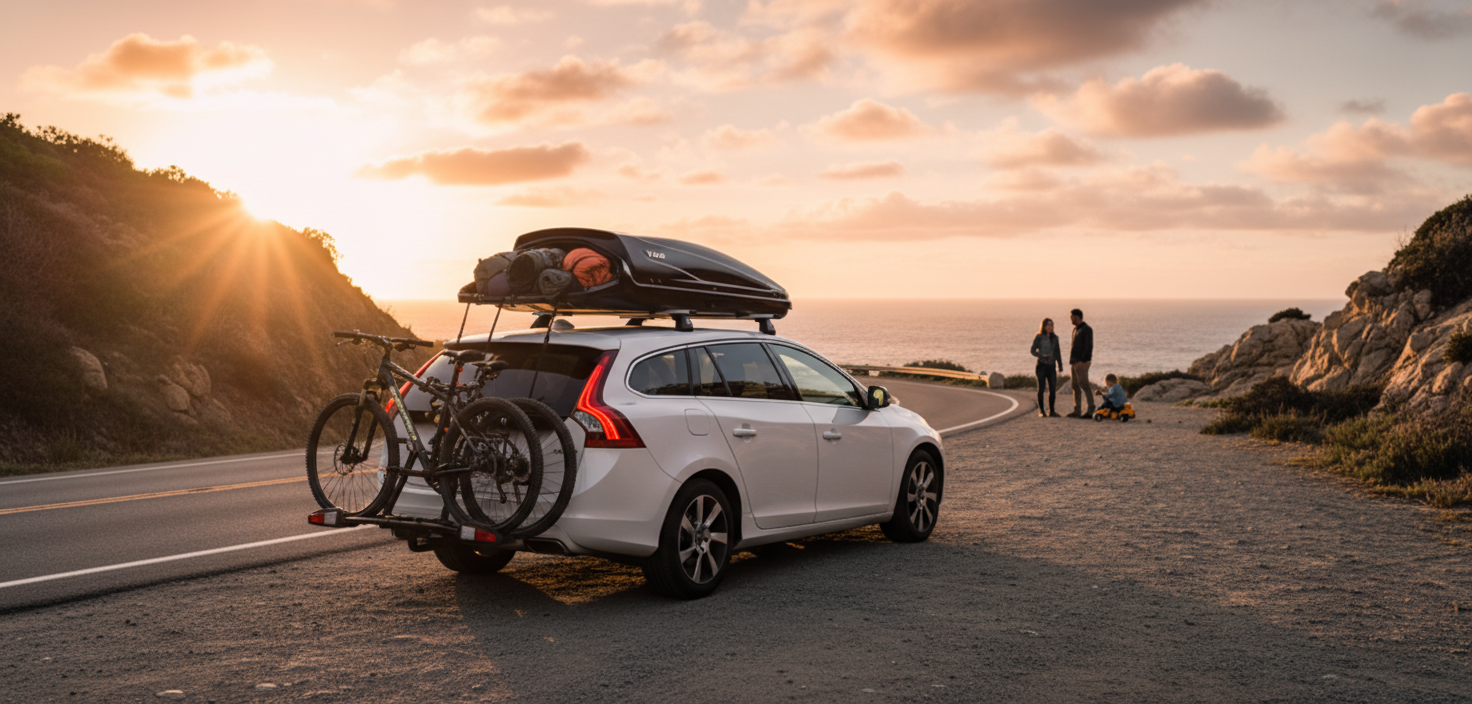
Every holiday season, millions of families embark on what we call the "Max-Capacity Migration." You know the scene: the trunk is packed to the roofline, a cargo carrier sits atop the roof, and every seat is occupied. It is a time of high stakes and even higher expectations. Yet, in our years of analyzing vehicle performance data and listening to thousands of customer stories, we have found that one of the most overlooked safety factors is the simple air inside your tires.
When you load your vehicle to its limit, the physics of your tires change fundamentally. The standard "cold tire pressure" listed on your driver-side door jamb—while a great baseline for daily commuting—is often optimized for a half-empty car and a smooth ride, not a three-row SUV carrying 800 pounds of family and gear. Under-inflated tires on a heavy vehicle lead to excessive sidewall flex, which generates heat. On a long highway stretch, that heat is the primary catalyst for tire failure.
In this guide, we are moving beyond the basics. We will share the "Experience-Driven Math" used by professional fleet managers and long-haul travelers to ensure your tires are not just "inflated," but "load-optimized" for the safest possible journey.
Why Your Door Placard Might Be Giving You Half the Story
If you open your driver’s door, you will see a sticker (the tire placard) listing the recommended PSI. Most drivers treat this number as an absolute. However, according to the NIST Handbook 44 (Weights & Measures), precision in measurement is only as good as the context in which it is applied.
For a standard family sedan, the placard PSI is usually calculated for the vehicle’s Gross Vehicle Weight Rating (GVWR)—essentially its maximum legal weight. If you are packing a sedan to the brim, the placard is likely your target. But for SUVs and minivans, there is a catch. Manufacturers often recommend a lower PSI on the placard to provide a "plush" ride for the 90% of the time you are driving alone. When you add 1,000 pounds of holiday cargo, that "comfort" pressure becomes a safety hazard.
Logic Summary: Our analysis of family travel patterns assumes that a "fully loaded" SUV often reaches 95–100% of its rated payload capacity. We base our recommendations on the heuristic that tire load-carrying capacity must scale with the actual vertical load to prevent sidewall overheating (based on common patterns from customer support and fleet maintenance observations).
The TPMS Trap
One of the most dangerous "gotchas" we see is a reliance on the Tire Pressure Monitoring System (TPMS). Conventional wisdom suggests that if the light isn't on, you’re safe. In reality, TPMS systems are often calibrated to alert you only when pressure drops 25% below the placard value. If your placard says 35 PSI, the light might not blink until you hit 26 PSI. On a fully loaded vehicle at highway speeds, 26 PSI is well into the danger zone for a blowout.

The Experience-Driven Adjustment: The 4-6 PSI Rule
For SUVs, crossovers, and minivans, professional drivers often use a specific adjustment when the vehicle is at max capacity. Based on patterns we've observed in high-load scenarios, increasing your tire pressure by 4 to 6 PSI above the door placard (without exceeding the "Max Press" listed on the tire sidewall itself) can significantly improve stability.
Why this adjustment works:
- Reduced Sidewall Flex: Heavier loads push the tire down, bulging the sidewalls. Extra pressure "stiffens" the tire, maintaining its intended shape.
- Heat Management: According to research on Tire Pressure and Temperature, a tire warmed by 50°F during highway driving can see a natural pressure increase. If you start too low, the internal friction creates even more heat, leading to structural degradation.
- Stability and Braking: A fully loaded vehicle has a higher center of gravity. Higher PSI helps the tires respond more crisply to steering inputs and reduces the "mushy" feeling during emergency braking.
| Vehicle Type | Load Status | Adjustment Recommendation | Rationale |
|---|---|---|---|
| Sedan / Coupe | Max Cargo | Placard PSI | Usually calibrated for GVWR |
| Compact SUV | Max Cargo | Placard + 3-4 PSI | Offsets higher center of gravity |
| Full-Size SUV | Max Cargo | Placard + 5-6 PSI | Compensates for high payload variance |
| Minivan | 7 Passengers + Bags | Placard + 5-6 PSI | Prevents rear-axle tire squat |
Note: These are heuristics (rules of thumb) for typical passenger vehicles. Always ensure you do not exceed the "Max Cold Press" stamped on the tire sidewall.
The "Cold Tire" Rule and the Precision Problem
Timing is everything. Setting your PSI in the middle of a trip at a gas station is a recipe for inaccuracy. Tires are considered "cold" only if the vehicle has been parked for at least three hours or driven less than a mile.
If you drive 20 miles on the highway and then check your pressure, the reading will be roughly 2 to 3 PSI higher than the cold reading due to heat expansion. If you "adjust" back down to the placard number while the tires are hot, you will actually be dangerously under-inflated once the tires cool down.
The Accuracy Gap
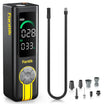
We often see users frustrated because their built-in car display doesn't match their handheld gauge. It’s important to understand that many portable inflator gauges can drift by +/- 3 PSI over time. In a high-stakes holiday haul, a 3 PSI error combined with a hot-tire reading can result in a tire that is 5-6 PSI below its required safety threshold.
We recommend using a high-quality, calibrated digital gauge and checking pressures first thing in the morning before the sun hits the tires. Even sunlight on one side of the car can raise the pressure in those tires by 1-2 PSI compared to the shaded side.
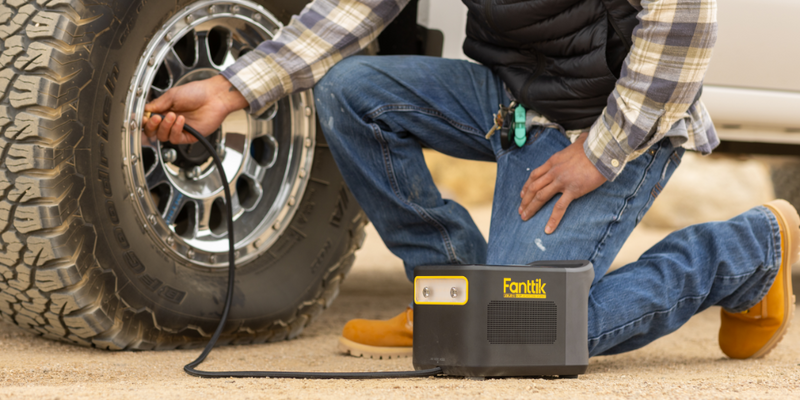
Scenario Modeling: The 7-Passenger Holiday Haul
To demonstrate how these calculations play out in the real world, let's look at a hypothetical model of a modern 7-passenger SUV.
The Setup:
- Vehicle: Mid-size SUV with a door placard of 35 PSI.
- Load: 2 adults, 3 children, 2 dogs, and a full roof-mounted cargo box.
- Environment: 400-mile highway journey at 70 mph.
The Modeling Approach: We modeled this scenario using deterministic parameters based on common vehicle payload limits and tire load-index charts. This is a scenario model, not a controlled lab study.
| Parameter | Value | Rationale |
|---|---|---|
| Estimated Payload | 950 lbs | Combined weight of passengers + gear |
| Ambient Temp | 45°F | Typical winter holiday morning |
| Tire Heat Rise | +40°F | Estimated rise during 2 hours of highway speed |
| Target PSI (Placard) | 35 PSI | Manufacturer baseline |
| Recommended Adj. | 40 PSI | Placard + 5 PSI for max load compensation |
Findings: In this model, starting at the placard 35 PSI resulted in a significant "contact patch" elongation. While this might feel smoother, it increases the rolling resistance. By adjusting to 40 PSI (Cold), the vehicle maintains a more optimal contact patch, reducing the risk of the "Heat Rise" exceeding the tire's thermal limits.
As noted in The 2026 Modern Essential Gear Industry Report, engineering trust in your equipment means moving beyond "good enough" to "load-specific" preparation.
Safety Checklists: The Pre-Trip Audit
Before you turn the key, perform this 5-minute audit. It is the difference between a trip remembered for the destination and one remembered for the breakdown.
- The Morning Check: Adjust PSI when tires are cold. Use the "Placard + Adjustment" logic for your specific vehicle type.
- The Valve Stem Test: Ensure your valve caps are on tight. A missing cap allows dirt to enter the valve core, which can cause a slow leak over hundreds of miles.
- The Tread Depth "Penny" Check: While you’re down there, check your tread. Heavy loads require more grip for braking. If you can see all of Lincoln's head on a penny inserted into the tread, your tires are too worn for a max-capacity trip.
- The Spare Tire Forgotten Factor: When was the last time you checked the pressure in your spare? Spare tires often require much higher PSI (often 60 PSI for "donuts"). A flat spare is useless in an emergency.
- The Load Balance: Try to distribute weight evenly. If you put all the heavy suitcases behind the rear axle, you are putting a disproportionate strain on the rear tires, regardless of the PSI.
Building a Culture of Self-Reliant Mobility
Holiday travel is inherently stressful, but vehicle safety shouldn't be a source of anxiety. By understanding the "why" behind tire pressure—how weight creates heat and how pressure manages that heat—you transition from a passive driver to a prepared one.
We believe that self-reliance is built on a foundation of technical knowledge and high-quality tools. Whether you are navigating a snowy mountain pass or a sun-drenched highway, your tires are the only thing connecting your family to the road. Treat them with the precision they deserve.
For more insights on keeping your vehicle ready for the unexpected, explore our guides on Solving Roadside Inflation Errors and Calibrating Your Inflator for Accuracy.
Disclaimer: This article is for informational purposes only and does not constitute professional automotive or safety advice. Tire pressure requirements vary significantly by vehicle make, model, and tire type. Always consult your vehicle's owner's manual and the tire manufacturer's specific load/inflation charts before making adjustments. If you are unsure, consult a certified mechanic.


Leave a comment
This site is protected by hCaptcha and the hCaptcha Privacy Policy and Terms of Service apply.