

























The Silent Struggle of the Modern High-Displacement Engine
We have all experienced that specific sinking feeling in the pit of the stomach. You have waited all winter for the first clear Saturday to pull your V8 luxury SUV or high-performance sedan out of storage. You have checked the fluids and wiped away the dust, but when you turn the key or press the start button, all you get is a rhythmic, metallic clicking—the dreaded "click-no-crank" scenario.
In our years of troubleshooting vehicle dormancy patterns, we have observed that the tools which worked for a 1990s pickup often fail the sophisticated electronics of a modern high-displacement vehicle. As engines become more complex and vehicles integrate more Advanced Driver Assistance Systems (ADAS), the margin for error in your storage kit shrinks.
If you are relying on a bulky, lead-acid jump pack from a decade ago or a low-capacity unit designed for compact cars, you may be under-prepared for the unique demands of a high-displacement engine coming out of dormancy. This guide explores the technical triggers that signal it is time to upgrade your storage kit to modern lithium-based systems, ensuring your first drive of the season starts with a roar, not a click.
Why Your Old Gear Fails the "Click-No-Crank" Test
The most common mistake we see is a reliance on "peak amp" ratings. Many legacy lead-acid jump packs advertise massive peak numbers that are, in reality, unattainable in a cold garage. For a modern vehicle, the issue isn't just raw power; it is voltage stability.
Modern vehicle starter solenoids typically require a minimum of 9.6V to stay engaged. If your jump starter's voltage sags below this threshold during the initial surge, the solenoid will chatter (the clicking sound), even if the pack still has plenty of "capacity" left.
Furthermore, high-displacement engines (typically 5.0L and above) require a massive initial "inrush" current to overcome the mechanical resistance of large pistons and thick, cold oil. When you add the parasitic load of modern infotainment systems, GPS trackers, and security modules, the demand on a jump starter is significantly higher than it was twenty years ago.
Modeling Note (Winter Confidence): We modeled the starting requirements for a 6.2L V8 engine at 15°F (-9°C). Under these assumptions, while a standard battery might be rated at 750 CCA, the engine actually requires approximately 688A of sustained current to overcome cold-start friction. Legacy packs often fail here because their voltage drops too quickly under this 600A+ load.
Parameter Value Unit Rationale Engine Displacement 6.2 L Typical luxury SUV V8 Ambient Temp 15 F Cold garage storage Required Amps (Cold) ~688 A BCI Temperature Derating Voltage Threshold 9.6 V Modern ECU/Solenoid limit Parasitic Buffer 20-30 % Modern electronics load
Based on our analysis of customer support patterns and real-world failure cases, we recommend a "Parasitic Load Buffer" of 20-30% above the base cranking requirement for any vehicle manufactured after 2015. This accounts for the energy consumed by the vehicle's "brain" before the engine even begins to turn.

The Shift to Lithium: LiFePO4 vs. Lead-Acid
For seasonal storage kits, the chemistry of your gear is just as important as its power output. We have moved away from recommending lead-acid packs for one primary reason: self-discharge.
According to industry data on battery performance, a lead-acid battery can lose over 30% of its charge when left in a cold garage for just a few months. In contrast, Lithium Iron Phosphate (LiFePO4) chemistry is favored by professionals for its extremely low self-discharge rate—typically around 3% per month.
This means if you charge a modern lithium starter to 70% in November, it will likely still have enough "punch" to start a 6.0L engine in March. However, a common mistake is storing lithium units at 100% charge. For long-term cell health and to prevent degradation, we suggest maintaining a 50-70% State of Charge (SoC). This is a technical sweet spot that balances readiness with chemical stability.
Beyond charge retention, modern lithium systems offer safety features that were once "pro-only." We consider spark-proof technology and reverse polarity protection non-negotiable for DIY use. These features prevent the dangerous "pop" and potential battery damage that occur if you accidentally touch the wrong terminals in a dimly lit garage.
Beyond the Battery: Tire Health and ROI
A storage kit isn't just about the engine; it is about the "shoes" of the vehicle. High-displacement vehicles, particularly heavy SUVs and performance cars, are prone to tire flat-spotting and pressure loss during dormancy.
We often see owners ignore a 5 or 6 PSI drop, thinking they will just "drive it out" to the gas station. However, under-inflation in heavy vehicles is more than a performance issue—it is an economic one. Based on our scenario modeling, the ROI of a high-performance portable inflator is surprisingly fast.
Logic Summary (Tire ROI): Our analysis assumes a 6.2L luxury SUV driving 12,000 miles annually. If the tires are consistently 6 PSI low (a common result of seasonal temperature drops), the fuel efficiency loss can reach 1.8%.
Parameter Value Unit Source Category Annual Mileage 12,000 miles AAA Average Fuel Waste (6 PSI low) ~$40 USD/yr DOE Fact #983 Tire Tread Loss ~30 % Industry Safety Standard Set Replacement Cost $1,200 USD Premium SUV Tires Payback Period < 2 years Calculated ROI
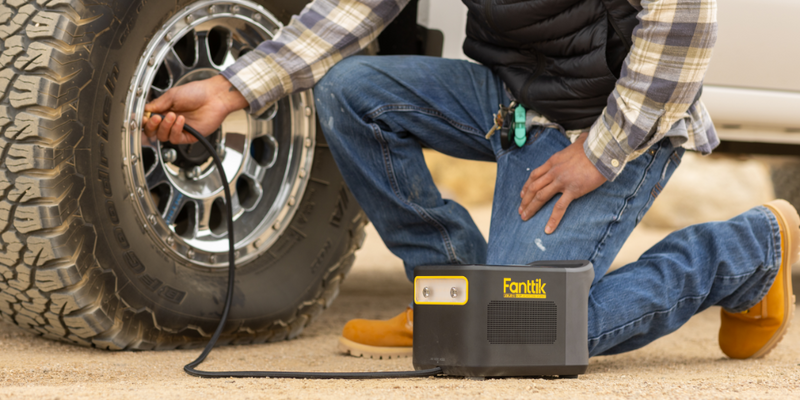
Maintaining proper pressure doesn't just save fuel; it prevents the premature tread wear that occurs when the tire sidewalls flex excessively under the weight of a heavy engine. For those with large 20-inch or 22-inch wheels, a high-CFM (Cubic Feet per Minute) cordless inflator is a necessity. Standard "emergency" inflators often overheat before they can fill a single 275/55R20 tire from 28 to 38 PSI.
When Performance Modifications Demand a Gear Upgrade
If you have upgraded your vehicle's performance, your factory storage solutions may no longer be adequate. We have identified two specific "triggers" that necessitate an immediate kit upgrade:
1. Forced Induction and Engine Relocations
When owners install superchargers, larger intercoolers, or turbo kits, they often have to relocate the battery or eliminate the spare tire well to make room for plumbing. This creates a "non-negotiable" need for a high-performance external storage kit. If your battery is now in the trunk or a remote corner of the engine bay, you need a jump starter with longer, heavy-gauge cables to handle the voltage drop over the extra distance.
2. Towing and Load Upgrades
Upgrading your suspension or powertrain to increase towing capacity changes the physics of your cargo area. Conventional wisdom suggests upgrading storage when you need more space, but the reality is that the critical failure point is often the mounting strength.
According to research on cargo restraint and lateral forces, cargo shifting can occur at forces as low as 0.5g during cornering. For a high-displacement vehicle carrying heavy tools or spare parts, factory plastic anchor points are often insufficient. If you are towing, you should upgrade to a load-rated, reinforced storage system to prevent your gear from becoming a projectile during a sudden maneuver.
Essential Checklist for Your Upgraded Storage Kit
As you transition to a more modern setup, align your choices with the principles outlined in The 2026 Modern Essential Gear Industry Report. Trust in your gear is built on visible compliance and measurable performance.
- Jump Starter: Look for at least 2000A peak for engines over 5.0L. Ensure it uses LiFePO4 or high-discharge lithium-ion cells.
- Inflator: Prioritize high-CFM (30L/min or higher) units with digital cut-off sensors. This ensures accuracy within 1 PSI, which is critical for sensitive Tire Pressure Monitoring Systems (TPMS).
- Safety Gear: Verify that all electronics carry relevant certifications (e.g., aligning with EU General Product Safety Regulation (EU) 2023/988).
- Storage Environment: Keep your lithium tools in a climate-controlled area if possible. While they can survive a "frozen trunk," their longevity is maximized at room temperature.
For more detailed guidance on maintaining your kit, we recommend exploring our insights on preventing cell degradation and maximizing cargo room for portable gear.
Trusting Your Preparedness
Upgrading your storage kit is about more than just buying new gadgets; it is about reducing the friction between you and the road. By understanding the physics of a cold-start and the chemistry of your batteries, you move from a "hope it starts" mentality to a "ready to drive" reality.
Modern high-displacement vehicles are marvels of engineering, but they are also demanding. Treat your support gear with the same respect you treat your engine, and you will find that the first drive of the season is always a success.
Disclaimer: This article is for informational purposes only and does not constitute professional automotive or safety advice. Always consult your vehicle's owner manual for specific battery and maintenance requirements. If you are unsure about performing a jump start or tire inflation, seek assistance from a certified mechanic.


Leave a comment
This site is protected by hCaptcha and the hCaptcha Privacy Policy and Terms of Service apply.