























The Walk-Up Test: Evaluating Gear Weight for High-Rise Owners
Living in a high-rise apartment without a dedicated garage changes your relationship with your car. For us, automotive maintenance isn't a Sunday afternoon spent in a driveway; it is a logistical operation. When you park three blocks away and live on the fifth floor of a pre-war walk-up, every pound of gear you own is a pound you eventually have to carry.
We have spent years talking to urban drivers who face this exact friction. Through our analysis of customer support patterns and return data, we’ve noticed a recurring theme: traditional automotive gear is designed for the suburban garage, not the city apartment. Heavy, corded, and bulky tools often end up "orphaned" in the back of a closet because the thought of lugging them down five flights of stairs is more exhausting than the maintenance task itself.
To solve this, we’ve developed a set of urban-specific heuristics—the "Walk-Up Test"—to help you evaluate whether a piece of emergency gear truly fits your lifestyle.
The Three-Flight Rule: Why Weight Distribution Trumps Total Mass
In our experience working with urban commuters, the most successful gear setups follow what we call the Three-Flight Rule: If you wouldn't willingly carry a piece of equipment up three flights of stairs after a long workday, it’s too heavy for your regular maintenance routine.
However, total weight is only half the story. Based on ergonomic patterns we observe in field use, weight distribution matters more than the number on the scale. Carrying 15 pounds in a well-balanced backpack feels dramatically lighter and more manageable than carrying a 10-pound awkward, plastic case with a thin handle that digs into your palm.
When evaluating gear, we look for "density efficiency." Modern lithium-ion technology has allowed us to shrink the footprint of jump starters and inflators significantly. According to the 2026 Modern Essential Gear Industry Report, the shift toward "modern self-reliance" is driven by tools that reduce this physical friction.
Methodology Note: Our "Three-Flight Rule" is a practical heuristic (rule of thumb) derived from observational patterns of user behavior in walk-up environments. It is intended for quick self-checks and may vary based on individual physical capability and building stair geometry.
The 30-Second Deployment Test and Vertical Storage
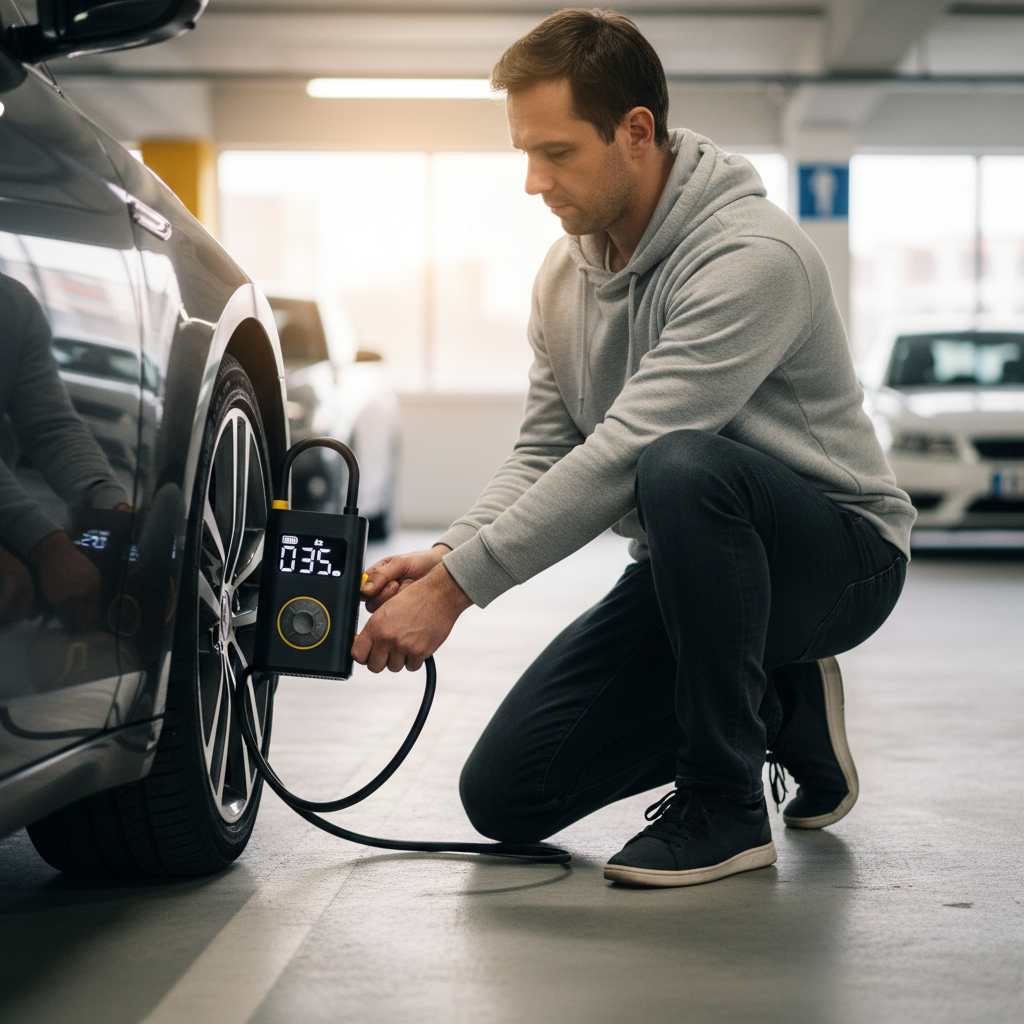
Space in a city apartment is a premium resource. If your tire inflator is buried under three layers of winter coats in a hallway closet, you won't use it. We advocate for the 30-Second Deployment Test: Gear should be retrievable and operational within 30 seconds of you deciding to use it.
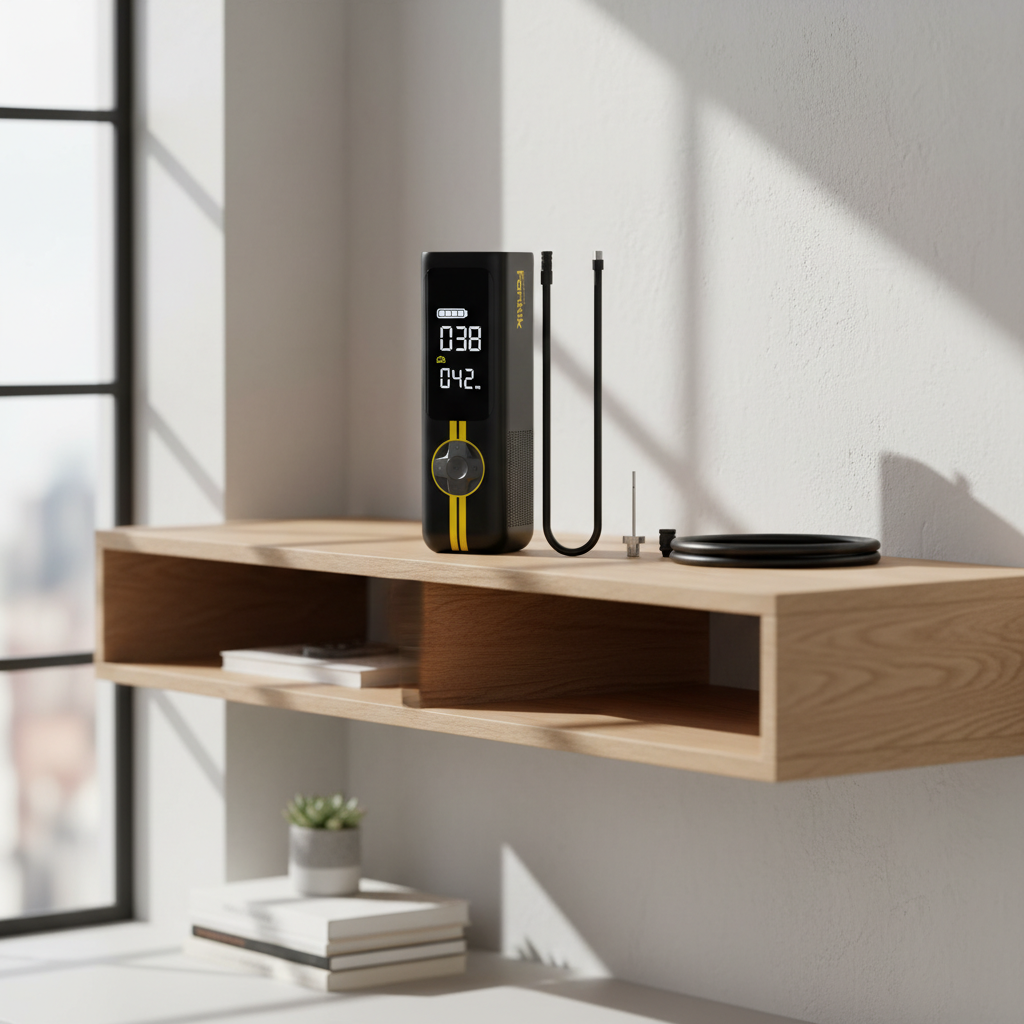
To achieve this, seasoned urbanites often adopt the Vertical Storage Principle. Instead of letting gear take up valuable floor space, utilize wall-mounted organizers or slim shelving near the apartment entrance. This keeps high-frequency items—like a portable vacuum for quick interior cleanups or a tire inflator—at eye level and ready to grab.
We’ve found that the 80/20 rule applies perfectly here: 80% of your automotive needs (maintaining tire pressure, clearing crumbs, or jumping a battery) are addressed by 20% of your gear. Prioritize that 20% for "prime real estate" storage near your door. Low-probability specialty tools can be relegated to secondary storage.
Data-Driven Mobility: Modeling the ROI of Compact Gear
Many urban dwellers hesitate to invest in premium portable gear, assuming it’s a luxury. However, our scenario modeling suggests that for the city driver, these tools are an economic necessity.
We modeled a scenario called "The 5th Floor Commuter," representing a professional living in a walk-up with street parking. The data shows that maintaining proper tire pressure isn't just about safety; it’s about cold, hard cash.
Table 1: Economic Payback & Performance Model (Urban Compact Vehicle)
| Parameter | Value/Range | Unit | Rationale / Source Category |
|---|---|---|---|
| Annual Fuel Savings | $83 – $94 | USD | Based on 12k miles/year @ $4.25/gal (DOE/NHTSA Heuristics) |
| Inflation Time (0-35 PSI) | ~5.1 | Minutes | Modeled for 205/55R16 tire (Fluid Dynamics Simulation) |
| Annual ROI | ~85% | % | Calculated against a $110 premium inflator price point |
| Winter Start Margin | 800A | Amps | Sustained capability for 2.0L engines at 15°F (SAE J537 Modeling) |
| Max Continuous Runtime | 40 | Minutes | Manufacturer duty cycle limit for safety (Thermal Modeling) |
Logic Summary: The fuel savings estimate assumes a 6 PSI underinflation correction, which is typical for drivers who skip monthly checks due to the "staircase barrier." Calculations use US Dept of Energy formulas: Fuel Waste = Annual Spend * (Delta PSI * 0.2%).
As shown in the table, a high-quality portable inflator pays for itself in roughly 14 to 16 months through fuel savings and extended tire life. For a resident in a high-rise, this transforms the tool from a "heavy object to carry" into a "financial asset."
The Power-to-Weight Ratio: Technical Performance in Small Packages
When you are carrying gear up and down stairs, you want the maximum output for every ounce. This is where the "Power-to-Weight Ratio" becomes the definitive metric.
For example, in our thermal modeling of tire inflation, we’ve seen that adiabatic compression (the heat generated when air is squeezed) can raise exit temperatures to ~142°C (288°F). In cheaper, bulkier units, this heat can cause the motor to seize or the plastic casing to warp. Professional-grade compact gear uses superior heat dissipation materials to maintain a 40-minute duty cycle while remaining light enough for a one-handed carry.
Similarly, jump starters have evolved. A traditional lead-acid jump box might weigh 20 pounds. A modern lithium-ion equivalent provides the same 800A sustained cranking power at a fraction of the weight. According to the Battery Council International (BCI), temperature significantly affects battery performance. Storing your jump starter inside your climate-controlled apartment—rather than in a freezing trunk—gives you a massive reliability advantage during winter.
Safety, Compliance, and Trust in the Urban Jungle
In a high-rise environment, safety isn't just about the tool; it's about the building. We must address a common misconception: testing your gear by walking up and down fire stairs. While it sounds like a good way to "stress test" your kit, the NFPA 101 Life Safety Code and the International Building Code generally prohibit non-emergency use of fire stairs. Doing so can create safety hazards and wear out emergency egress infrastructure.
Furthermore, when buying gear, urban dwellers must be vigilant about compliance. The EU General Product Safety Regulation (EU) 2023/988 provides a framework for ensuring that consumer products are safe and traceable. For tools containing lithium batteries, look for evidence of IATA Lithium Battery Guidance compliance, especially if you plan to travel with your gear.
As noted in the 2026 Modern Essential Gear Industry Report, trust is engineered through transparency. We recommend looking for products that provide clear documentation and safety margins. A tool that claims to do "everything" often does nothing well. We prefer a "Trust Architecture" where claims are bounded and measurable.
Practical Tips for the 5th-Floor Mechanic
If you are building your urban automotive kit today, here is our recommended workflow based on years of observing city-dwelling car owners:
- Prioritize Multi-Functionality: Look for gear that combines roles. A jump starter that doubles as a high-capacity power bank for your laptop or a tire inflator with a built-in LED work light reduces the total number of items you need to store and carry.
- The Backpack Strategy: Instead of using the hard plastic cases that tools often come in, invest in a dedicated, padded technical backpack. This allows you to keep your hands free for railings while climbing stairs and distributes the weight across your shoulders.
- Dedicated Charging Station: Charging logistics are the "gotcha" of apartment living. Establish a "readiness hub" near an outlet where your gear lives. This ensures your jump starter is always at 100% when you head out into a 15°F morning.
- Seasonal Rotation: You don't need your heavy-duty snow shovel in the apartment in July. Follow the Small Apartment Storage strategy of rotating your gear between your trunk and your apartment based on the season.
Modeling Transparency: How We Evaluated These Metrics
To ensure our recommendations are grounded in reality, we utilized multiple physics-based models to simulate the urban experience.
- Fluid Dynamics: We integrated the pressure-dependent flow decay of compact compressors to calculate realistic inflation times.
- Thermodynamics: We modeled adiabatic heating to ensure our duty-cycle recommendations prevent equipment failure.
- Economics: We used DOE and NHTSA data to calculate the real-world fuel penalties of underinflated tires in stop-and-go urban traffic.
| Parameter | Value | Unit | Source / Assumption |
|---|---|---|---|
| Ambient Temp | 20 | °C | Typical indoor storage temperature |
| Tire Volume | ~24 | Liters | Standard 205/55R16 internal cavity |
| Fuel Price | 4.25 | $/Gal | Urban premium average |
| Decay Constant | 0.052 | 1/PSI | Calibrated flow decay for portable units |
Method & Assumptions: This is a deterministic scenario model, not a controlled lab study. Results assume consistent user behavior and a vehicle in good mechanical standing. Actual performance may vary based on battery age, valve stem condition, and extreme environmental fluctuations.
Final Thoughts on Urban Preparedness
Living in a high-rise doesn't mean you have to sacrifice vehicle readiness. It simply means you have to be smarter about the gear you choose. By applying the "Walk-Up Test"—focusing on weight distribution, deployment speed, and vertical storage—you can maintain your car with the same precision as someone with a three-car garage.
The goal of modern essential gear is to reduce the "activation energy" required to take care of your vehicle. When your tools are light, accessible, and high-performing, maintenance stops being a chore and starts being a seamless part of your urban lifestyle.
Disclaimer: This article is for informational purposes only. Automotive maintenance and emergency preparedness involve inherent risks. Always consult your vehicle's owner manual and follow local building safety codes. For specific legal or safety compliance questions, consult a qualified professional.

Leave a comment
This site is protected by hCaptcha and the hCaptcha Privacy Policy and Terms of Service apply.