












































No single PSI number fits every cargo e-bike. To choose tire pressure for a cargo e-bike, start with your tire's marked pressure range and any rim limit. Then pick a setting inside those limits that matches the weight you actually carry and the way you ride.
The specs from your bike, tire, or wheel maker set your real target. If you cannot find a suitable pressure inside your component limits, confirm with the manufacturer or a bike shop before taking a loaded ride.
How to Choose a Starting Pressure
Start with the documentation for your exact bike, tires, and wheels rather than a generic cargo-bike number. In its tire pressure guidance, bicycle tire maker Schwalbe notes that a universal pressure recommendation is impossible for a specific bike or tire. The right pressure depends mostly on the load on the tire, which comes primarily from rider and cargo weight rather than the bike itself.

That is why two riders on the same cargo bike often need different settings. A solo commute puts a very different load on the tires than hauling a child seat plus a week of groceries. Before you set your pressure, write down four details:
- The exact tire size and model printed on the sidewall.
- The rim or wheel model, plus any pressure marking on the rim or rim tape.
- Your intended load: rider, passenger, and cargo.
- Your riding surface, such as smooth pavement or rougher paths.
Match those details to your component guides. Some cargo tire makers publish setup-specific advice. For its Motion Pick-Up cargo tire, Schwalbe notes that total system weight (you, the bike, and the cargo) can vary widely, so you should check pressure regularly with a gauge. Schwalbe also points out that squeezing the tire by thumb is unreliable on that model's stiff construction. While that note applies specifically to the Motion Pick-Up, a gauge reading beats guessing on any cargo setup.
If your documentation lists a pressure for your load, dial it in with a gauge. Otherwise, use the component limits and load factors below to narrow your choice.
How Tire and Rim Limits Bound Your Choice
Your tire and rim limits set the safe operating window for your setup, not your target riding pressure. Schwalbe notes that the allowed pressure range is printed on the tire sidewall, and your operating pressure must never go above that maximum or drop below the minimum.
Your rim has limits, too. Giant's tire pressure guide states that you should never inflate past the maximum shown on the rim, the tire, or the rim tape. It also emphasizes that maximum pressure is not the recommended riding pressure. Running at the upper limit can create a harsh, potentially dangerous ride.
Here is how to combine those markings into a safe working range:

- Lowest allowed: the minimum pressure printed on the tire.
- Highest allowed: the lowest maximum rating among your tire, rim, and rim tape.
- Your target: a pressure inside that window that matches your load, based on your component guides.
Check your rim documentation directly if the rim itself has no pressure marking, rather than relying on the tire sidewall alone. For example, Schwalbe lists 35 to 65 PSI for its Pick-Up 55-406 (20 x 2.15) tire. That range only defines the allowed window for the tire itself. It is not a recommended riding setting, and it tells you nothing about what your rim can handle.
If the rim's maximum falls below the tire's minimum, there is no overlapping safe window. If you cannot locate a rating for your components, you cannot confirm a safe operating range from the available markings. In either situation, hold off on riding loaded and contact the bike, tire, or wheel maker—or a local cargo-bike shop—before inflating.
How Load and Riding Conditions Affect Pressure
Your total load and riding conditions determine where you should land inside your allowed pressure window. According to Schwalbe, narrower tires and heavier total loads require higher pressure. Your riding priorities also factor in: higher pressure lowers rolling resistance, tread wear, and puncture risk, while lower pressure improves ride comfort and grip.
On a cargo e-bike, this creates a direct practical tradeoff. Carrying a heavy load on a narrower tire pushes your target toward the upper end of your allowed range. Running a wide tire with a light load leaves more room to drop the pressure for comfort and traction. Smooth pavement and rough paths will also shift whether rolling speed or shock absorption matters more on a given trip.
Available manufacturer guides do not provide a fixed PSI-per-pound formula, a standard front-to-rear pressure split, or exact numbers for specific terrain. Because of that, whenever your load changes significantly—like adding a passenger—check your bike or tire documentation for that heavier setup and adjust with a gauge.
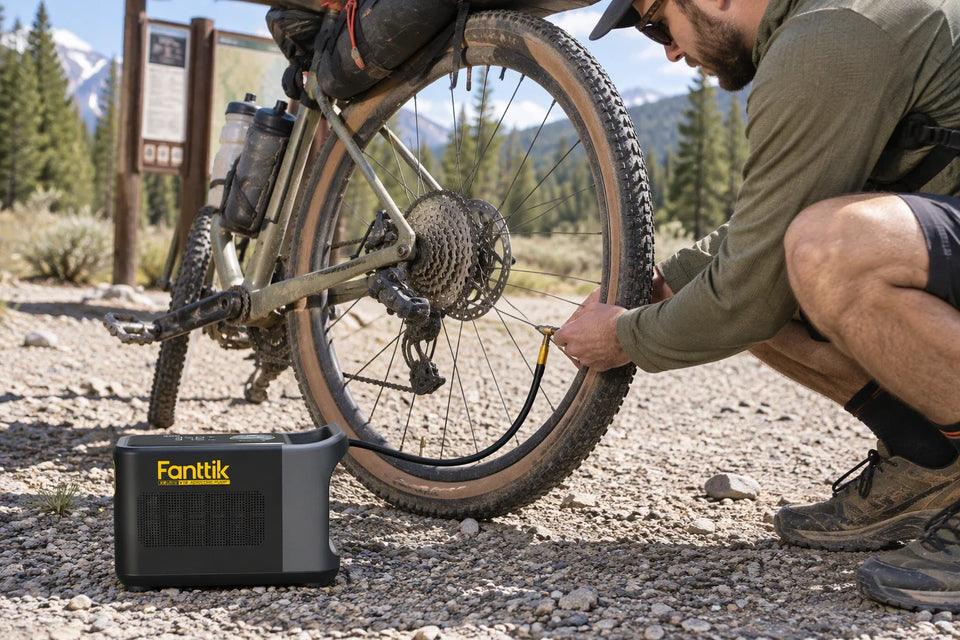
Once you settle on a target PSI, a pump with an accurate gauge makes it easy to hit that number before every trip. Our bike-pump setup and care guide walks through valve checks and the inflation workflow for that pump.
FAQs
How often should I check cargo e-bike tire pressure?
Schwalbe's North America guidance recommends checking and adjusting pressure at least once a month, since bicycle inner tubes slowly lose air over time. Because a cargo bike's load often changes from trip to trip, it also pays to check before heavy hauls, in line with Schwalbe's advice to check its Motion Pick-Up cargo tire regularly.
Can I just squeeze the tire to check it?
No. Schwalbe calls the thumb test very inaccurate because most bike tires feel equally firm above about 29 PSI (roughly 2 bar). On stiff, heavily reinforced cargo tires, squeezing by hand tells you even less. Always use a pressure gauge.
Do wider cargo tires run lower pressure?
Generally, yes. Schwalbe notes that wider tires typically run at lower pressures because their larger air volume helps absorb bumps. You still need to stay within the minimum and maximum limits printed on your tire and rim.
What happens if I ride with pressure too low for a long time?
Schwalbe notes that riding on continuously low pressure causes premature tire wear, typically showing up as sidewall cracking and faster tread wear. Lower pressure does cushion road shocks better, so the goal is finding a setting inside your allowed limits that balances ride comfort with tire lifespan.
Can I use a car tire inflation rule for my cargo bike?
No. Schwalbe points out that on a bicycle, the rider and cargo make up most of the total weight, whereas a car's curb weight makes up the bulk of its load. Automotive habits—like using a single door-jamb number or adding a flat PSI bump—do not translate to bicycle tires.
Continue reading
 When Is a Cordless Pressure Washer Too Small for a Large Cleaning Job?
A practical fit test for big cleaning jobs that compares flow, mode-specific runtime, water setup, and surface needs,...
 How to Pressure Wash Concrete Steps Without Etching the Surface
A step-by-step way to clean outdoor concrete steps with a pressure washer: check the surface, test a hidden...
Leave a comment
This site is protected by hCaptcha and the hCaptcha Privacy Policy and Terms of Service apply.