












































Yes, but only when three things line up. The exact model's instructions have to describe a water-feed setup that works with water you can actually reach. Your property has to allow balcony washing, and local rules have to allow the path the runoff will take.
If any one of those is unknown, wait. A cordless pressure washer solves the power problem because you don't need an outlet. It doesn't automatically solve the water problem or the runoff problem. The checks below walk through each one so you can decide whether to go ahead.
Can Your Washer Use the Water Source You Have?
Start with the manual for your exact model, not with whatever container happens to be nearby. "Cordless" tells you how the washer is powered. It says nothing about how the washer takes in water. One model may be designed around a built-in tank, while another may expect a hose connection or a specific suction accessory.
Here's what to look for in the current manual or the manufacturer's instructions:
- The approved water source. Does it name a built-in tank, a supply hose, or a separate container with an intake line?
- Required parts. Note any hose, filter, or adapter the setup needs, and confirm you have the exact part listed.
- Setup limits. Look for any conditions on how the source must be positioned or connected.
Then compare that against what your balcony really offers. Maybe that's a kitchen sink inside, a bucket, or nothing close by. If the instructions don't clearly cover your source, don't improvise with a random bucket or an unlisted accessory. Ask the manufacturer's support team about your model first.
Built-in tanks are one documented example. Our NB10 Fold, for instance, is listed with a foldable 3.2-gallon tank and names patio cleaning as a use. A listing like that tells you what the washer carries. It doesn't settle whether your balcony, building, or runoff route is suitable.

Water supply also matters before you press the trigger. Running dry can be a problem, so it's worth reading how to confirm washer water supply before startup. Use that alongside your model's instructions, not in place of them.
Will Your Building and Runoff Rules Allow It?
Get two answers from property management: whether you can pressure wash on your balcony, and where the wash water is allowed to go. Those are separate questions. A building might allow light cleaning but ban spraying, or allow washing only if no water drips onto the units below.
Next, figure out where the water would actually go. It could run into a balcony drain, over the edge, down onto a patio or parking area, or into a storm drain. Don't assume a balcony drain is approved for wash water just because it's there. Ask what it connects to.
That question matters because of what storm drains do. The EPA notes that stormwater generally flows to waterways without additional treatment, unlike wastewater that goes to a treatment plant. It also describes municipal programs, including local ordinances, aimed at finding and stopping non-stormwater discharges into storm-drain systems. That's general background. It doesn't tell you the rule for your address.
Local rules can be specific. In Bellingham, Washington, for example, the city states that pressure-washing wastewater may not enter storm drains. Its guidance calls for capturing the runoff and sending it to a drain that leads to the sanitary sewer. That rule applies in Bellingham. Your city's requirements may be different, so check them yourself.
If management can't tell you where the water goes, or your local rule is unclear, contact your city's stormwater or public works office before you wash. A short email naming your building type and the drain you'd use usually gets a clearer answer than a general question.
Use This Go/No-Go Check Before You Set Up
Go ahead only if all three checks pass. Passing one doesn't cover the others.
- Water source confirmed: Your exact model's instructions document a water-feed setup that works with a source you can use on the balcony. If not: get model-specific clarification. Don't swap in an unlisted container or accessory.
- Building permission confirmed: Property management says balcony pressure washing is allowed. If not or unknown: don't wash on the balcony. Ask whether the property has an approved wash area instead.
- Runoff route confirmed: You know where the water goes, and the property and local rules allow that route. If not or unknown: hold off until management or your local stormwater office gives you an answer.
If any item is still open, the answer for today is to wait. In the meantime, a permitted cleaning method or an approved location elsewhere on the property can handle the job until all three checks are settled.
FAQs
Can a cordless pressure washer pull water from a bucket?
Only if the instructions for your exact model say so. Some washers are built around a tank or a specific intake setup. Don't assume a bucket will work unless the manual documents it.
Is it legal to let pressure washer water drain off my balcony?
That depends on your property's rules and the rules where you live. Some cities, Bellingham among them, prohibit pressure-wash wastewater from entering storm drains. Ask management where the water goes and check your local requirements.
Who should I ask about balcony washing rules?
Start with your property manager or HOA for building permission and drainage. For the runoff rule, contact your city's stormwater, public works, or wastewater office.
Does a built-in water tank mean I can use the washer anywhere?
No. A tank answers the water-supply question for that model. It doesn't give you building permission or approval for where the runoff goes.
Continue reading
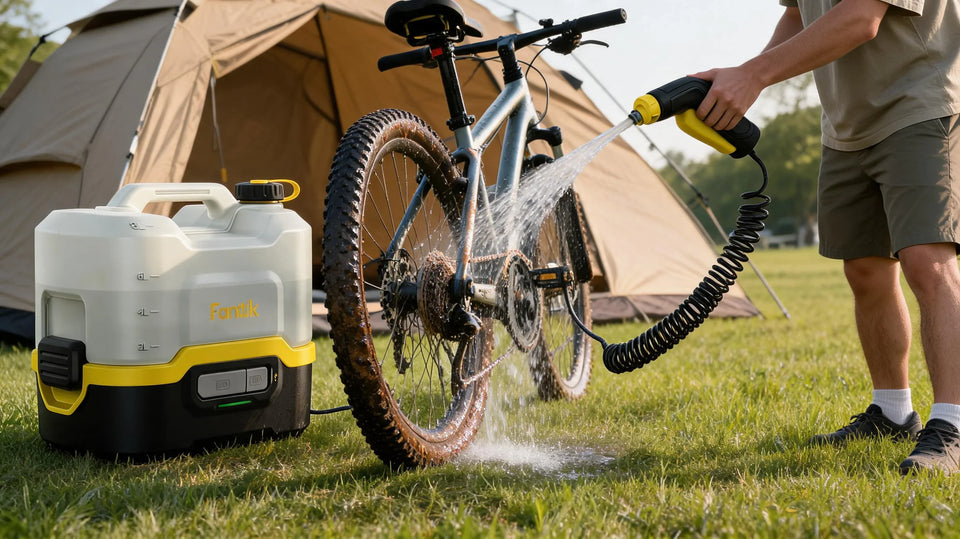 Using a Portable Pressure Washer at a Campsite Without a Hose
Find out when a cordless washer can pull from a bucket or barrel at camp, and which three...
 Electric Scissors or Manual Scissors for Large Fabric Projects?
Choose between powered and manual cutting tools by fabric, layer count, cut shape, and repetition, not by project...
Leave a comment
This site is protected by hCaptcha and the hCaptcha Privacy Policy and Terms of Service apply.