












































For a weekend at a family campground, you don't always have to choose between an instant tent and a cabin tent. Specific models can combine both.
"Instant" describes how the tent goes up, and "cabin" describes its shape. The real decision is which matters more to your family: fewer steps when you arrive and leave, or an interior layout that fits your beds, gear, and the people who need to stand up inside.
If a short stay means pitching after a long drive on Friday and packing up before checkout on Sunday, put setup first. If your family plans to spend rainy hours inside, sleep on large air mattresses, or keep bags indoors, put the floor plan and headroom first. Then compare the actual model numbers, not just the labels.

Can an Instant Tent Also Be a Cabin Tent?
Yes. The two labels answer different questions, so one tent can carry both. An instant tent uses a pre-attached frame, while a cabin tent is defined by steep, near-vertical walls that maximize usable standing height compared to inward-sloping domes.
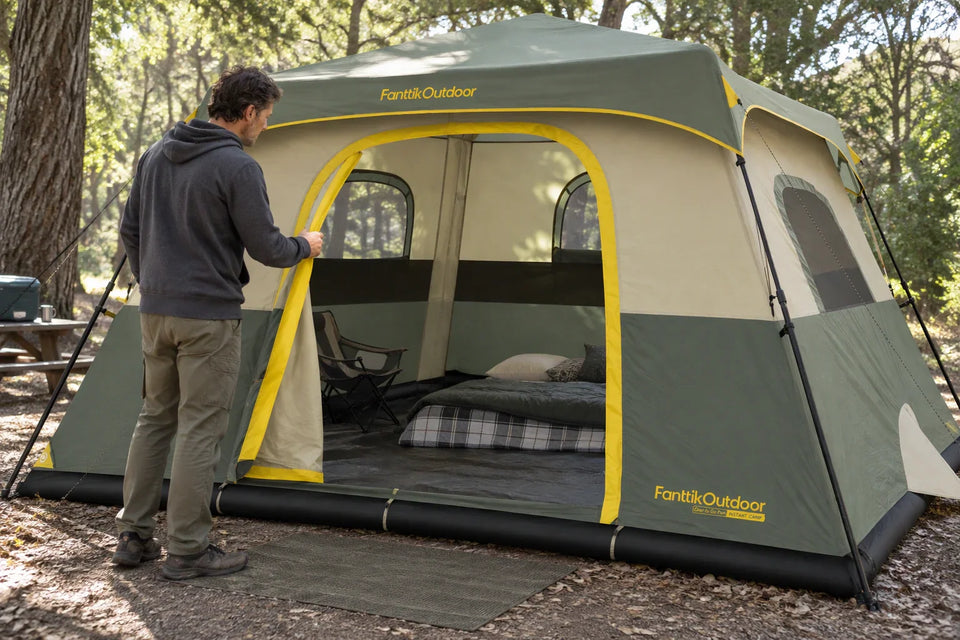
That means you should rate any tent on two separate scales. First, how does it go up? Second, what shape and floor plan do you get once it's up? Our instant cabin tent lineup puts both features in one design. Not every cabin tent is instant, though. Many conventional cabin tents still use separate poles that you assemble on site.

That difference has a practical cost. Conventional cabin tents with separate pole assemblies require sorting, threading, and securing multiple frame pieces before the tent stands. Pre-attached instant frames skip those assembly steps entirely, showing why setup method remains a separate question from interior shape.
Compare Setup, Layout, and Packed Size for Your Weekend
What the Supplied Model Listings Show
Two of our models show how instant setup and cabin shape fit together. Both are instant cabin tents, so this table compares two versions of the combined design. It does not compare instant tents against conventional cabin tents.
| Model | Listed setup and interior | Packed dimensions |
|---|---|---|
| Zeta C8 Pro model details (instant cabin, 8-person) | 60-second setup, pre-installed steel poles; 13 ft x 9 ft floor, 117 sq ft; listed fit for two queen air mattresses | 45 x 8.75 x 8.75 in; 26.84 lb |
| Alpha C6 Pro model details (instant cabin, 6-person) | 60-second setup, integrated fiberglass frame, no separate support poles; 121.3 sq ft floor; 90.5 in center height | 41.73 x 11.02 x 11.42 in; 29.76 lb |
Both listings give the same 60-second setup claim, so neither one wins on setup speed. The difference is the frame. The Zeta C8 Pro uses pre-installed steel poles. The Alpha C6 Pro uses an integrated fiberglass frame and lists three separate entrances, plus windows you can close from inside. That matters if kids are going in and out all weekend, or if rain arrives after dark.
Apply the Layout and Pack Dimensions to Your Family
Start with the beds. If your family plans to bring two queen air mattresses, the Zeta C8 Pro listing names that setup directly, on a 13 ft x 9 ft floor. The Alpha C6 Pro gives a slightly larger floor area of 121.3 sq ft, but its listing doesn't include a mattress layout. Before you assume two queens will fit, compare your mattresses' actual length and width with its floor. Real air mattresses can differ from the nominal queen size, so measure yours first.
Next, consider standing room. The Alpha's 90.5 in center height is useful when tall adults need to stand up to change clothes. That number describes the peak, though, not the clearance at every spot on the floor. If headroom near the walls matters, plan to keep beds along the edges and leave the standing area in the middle.
Then check the bag shape against your vehicle. The Alpha's bag is 3.27 in shorter in its longest dimension. The Zeta's bag is 2.27 in and 2.67 in smaller in its other two dimensions. In a cargo area limited by length, the shorter bag has an advantage. If the open spot is a narrow gap between coolers or car seats, the slimmer bag may fit better. Neither bag is more compact in every direction.
Here is how to weigh the two priorities. Put setup ease first when the hardest part of your weekend is pitching on arrival and breaking down at departure, especially with small kids to watch. A pre-attached frame removes the pole-assembly step, and both models above share that feature. Put layout and room first when your sleeping surfaces, bags, and tall family members must all fit inside. If you're still considering a conventional non-instant cabin tent for extra room, compare its documented floor size, wall height, and packed size against these figures before deciding that the extra setup time is worth it. Our instant tent range is useful for that side-by-side spec check.
FAQs
Is a tent's person-capacity label enough to tell whether it will fit your family?
No. A capacity label usually counts sleeping pads placed side by side, with little room left for gear. To check the fit, sketch your planned beds on the listed floor dimensions. Then mark where the bags, cooler, and shoes will go. If the plan only works with no walking space, you probably need a bigger floor.
How should you compare packed tent dimensions with your vehicle?
Measure the trunk or cargo opening and the storage space where the bag will ride. Compare all three listed packed dimensions with those measurements, not just the length. A bag can fit the length of the trunk and still be too thick for the space once other gear is loaded.
Does a tent's center height tell you how much standing room it has?
Only at one point. Center height is measured at the peak, and the ceiling gets lower toward the walls. Cabin shapes keep the walls steeper than domes do, but you still need to compare listed wall or corner heights, when they're available, to judge how much of the floor works for standing.
Continue reading
 How to Drill Melamine Without Chipping the Surface
A step-by-step method for holes in melamine-faced panels: confirm the panel, match the bit to blind or through...
 Storing a Camping Tent in a Small Apartment Between Trips
Practical steps to dry, place, and loosely pack a tent at home between trips, plus pole storage, spot...
Leave a comment
This site is protected by hCaptcha and the hCaptcha Privacy Policy and Terms of Service apply.