












































Only if your car stays inside that model's documented storage range at the exact spot where the jump starter sits. No single storage limit applies to every jump starter, and a parked car in summer can get hotter than some ranges allow. For a sense of scale, one study's 60-minute cabin measurements averaged 46.7°C (about 116°F) for cabin air in sun-exposed vehicles and 38.3°C (about 101°F) in shaded ones—averages that reflect specific test conditions rather than a trunk or a seasonal maximum.

So start by finding your model's storage range. Then compare it with the heat you expect in the cabin or trunk over the whole summer. If the expected temperatures could go past that range, or you can't tell, keep the unit somewhere cooler.
Find the Right Temperature Limit for Your Model
The number you want is the storage temperature, which is the range the unit can handle while it sits unused. A manual may also list other ranges, and those don't answer the storage question.
- Match the exact model. Use the manual or official product documentation for your exact model and version. A sister model's figure doesn't count.
- Find the line labeled for storage. Look for wording like "storage temperature." Write down both ends of the range and the unit, °F or °C.
- Keep other ranges separate. Working, operating, and charging ranges describe the unit in use or on a charger. For example, our product spec table lists 5°F–113°F as the Working Temperature for the T8, T8 APEX, and T8 MAX. That figure covers use, so it doesn't tell you how hot a car can get while the unit sits in storage.
- Ask if storage isn't listed. If you can't find a storage range, ask the manufacturer for that model's storage guidance. Don't guess it from a working or charging range.
How to Decide Whether a Hot Car Is Within That Limit
Next, line up the documented range against the place where the unit will actually ride.
- Write down both ranges in the same units. One is the model's storage range. The other is the temperature range you expect at that exact spot across the whole storage period. To turn Celsius into Fahrenheit, use °F = (°C × 9/5) + 32.
- Estimate the real conditions at that spot. Calling a spot "the trunk" or "shaded parking" tells you nothing about its temperature. You need some basis for the heat in that location. As noted earlier, 60-minute test cabin averages reached about 116°F in full sun and 101°F in shade, but actual vehicle heat fluctuates and trunks differ from cabins.
-
Pick your branch.
- The expected range stays fully inside the storage range: that spot fits the documented limit.
- It may cross either end: the car doesn't fit. Store the unit where conditions stay within range, and bring it along for trips.
- You don't know the conditions: treat that spot as unconfirmed and pick a location whose conditions you can keep within range.

Heat affects more than storage limits. Our guides cover heat and cranking amps and self-discharge during trunk storage, which help if you keep a unit in the vehicle for months.
What to Do If It May Have Exceeded Its Storage Limit
If the unit may have gotten hotter than its storage range, follow that exact model's manufacturer instructions for inspection, charging, and whether to keep using it. Don't borrow a routine meant for a different model. A possible excursion doesn't prove the unit is damaged, and it doesn't prove the unit is fine either.
If your manual doesn't cover heat exposure, contact the manufacturer with the model name and a description of what happened, such as where the unit sat, for how long, and in what weather. For a Fanttik unit, you can contact our support team. If you want to know what heat damage can look like on a battery, our guide to spotting battery swelling explains the visual checks.
FAQs
Does a brief excursion above the storage range automatically mean the jump starter is damaged?
No. Only the exact model's manufacturer guidance can tell you what to check and whether to keep using it.
What if the manual lists a working or charging range but no storage range?
Don't treat either one as a storage allowance. Those ranges describe use and charging. Ask the manufacturer for the storage range for your model.
Can one hot afternoon's temperature reading show that a jump starter is safe in the car all summer?
No. One reading only shows that moment. Summer conditions shift with sun, parking spot, and heat waves, so the decision has to rest on the full range you expect for the season.
Continue reading
 Jump-Starting a Start-Stop Car: Follow Its Battery Instructions
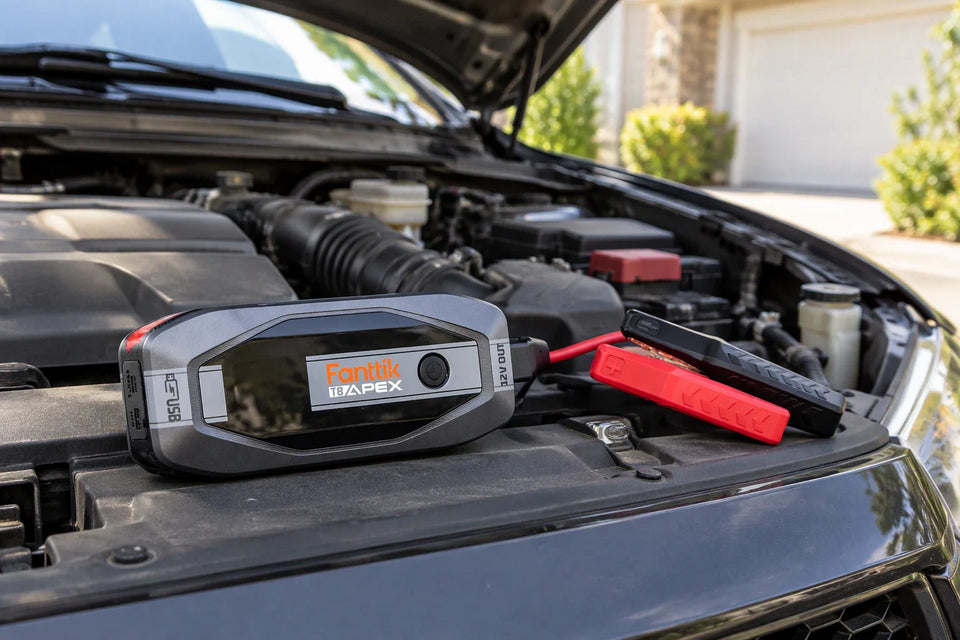
A portable booster isn't automatically safe on a start-stop car. Compare your car's jump-start points with the booster's...
 After Using a Jump Starter, Recharge It Before the Next Drive
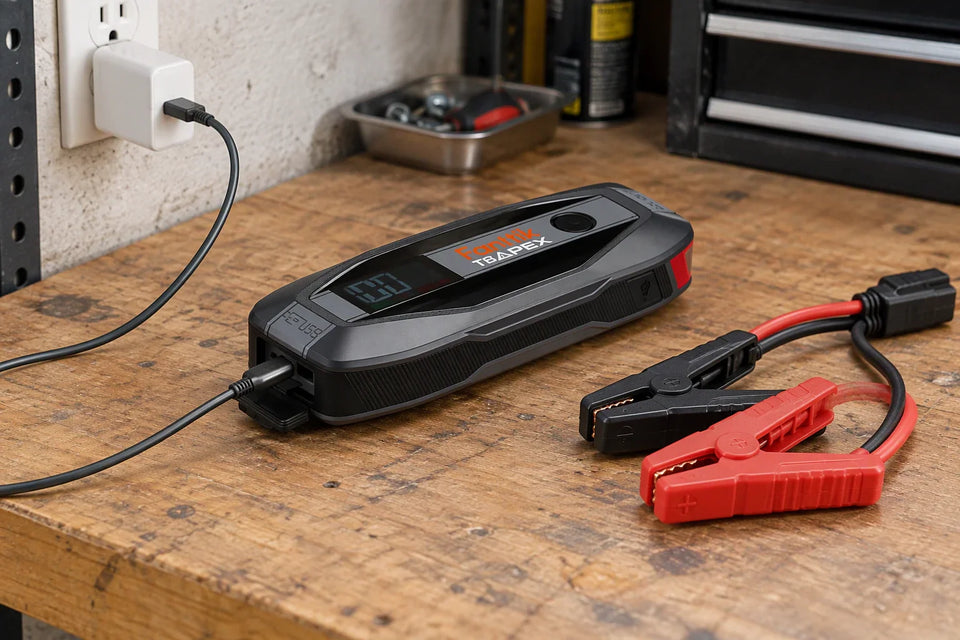
What to do once your jump starter has started the car: recharge it the way your model's instructions...
Leave a comment
This site is protected by hCaptcha and the hCaptcha Privacy Policy and Terms of Service apply.