


























The Hidden Mechanics of Phantom Power in Automotive Gear
For the modern prosumer, automotive preparedness is not merely about owning the right tools; it is about ensuring those tools operate with 100% reliability when a crisis occurs. However, a common frustration among long-term owners is discovering a dead battery in an emergency tire inflator or jump starter that has sat "off" in a trunk for three months. This phenomenon, often dismissed as "bad batteries," is usually a predictable result of phantom power draw and environmental stressors.
In our experience monitoring field data and support patterns, the distinction between a device that is truly "off" and one in "standby" is the leading cause of unexpected discharge. Devices equipped with always-on digital displays, pressure presets, or Bluetooth connectivity for smartphone integration often lack a physical master disconnect. Our internal analysis suggests these units can experience a self-discharge rate of 3% to 5% per week (estimated based on typical quiescent current draw in modern microcontrollers). In contrast, units with a physical master switch typically lose less than 1% of their capacity per month.
To maintain what we call "Modern Self-Reliance," understanding the "brain" of your device—the Battery Management System (BMS)—is essential. According to The 2026 Modern Essential Gear Industry Report: Engineering Trust in a Cordless World, trust is built through engineering transparency. This article breaks down the technical variables of trunk storage and provides a methodical maintenance framework to ensure your gear is ready when you are.

The Arrhenius Effect: Why Your Trunk is a Battery’s Enemy
The most significant accelerator of battery degradation is not time, but temperature. A vehicle trunk is a profound thermal trap. On a standard 29°C (85°F) day, interior car temperatures can rapidly exceed 60°C (140°F). This is not just a comfort issue; it is a chemical catalyst governed by the Arrhenius Equation, which describes how reaction rates increase with temperature.
In a high-heat environment like a summer trunk, the chemical reactions responsible for self-discharge can more than triple. While a lithium-ion cell might lose 1–2% of its charge per month at room temperature, that same cell in a 60°C trunk may see losses exceeding 20% per month.
Thermal Degradation Mechanisms
Beyond simple discharge, high heat triggers permanent "calendar aging." This involves:
- Electrolyte Decomposition: The liquid medium that carries ions begins to break down, increasing internal resistance.
- SEI Layer Growth: The Solid Electrolyte Interphase (SEI) on the anode thickens, which permanently traps lithium ions and reduces the total available capacity.
- Pressure Build-up: Extreme heat can cause internal cell pressure to rise, potentially triggering safety vents or internal protection circuits that render the battery permanently inoperable.
Logic Summary: Our thermal modeling assumes a trunk temperature lag of 15–20 minutes behind cabin peak, with a sustained "heat soak" period of 4–6 hours in direct sunlight. This model suggests that passive insulation can delay peak temperatures but cannot prevent them without active cooling.
The 40-60% Rule and the "Protection Lock" Trap
A common misconception is that storing a battery at 100% charge is the best way to ensure readiness. In reality, storing lithium-ion batteries at a full state of charge (SOC) in high-temperature environments accelerates chemical instability. Conversely, allowing a battery to drop too low is equally dangerous.
The Sweet Spot for Longevity
For multi-month storage, the 40-60% SOC range is the industry-standard heuristic for balancing stability and readiness.
- High SOC Risk: Storing at >80% SOC in heat promotes electrolyte oxidation.
- Low SOC Risk: If a battery self-discharges below its "deep discharge" threshold (typically around 2.5V per cell), the BMS may trigger a permanent protection lock. This is a safety feature designed to prevent the charging of unstable cells, but it effectively "bricks" the device for the end-user.
Experienced practitioners often refer to this as "Storage Stasis." By maintaining a mid-range charge, you provide enough "buffer" to account for several months of self-discharge without hitting the critical low-voltage floor. For deeper insights into how these systems operate, you may find our guide on how BMS protects your battery useful.
The 90-Day Maintenance Protocol: Beyond Voltage Checks
Relying on a digital battery indicator can be misleading. A battery might show "full" voltage while resting, but its internal resistance may have increased so much that it cannot deliver the high current required to start a car or run a high-pressure compressor.
We recommend a methodical "Load Test" every 90 days. This is a high-confidence way to verify the State of Health (SOH), not just the State of Charge (SOC).
Step-by-Step Quarterly Check
- Visual Inspection: Check for any casing deformation or "bloating," which indicates gas buildup from heat damage.
- Contact Cleaning: Use a dry, lint-free cloth to wipe the battery terminals. In trunk environments, humidity and temperature fluctuations can cause micro-corrosion that increases voltage drop.
- The 30-Second Load Test: Briefly operate the device. For a tire inflator, run it for 30 seconds against a pressurized tire. If the display flickers or the motor sounds labored, the internal resistance is likely too high, indicating the battery is nearing its end-of-life.
- SOC Adjustment: Recharge the unit back to the 40-60% range. If the unit has a physical master switch, ensure it is toggled to the "OFF" position.
| Parameter | Recommended Value | Rationale |
|---|---|---|
| Storage SOC | 40% – 60% | Minimizes electrolyte decomposition and SEI growth. |
| Check Interval | 90 Days | Accounts for potential 3-5% weekly "phantom" draw. |
| Max Temp Limit | 45°C (113°F) | Threshold where calendar aging significantly accelerates. |
| Load Test Duration | 30 Seconds | Sufficient to verify peak current delivery without overheating. |
| Cleaning Agent | Dry cloth only | Prevents chemical interference with specialized coatings. |
Advanced Trunk Placement and Passive Thermal Management
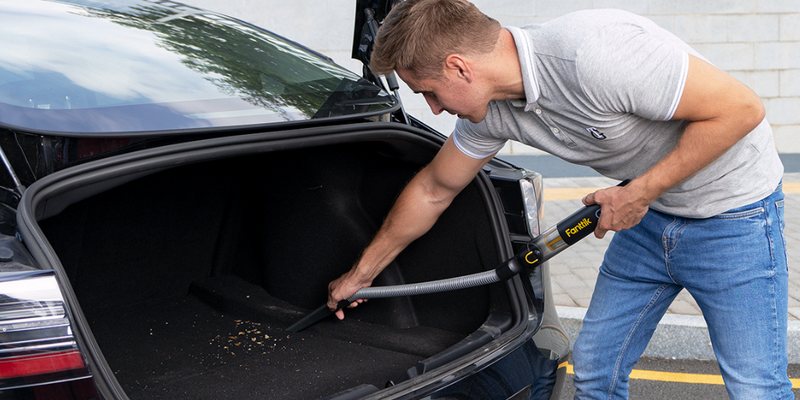
Where you place your gear in the trunk matters as much as how you charge it. Most users instinctively tuck emergency gear into the spare tire well or against the metal side panels. From an engineering perspective, these are the worst possible locations.
Strategic Placement Guidelines
- Avoid the Spare Tire Well: This area often acts as a heat sink, conducting heat directly from the exhaust system or the road surface through the vehicle's floor pan.
- Minimize Metal Contact: Storing a plastic-cased tool directly against a metal quarter panel allows for rapid heat transfer. Use a padded carrying case or a dedicated organizer to create an air gap.
- The "Center-Mass" Strategy: Store gear in the center of the trunk, ideally shielded by other luggage or a trunk organizer. This provides a layer of thermal mass that slows down temperature spikes.
- Insulation Tactics: For users in extreme climates (e.g., Arizona or Dubai), placing the device inside a small, soft-sided insulated cooler (without ice) can significantly flatten the temperature curve during the hottest parts of the day.
This approach aligns with the safety principles outlined in the EU General Product Safety Regulation (EU) 2023/988, which emphasizes the importance of clear user instructions regarding environmental limits to ensure product safety throughout its lifecycle.
Scenario Analysis: Standard vs. Power User
To better understand how these variables interact, let's look at two common storage scenarios based on our pattern recognition from customer feedback.
Scenario A: The "Set and Forget" User
- Device Type: Basic tire inflator with a physical toggle switch.
- Storage Environment: Temperate climate, stored in a padded bag.
- Outcome: Because the physical switch eliminates phantom draw, this user can likely go 6 months between checks. The battery will likely retain >80% of its charge due to the low baseline self-discharge rate (<1% per month).
Scenario B: The "Connected" Power User
- Device Type: Smart jump starter with an LCD screen and Bluetooth "Find My" features.
- Storage Environment: Hot climate (Southern US), stored in the spare tire well.
- Outcome: The combination of a 5% weekly phantom draw and a 3x increase in chemical discharge due to heat could lead to a total charge loss in as little as 4–6 weeks. This user risks a "protection lock" failure if they do not perform monthly checks.
For those managing multiple devices across different vehicles, we recommend tracking seasonal care for multi-car households to maintain a consistent log of these checks.
Strategic Maintenance for Long-Term Readiness
Managing self-discharge in a trunk environment is a balance of chemical understanding and disciplined habits. By moving away from "voltage-only" thinking and adopting a load-testing mindset, you transform your emergency gear from a "hope-based" asset into a "verified" one.
The goal of modern engineering is to reduce the friction of ownership. However, the laws of thermodynamics still apply. Whether you are managing tool battery health in unheated garages or preparing for a cross-country road trip, the principles remain the same: control the temperature, manage the state of charge, and verify performance under load.
By following the 90-day maintenance protocol and utilizing passive thermal management, you ensure that your investment in high-quality automotive gear remains a reliable lifeline. Reliability is not a static feature of a product; it is a collaborative result of engineering excellence and informed ownership.
Disclaimer: This article is for informational purposes only and does not constitute professional automotive or electrical engineering advice. Always refer to your specific product’s user manual for manufacturer-approved storage temperatures and maintenance procedures. Lithium-ion batteries can pose a fire risk if damaged or improperly maintained; consult a qualified technician if you observe signs of battery swelling or thermal runaway.
Sources
Continue reading
 Handling Back-to-Back Starts: Why BMS Throttles Power Output
Covers thermal gradients, safety standards, and actionable cooldown heuristics for maintaining battery health.
Handling Back-to-Back Starts: Why BMS Throttles Power Output
Covers thermal gradients, safety standards, and actionable cooldown heuristics for maintaining battery health.
 Preventing Overcharge: How BMS Protects Your Home Charging
Explains BMS safety features, CC-CV algorithms, cell balancing, and how to identify common pitfalls in budget battery designs.
Preventing Overcharge: How BMS Protects Your Home Charging
Explains BMS safety features, CC-CV algorithms, cell balancing, and how to identify common pitfalls in budget battery designs.
Leave a comment
This site is protected by hCaptcha and the hCaptcha Privacy Policy and Terms of Service apply.