












































The most practical new driver gifts are tools that each handle one clear roadside job. A tire-pressure gauge checks tire pressure. A tire inflator adds air. Jumper cables or a portable jump starter help when a weak battery won't start the car.
Choose the one that matches the problem your new driver is most likely to face. Then check two details about their car before you buy, so the gift fits the vehicle and gets used the right way.
Which Practical Car Tool Fits Their Likely Need?
Start with the job, not the gadget. NHTSA's roadside-kit list names a tire-pressure gauge, jumper cables, and a jack as separate items, because each one handles a different problem.
| Preparedness task | Tool category | Good gift when |
|---|---|---|
| Checking tire pressure | Tire-pressure gauge | They can add air but need to know when |
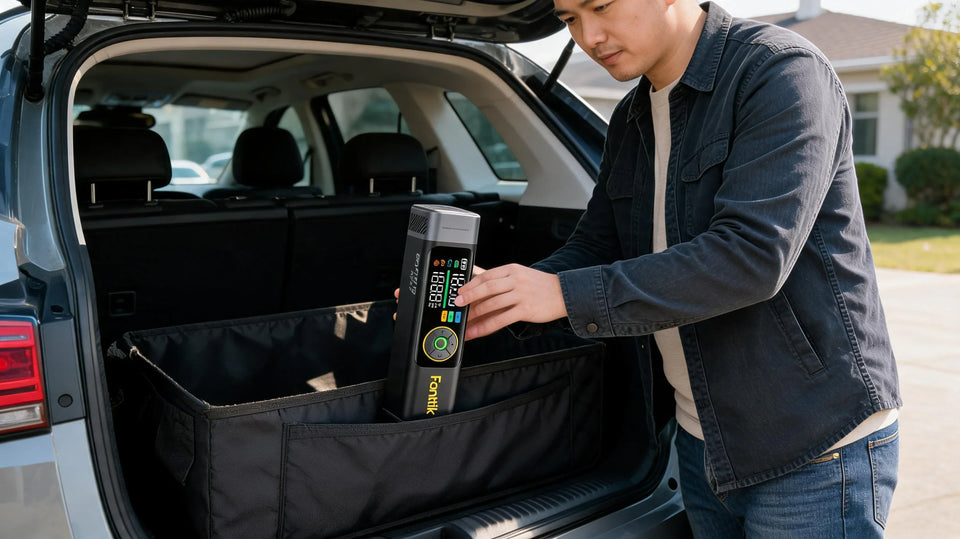
| Adding air to a low tire | Tire inflator | They want to top up at home or on the road |
| Battery won't start the car | Jumper cables or portable jump starter | Pick by whether a second car is likely nearby |

These tools don't overlap. An inflator adds air, but it won't fix a puncture and it won't help a dead battery. A jump starter does nothing for a low tire. If the main need is adding air, you can compare car tire inflators once you know their car's target pressure.

For battery trouble, the choice comes down to help and storage. AAA's tool comparison explains that jumper cables need another vehicle to provide the jump. A portable jump starter has its own built-in battery, so no second car is needed. AAA also notes that portable starters are a bit bulkier and shouldn't be stored in a hot car. Cables suit a driver who usually has family or friends nearby. A portable starter suits someone who often drives alone, as long as they have a plan for storing it. To learn more about that category, read our guide on how jump boxes help motorists.
What to Check Before You Buy for Their Car
Two facts about their car decide whether the gift will be used correctly. Look them up before you wrap anything:
- Their recommended tire pressure. NHTSA's tire-pressure guidance says this number is in the owner's manual and on a placard on the driver's door pillar or door frame. The number printed on the tire sidewall is the tire's maximum pressure, not the target for the car. NHTSA also says to check tires when cold, meaning at least three hours after driving. A note with the placard PSI makes a gauge or inflator gift ready to use. If they'll carry heavy loads, our article on loaded vehicle tire pressure covers that case.
- Their car's jump-start procedure. AAA's manual guidance says to follow the owner's manual, since some newer vehicles, including hybrids and EVs, may require manufacturer-specific jump-starting or battery procedures. If their manual lays out a specific method, don't assume a generic cable or portable-starter approach applies. Point them to that page when you give the gift.
Should You Choose One Tool or a Broader Roadside Kit?
Pick one focused tool when you know their need and they already have the basics. If they keep getting low-tire warnings, or their car has a weak battery, a single matched tool is easy to understand and more likely to be used.
Consider broader coverage when several basics are missing or you aren't sure what they need. NHTSA's recommended kit contents go well beyond one tool: a phone and charger, a first-aid kit, a flashlight, flares and a white flag, jumper cables, a tire-pressure gauge, a jack with a ground mat, and work gloves with a change of clothes. A driver starting from zero may get more from several of those than from one tool.
A quick way to decide: known need plus existing basics means one focused tool. Several missing basics or an unclear priority means you should build or buy a wider kit. Neither choice is better for every driver.
FAQs
Is a tire inflator a good gift for someone who has never used one?
It can be, if you pair it with their car's placard PSI so they know the target. Learning to read pressure first helps. For roadside use, our article on highway shoulder tire inflation covers positioning the car and when to call for help instead.
Do tires lose air even without a puncture?
Yes. NHTSA notes that all tires naturally lose some air over time, and it calls underinflation the leading cause of tire failure. That is why a gauge is useful even when nothing seems wrong.
Should I check the spare tire too?
Yes. NHTSA's tire guidance specifically reminds drivers not to forget the spare. If your gift is a gauge or inflator, show them how to check it as well.
How long should jumper cables be?
AAA says jumper cables come in lengths between 10 and 20 feet, and longer cables are easier to use. The extra length means less maneuvering to reach the car giving the jump.
Does a roadside tool replace roadside assistance?
No. A tool handles one task. AAA advises calling roadside assistance if you have any doubts about a jump-start, and a membership can be a sensible add-on gift.
Continue reading
 Check a Stored Jump Starter Before Relying on It for a Winter Trip
A practical pre-trip routine for a jump starter left unused for months: look over the unit and leads,...
 Holiday Gifts for Car Detailing Enthusiasts
A holiday guide that maps four detailing tools to the jobs they do, plus a quick check on...
Leave a comment
This site is protected by hCaptcha and the hCaptcha Privacy Policy and Terms of Service apply.