































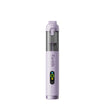






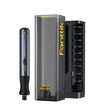
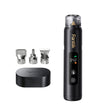


If your dashboard flashes a low tire pressure warning on the highway, protect yourself from traffic first and worry about air second. To inflate the tire safely on the highway shoulder, you must get the vehicle fully out of active lanes and verify that the tire is intact. If either condition fails, avoid roadside work and call for professional roadside assistance immediately.
Key Takeaways
- A low-pressure alert means stop and inspect, not "keep driving until it's convenient."
- Only attempt a top-up once the vehicle is fully clear of traffic and the tire shows no damage or rapid air loss.
- Use the pressure on your vehicle's tire placard as the target, never the maximum PSI stamped on the tire's sidewall.
- Call for professional roadside recovery if the shoulder is exposed, the tire looks damaged or flat, or pressure won't hold.
- Added air restores mobility temporarily; it doesn't fix a puncture or other tire damage.
When Should You Inflate a Low Tire Versus Call for Help?
Inflate the tire only when you can get fully out of traffic and the tire looks intact; call for professional roadside recovery whenever either condition fails. A dashboard warning means at least one tire is significantly underinflated, and it should prompt a safe stop and a tire pressure inspection as soon as possible. That warning alone doesn't tell you the tire is safe to keep driving on — it's a reason to check, not a green light to continue at highway speed.
A quick look at the tire answers most of what's left. Bulges, cuts, sidewall damage, an apparently flat tire, or air that's disappearing fast are treated as signs of tire damage that call for professional tire or roadside service rather than a top-up. Whether a tire inflator you already carry can help at all depends on its connector and pressure range actually matching your tire, not on the category of device it belongs to.
If the shoulder itself is too narrow, poorly lit, or keeps you close to moving traffic, that's its own stop condition covered next. When either the workspace or the tire fails these checks, staying protected inside the vehicle and calling for recovery beats attempting a roadside fix during a highway shoulder tire inflation emergency.
How to Position the Vehicle on a Highway Shoulder
Move the vehicle as far from moving traffic as the shoulder allows, turn on your hazards, and decide whether staying inside is safer than stepping out. The right setup protects people before it protects the tire.

- If the car is still driveable, slow down gradually and steer smoothly onto the shoulder or a wider pull-off; avoid sudden braking or swerving.
- Get the vehicle fully off the travel lanes when possible, onto level, stable ground with good visibility in both directions.
- Turn on your hazard lights immediately, and note your highway, direction of travel, and the nearest mile marker or exit.
- Call for help before starting any roadside work, whether that's roadside assistance, your insurer's dispatch line, or 911 for an unsafe situation.
- Stay inside your vehicle with your seat belt fastened once it's safely out of traffic, rather than standing near the roadway.
No single shoulder distance guarantees safety on every highway. Guidance from state transportation authorities is to move away from traffic as far as the situation allows, because clearance depends on lane width, traffic speed, and visibility at that exact spot. If you are weighing which compact tire inflator to keep in the car for situations like this, that's a decision for calmer conditions, not something to research from the shoulder.
How to Inflate the Tire Safely, Step by Step
Work through this order every time: secure the vehicle, inspect the tire, confirm your target pressure, connect the inflator, monitor it, then recheck before you move. Skipping a step is how a temporary fix turns into a bigger problem.
- Confirm the vehicle is fully off the travel lanes, hazards are on, and the area still feels controllable before you approach the tire.
- Look at the tire and valve stem for cuts, bulges, or obvious flatness. If anything looks damaged, stop here and call for help instead of adding air.
- Find your vehicle's recommended cold tire pressure on the driver's-door placard or in the owner's manual. That number is the target, not the maximum PSI molded into the tire's sidewall.
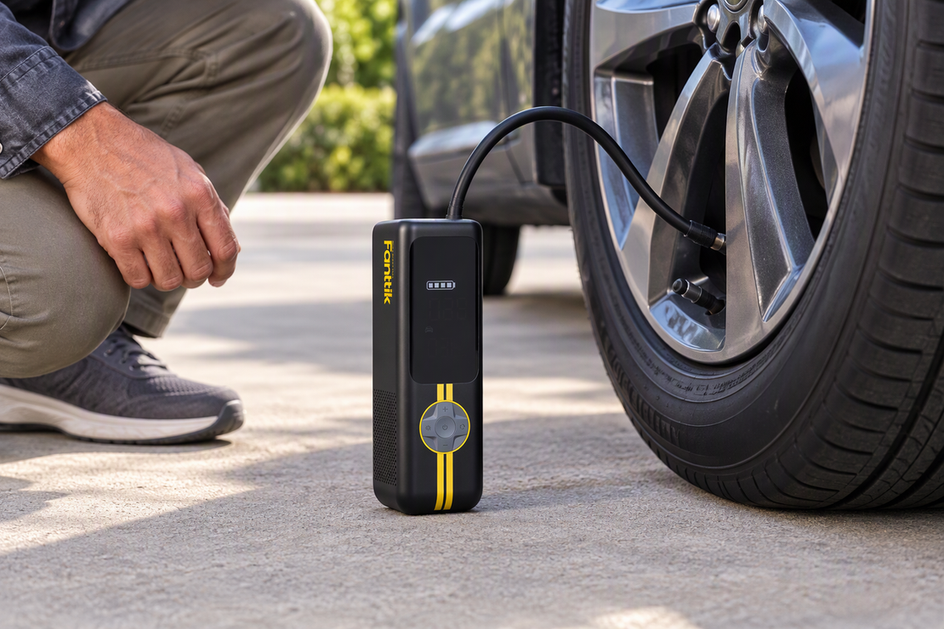
- Match the inflator's hose and valve connector to the tire without forcing the fitting, and confirm your specific tire inflator model documents an operating range that covers this job.
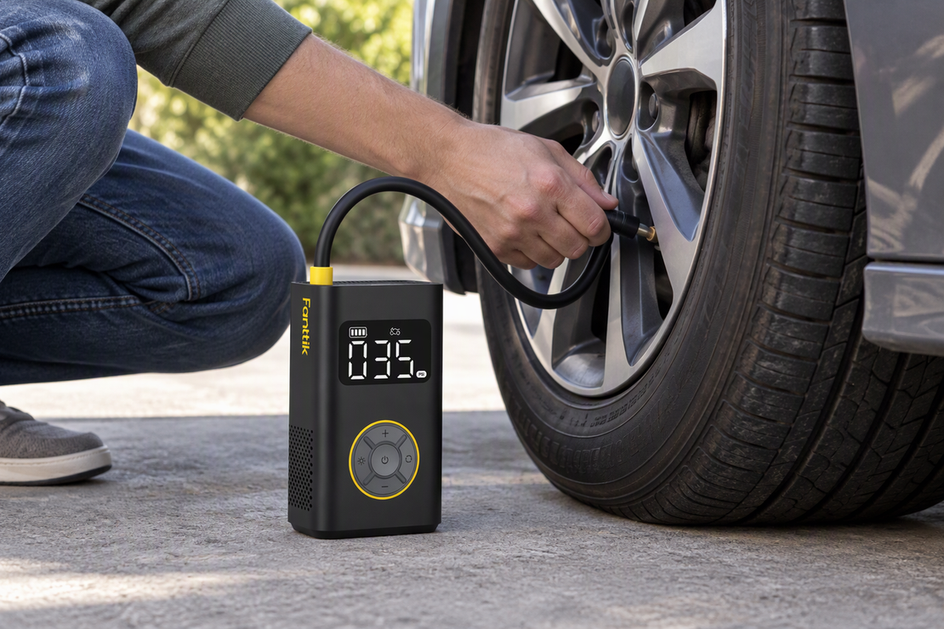
- Turn on the inflator and watch the pressure reading as it climbs. Stop immediately if the connection leaks, the device overheats, or the tire's condition changes.
- Disconnect once you reach the placard number. Because the tire is warm from driving, adding air toward that cold-pressure target is fine, but plan a cold pressure recheck later rather than releasing air to force an exact match now.
- Decide what's next. If the tire held pressure and looks fine, a safe roadside tire top-up on a highway shoulder may allow a cautious drive to an exit service facility. If it won't hold air or anything still seems off, call for professional recovery instead.
What Makes a Roadside Top-Up Practical?
A top-up is realistic when the pressure deficit is small, the tire is intact, and the inflator's connector, charge, and operating limits actually match the job — not simply because the device carries a high maximum PSI rating. That number describes a pressure ceiling, not how quickly air arrives.
Recommended tire pressure and maximum PSI answer different questions. The placard number is your vehicle's target; the sidewall number is only the structural limit that specific tire can hold, and filling to it overinflates the tire. How much air is needed and how fast it arrives are separate questions too: a bigger pressure deficit and a larger tire simply require more air, while airflow and a tight valve connection determine how quickly that air gets delivered. Battery capacity, runtime, and duty cycle are distinct specs from each other, and none of them alone proves an inflator can finish a given roadside fill.
If you don't know whether the inflator's connector, application range, charge state, and documented operating limits match the tire and pressure gap in front of you, treat the top-up as uncertain rather than assume it will finish the job. That uncertainty, layered on an already exposed roadside position, is a reasonable trigger to call for help instead of continuing to try.
FAQs
Can a portable tire inflator repair a puncture?
No. A portable inflator adds air, but it does not seal a puncture, valve leak, sidewall cut, or structural damage. If pressure drops again soon after adding air, stop relying on the device and call for professional roadside assistance or towing.
Should you inflate to the maximum PSI shown on the tire sidewall?
No. Never use the sidewall maximum PSI as your inflation target. Always follow the vehicle manufacturer's recommended cold pressure listed on the driver door jamb placard or in the owner's manual to avoid severe overinflation.
What should you do if the low-pressure alert stays on after inflation?
If the alert remains on and pressure is actively dropping, the tire cannot hold air and requires professional service. If the tire holds pressure, drive cautiously to a safe facility where the tire and TPMS sensors can be inspected.
Continue reading
 How to Deep Clean Sand and Crumbs from Car Seat Crevices with Handheld Vacuums
A step-by-step guide to clearing packed sand and crumbs from car seat seams using nozzle attachments, safe air...
Carpet Pet Hair Removal: Matching Vacuum Suction and Rubber Bristles
A practical guide to loosening embedded pet hair with rubber bristles and lifting it with vacuum suction, plus...
How to Deep Clean Sand and Crumbs from Car Seat Crevices with Handheld Vacuums
A step-by-step guide to clearing packed sand and crumbs from car seat seams using nozzle attachments, safe air...
Carpet Pet Hair Removal: Matching Vacuum Suction and Rubber Bristles
A practical guide to loosening embedded pet hair with rubber bristles and lifting it with vacuum suction, plus...

Leave a comment
This site is protected by hCaptcha and the hCaptcha Privacy Policy and Terms of Service apply.