








































There is no universal minimum PSI that makes it safe to drive every slow-leaking tire to a shop. The right target is the recommended cold tire pressure listed on your vehicle's door placard or owner's manual, not a generic number pulled from the internet.
Before you inflate anything, check the tire itself. A tire that is flat, losing air fast, or visibly damaged should not be driven at all, even a few blocks. If the tire is only slightly low, holds air after you add pressure, and shows no damage, you can consider the shortest practical drive to a shop as a service-access step, not a normal trip.
What PSI Is Safe for Driving to a Tire Shop?
The safe number is not universal. It is whatever your vehicle manufacturer lists as the vehicle-specific recommended cold pressure, found on the driver-side door edge, the glovebox, or the owner's manual.
That placard number is your inflation target, not proof that a leaking tire is sound. Reaching it only means the tire currently holds the pressure the manufacturer expects for that specific vehicle. It says nothing about whether the tire lost air because of a nail, a bad valve, a damaged bead, or something worse.
Keep three numbers separate in your head. The placard pressure is what you inflate toward. The maximum pressure molded into the sidewall is a structural ceiling, not a driving target. A TPMS warning light typically triggers well below the recommended pressure and is a signal to check the tire, not a measurement of how low is still safe. Treating any of these as an all-purpose safety floor is where drivers get into trouble.
When Should You Stop and Call Roadside Assistance?
Some conditions mean you should not drive the vehicle at all, even to a nearby shop. Call roadside assistance or arrange a tow instead.

Stop and get help if any of the following apply:
- The tire is flat or nearly flat, or it has lost most of its air.
- The tire keeps losing pressure quickly after you add air, or it needed inflation again within minutes.
- You see a bulge, blister, deep cut, or exposed cord in the sidewall or tread.
- The tire looks unseated from the wheel, or a run-flat tire has been driven beyond what your vehicle's instructions allow.
- The wheel itself is bent, cracked, or visibly damaged.
A tire that continually needs re-inflation is treated as a real safety risk rather than a maintenance routine, and it needs professional inspection rather than another top-off. Adding air to a tire in any of these conditions does not make it safe; it only delays the moment the problem becomes obvious on the road.
How to Inflate and Check a Slow-Leaking Tire Before Moving
Work through this sequence before you decide whether to drive anywhere. Skipping steps to save time is exactly how a manageable slow leak turns into a roadside breakdown.
- Move to a safe, level spot away from traffic. If where you are parked feels unsafe to work in, call for help instead of stepping out into a live lane.
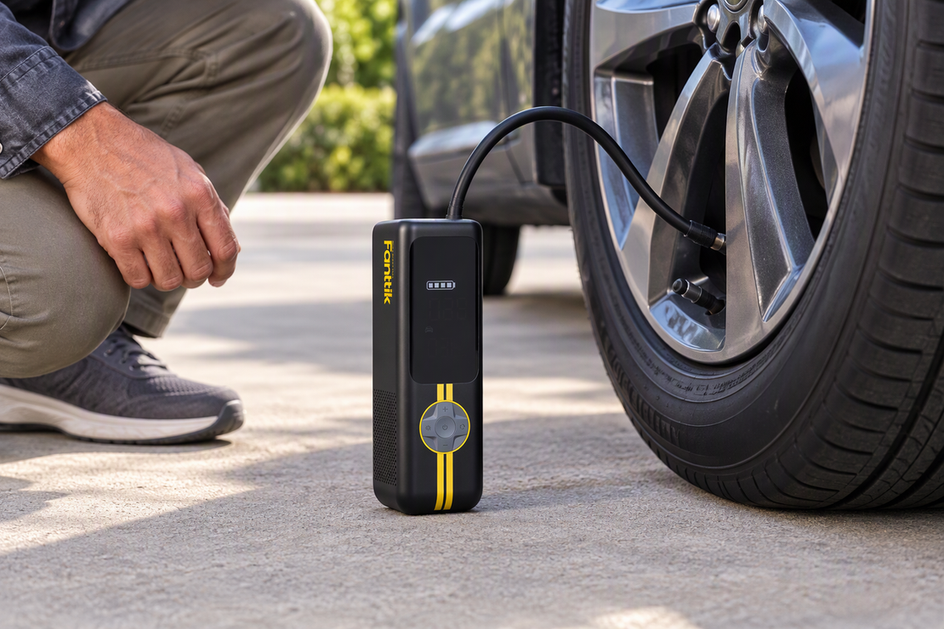
- Walk around the tire and look at the tread, sidewall, valve stem, and wheel before adding any air. A portable tire inflator can add pressure, but it cannot tell you whether the tire is structurally damaged.
- Find your vehicle's recommended cold pressure on the door placard or in the owner's manual. Use that number, not a number from a similar-looking vehicle or a general rule of thumb.
- Measure the current pressure with an accurate gauge. A cold pressure reading assumes the vehicle has been parked for at least three hours; if the tire is warm from recent driving, note that and avoid treating a warm reading as a new safety cutoff.
- If the tire is intact and only low, inflate it to the placard's recommended cold pressure using a portable inflator or another air source. Do not add air to a tire that is flat, unseated, or visibly damaged.
- Recheck the pressure a few minutes later. If it is dropping again, treat this the same as the stop conditions above and follow safe roadside inflation procedures. If it holds, move on to deciding whether a short trip is reasonable.
A dashboard TPMS light turning off after inflation is a convenience signal, not confirmation that the leak is resolved or that the tire is undamaged.
Why Driving Underinflated Can Damage the Tire and Wheel
Driving on a low tire flexes the sidewall more than it was designed for, and that extra flexing builds up heat inside the tire structure. Even a short distance at low pressure can create internal structural damage that adding air afterward does not undo.
That damage is not always visible from the outside. A tire can look normal after you inflate it and still have weakened internal layers from the miles it spent underinflated. The wheel is at higher risk too, since a properly inflated tire is what cushions the rim from impacts with potholes, curbs, and rough pavement; a soft tire transfers more of that shock directly to the wheel.
This is the reason restoring pressure is not the end of the story. A tire that was driven very low needs to be checked by someone who can inspect it off the vehicle, not just refilled and put back into daily use.
If It Holds Air, Is a Short Trip Still Reasonable?
Passing the checks above does not create a blanket rule that any slow leak is safe to drive on. It only supports a narrow, conditional judgment: the shortest practical route to a shop, taken carefully, once you know the tire is intact and holding pressure.
That judgment applies only under favorable conditions. Consider it reasonable when the tire is mounted and undamaged, it held the recommended pressure after inflation with no fast drop, the route is short and direct, and you are driving at moderate speed without a heavy load. Shift to roadside assistance instead when the trip would be long, fast, on a highway, in heavy heat, or carrying significant weight, since those conditions increase heat and stress on a tire that is already compromised.

Any temporary inflation or mobility kit only buys time to reach a service location; it is not a repair. If your vehicle came with a specific spare tire or mobility kit, follow its own speed and distance instructions rather than a general assumption. Stop immediately if the pressure drops again, the TPMS warning returns, or the vehicle starts to handle differently.
FAQs
Can TPMS tell me whether a slow leak is safe to drive on?
No. TPMS is designed to prompt you to check the tire, not to confirm that a leak is slow enough or that pressure is holding steady. It may not warn about a rapid loss in a single tire quickly enough to matter, so use an accurate gauge and a visual check even if the warning light is off or turns off after you add air.
How quickly should a tire that keeps losing air be inspected?
Promptly. A tire that continually requires re-inflation is considered a serious safety concern, not a routine you can maintain indefinitely. Arrange professional inspection as soon as you reasonably can instead of topping it off again and hoping the leak stays manageable.
What if the tire holds air after I drove on it while very low?
Holding air afterward does not rule out hidden internal damage from the underinflated miles you already drove. A tire that was driven very low may need to come off the wheel for a full internal inspection before anyone can confirm it is still safe to use.
Leave a comment
This site is protected by hCaptcha and the hCaptcha Privacy Policy and Terms of Service apply.