











































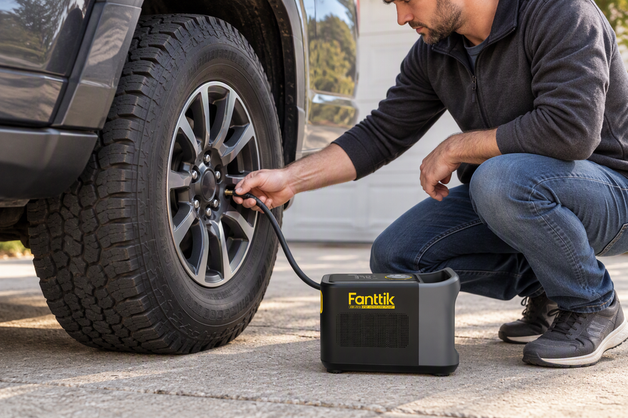
You can leave a portable tire inflator in a hot car only when your exact model's storage guidance covers the heat that car will reach. No single safe temperature applies to every inflator, so the deciding number has to come from the manual for your model.

If you can't find a storage limit, or the limit doesn't cover a parked car in summer, keep the inflator somewhere cooler. That cooler spot can be a garage shelf or a closet. Put it back in the car before a trip.
Can You Leave a Tire Inflator in a Hot Car?
Yes, but only under one condition: the manufacturer's storage rating for your exact model covers the conditions inside your parked car. Storage means the inflator is sitting powered off rather than running or charging. That powered-off state is what matters when leaving it in a vehicle all afternoon.
This distinction matters because a manual may list more than one temperature range. One range can cover operation, which is when the motor and compressor are running. Another can cover charging, for models with a built-in battery. A third can cover storage. These ranges describe different conditions. A range written for operation or charging does not tell you how the device handles sitting in a closed, sun-heated car for hours. So it can't approve hot-car storage.
Rechargeable inflators need extra attention. A cordless model carries a battery that stays inside the unit while it sits in the car. For devices that use lithium-ion batteries, OSHA's lithium-ion battery fact sheet lists exposure to excessive heat or cold among the conditions that can start thermal runaway. Thermal runaway is a chain reaction in which heat from one failing cell damages nearby cells. Not every inflator uses this battery type, but each unit's documented storage guidance remains the rule for that specific model.
Here is how the decision works in practice. If your manual gives a storage range and you're confident your parked car stays within it, the inflator can live in the car. If the manual gives no storage range, or your car may get hotter than the range allows, don't treat the gap as permission. Store the inflator indoors during hot stretches and move it to the car when you drive. Daily temperature swings in a parked car can also affect electronics in other ways. Our guide to temperature swings and internal condensation explains that separate issue.

How to Check the Right Temperature Limit
Use your exact model's own documentation. Don't rely on a similar model, a product listing, or a general rule of thumb. These steps take a few minutes and give you a clear yes, no, or ask-the-maker answer.
- Find the exact model number on the unit. Model names within one product line can differ by a single suffix. If you own a Fanttik inflator, the model number is on a label on the unit itself. Look on the underside, on the battery-compartment door, or along the rear housing seam.
- Open the current manual for that model. Use the manual that matches the full model number. Don't use one for a sibling model with a similar name. For Fanttik owners, the digital manual for each model is on that model's support hub.
- Search the manual for the word "storage." On a phone or computer, use your browser's find tool (Ctrl+F or Cmd+F) and search "storage," "store," and "temperature." You're looking for wording that applies when the device is powered off and put away. A spec table may list operating, charging, and storage conditions on separate lines. Read the label on each line before you use its number.
- Compare the storage limit with your car, not with the weather. A closed car parked in direct sun can get much hotter than the outdoor air. If the storage limit is close to or below what your car may reach, the result is a no for summer days. Keep the inflator indoors and load it when you leave.
- Treat a missing storage limit as unanswered, not approved. If the manual lists only operating or charging conditions, the storage question is still open. Store the inflator somewhere cooler and ask the manufacturer for the storage guidance for your exact model. Fanttik owners can contact Fanttik support with the model number from step 1.
After a long hot spell with the inflator stored in the car, a quick look before you rely on it is worthwhile. Our post-heatwave gear check guide walks through auditing vehicle-stored tools. If you decide to keep the inflator indoors for the season, our tips on storing seasonal car tools cover keeping it clean in a closet.
FAQs
Can I charge a rechargeable tire inflator in a hot car?
Avoid it if your inflator uses a lithium-ion battery. The National Park Service hot-car charging advice says never to leave devices charging in direct sunlight or inside a hot car. It names a summer dashboard as one of the worst spots. That advice covers charging. It is not a storage rating for a powered-off unit, so you still need your model's storage guidance to decide whether the inflator can stay in the car.
Does the lithium-ion charging warning apply to every portable tire inflator?
No. It applies to devices confirmed to use lithium-ion batteries. Check your manual or the battery label to see what powers your unit. Corded inflators and other types have their own requirements. For any model, the manufacturer's storage guidance decides portable tire inflator storage, whatever the battery type.
What if the manual lists operating or charging temperatures but no storage range?
Treat the storage limit as missing. Don't borrow the operating or charging number, because each one describes a different condition from sitting powered off in a closed car. Keep the inflator somewhere cooler until the manufacturer gives you a storage condition for your exact model number.
Is a model's storage limit the same across a product line?
Don't assume it is. Models in the same series can use different batteries, housings, and components, and their manuals are separate. Match the full model number, including any suffix, to its own manual before applying a storage limit. That gives you an answer for the inflator in your car, not a similar one.
Continue reading
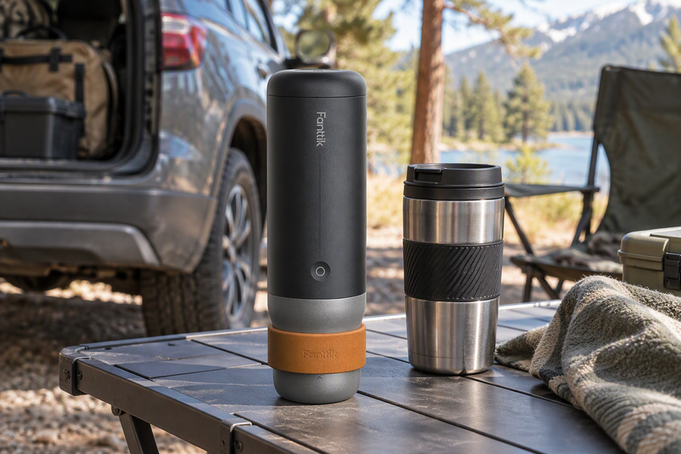 How to Plan Road-Trip Coffee When Power, Water, and Cleanup Vary
A stop-by-stop method for brewing coffee on the road: match brewer and outlet ratings, size water from your...
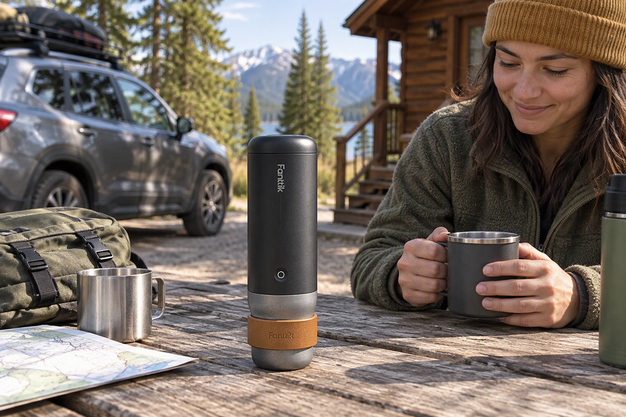 How to Make Road-Trip Coffee Stops Safer and Easier to Clean Up
A step-by-step plan for brewing coffee at a parked stop, from water prep and spill setup to wastewater...
Leave a comment
This site is protected by hCaptcha and the hCaptcha Privacy Policy and Terms of Service apply.