












































Buy a jump starter inflator combo when both of its documented functions match your car and your tire task, and carrying one device instead of two matters to you. Buy separate tools when you want to pick each one for its own job and you're fine keeping two devices charged and stored.

Either way, the combo label alone proves nothing. Your vehicle's manual decides whether jump-starting is advised at all, and your door placard sets the tire pressure an inflator has to reach.
Choose the Setup That Fits Both Roadside Tasks
Start with the car, not the tool. Your vehicle-recommended tire pressure is listed in the owner's manual and on a placard on the driver's door pillar or frame. The number on the tire sidewall is the maximum the tire can hold, not your target.
For the jump-start side, check the vehicle manual before you rely on any jump starter. Some manufacturers advise against jump-starting, and others give vehicle-specific instructions. If your manual says not to jump-start, neither a combo nor a separate jump starter is a suitable jump-start solution for that car. An engine-size rating on the box does not override that.
With both requirements in hand, compare what each of our two arrangements actually documents:
| Arrangement | Documented task evidence | Fits when |
|---|---|---|
| Beyond 10 Apex combo (one device) | Jump starter + tire inflator; rated for up to 7.0L gas / 5.0L diesel; inflates an R15 tire from 28 to 33 PSI in 1 minute | Your engine is within the rating, your manual permits jump-starting, and your tire task resembles the R15 example |
| X9 Pro and Potent T10 pair (two devices) | X9 Pro: 150 PSI max, up to 23 minutes continuous work. Potent T10: 1800A peak, up to 7.0L gas / 5.0L diesel | Each tool passes its own check and carrying two devices is acceptable |
Both arrangements share the same engine rating, so the jump-start side rarely splits the choice. The inflator evidence is where they differ. Our combo gives one concrete tire result, but only for an R15 tire and a 28 to 33 PSI top-up. The X9 Pro figures describe a pressure ceiling and a runtime, not how it performs on a particular tire size. So if you need to match a specific tire, the combo's example is the closer documented data point, as long as your tire resembles it.

A combo is not a fit when either function misses. Say your engine is larger than 7.0L gas or 5.0L diesel: the combo's inflator may suit your tires, yet the device still can't cover the jump-start job. In that case, choose a jump starter rated for your engine and keep the inflator decision separate.
The real carrying difference is one device versus two. That is an item count. It does not show that the combo is smaller, lighter, or easier to maintain.
How Storage and Charging Change the Choice
Keeping the gear ready matters as much as buying it. Here is what changes between the two setups:
- Count what you have to track. A combo is one device to charge and store. A separate pair is two. Fewer items does not automatically mean less upkeep, but it does mean one fewer battery to forget.
- Follow general jump-starter habits. Interstate's general jump-starter storage advice is to recharge a portable jump starter after use and store it indoors, away from outdoor temperature extremes. That is category guidance, not a schedule for any of our models.
- Use each model's own instructions for intervals. Charging intervals and in-car storage conditions for the Beyond 10 Apex, X9 Pro, and Potent T10 come from each product's current manual. The X9 Pro charges by USB-C cable, but that alone doesn't set how often to top it up.
- Test before long trips. A simple routine for pre-trip tool readiness covers battery checks and gauge accuracy, and it works for either setup.
If you know you'll forget to charge a second device, that is a fair reason to lean toward a verified combo. If you'd rather replace one tool later without losing the other, separate tools give you that flexibility. For battery-powered gear you plan to keep for years, our guide on when to retire emergency gear covers lithium battery health.
FAQs
Does a 150 PSI maximum mean an inflator will fill my tire quickly?
No. Maximum pressure is the ceiling the inflator can reach, not an inflation speed. The X9 Pro's 150 PSI maximum and 23-minute continuous runtime don't tell you how fast it fills a particular tire. Look for documented results on a tire like yours instead, and see our explainer on cordless versus 12V inflators for how power source affects use.
Does a combo guarantee a smaller or lighter roadside kit?
No. One device instead of two doesn't establish less volume or weight. Compare the listed dimensions and weight of the actual items against your trunk or under-seat space before deciding.
When should I check tire pressure before deciding what an inflator must do?
Check when tires are cold. NHTSA recommends a cold tire-pressure check, at least three hours after driving, for an accurate reading. Compare that reading with your placard pressure to see how much air you typically need to add.
Does my battery type change how I should jump-start?
It can. Your vehicle's manual controls grounding points and steps. If your car uses an AGM battery, our guide to AGM jump-start grounding rules explains why.
Continue reading
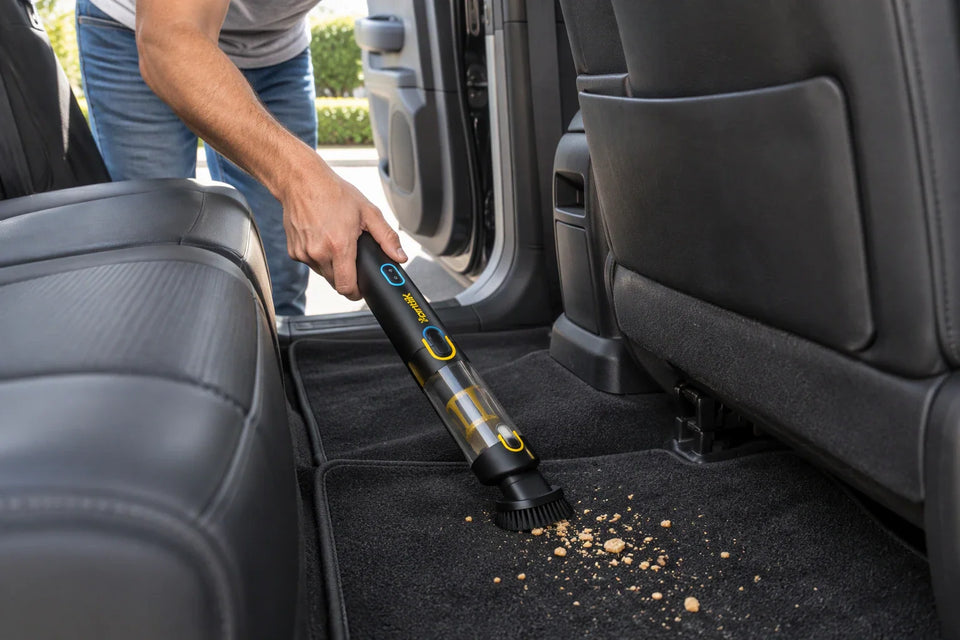 Car Vacuum or Blower for Dry Debris? Choose Whether to Capture or Move It
Use a vacuum to capture crumbs and grit, and use a blower only to push loose debris toward...
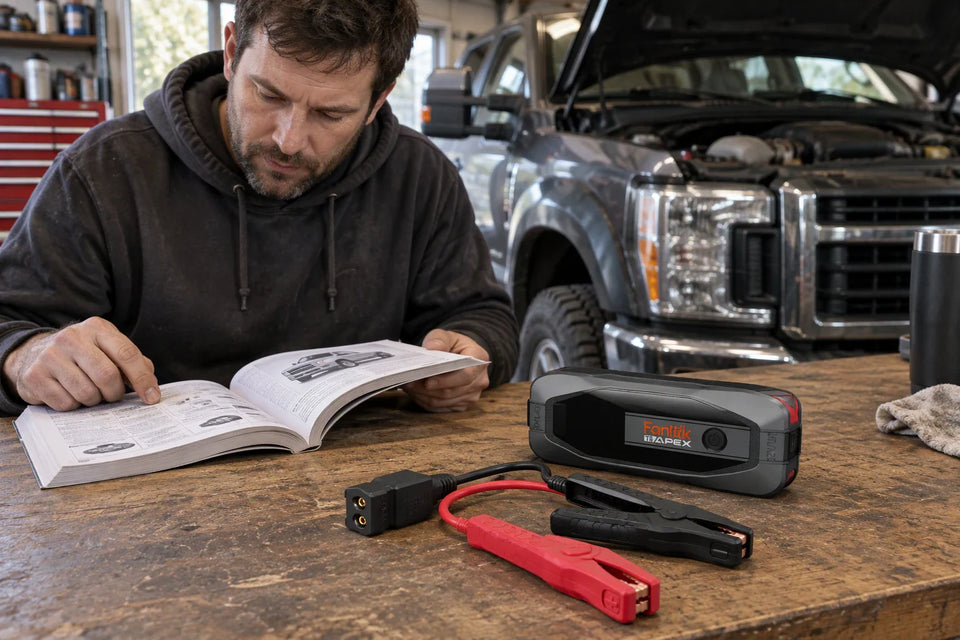 Choosing a Portable Jump Starter for a Diesel Vehicle
A practical way to match a portable jump starter to your diesel: read the vehicle's jump-start rules, separate...

Leave a comment
This site is protected by hCaptcha and the hCaptcha Privacy Policy and Terms of Service apply.