










































Short answer: a cordless tire inflator runs on its own rechargeable battery. It is not a 12V plug-in that still needs the car, and it is not a wall compressor. Choose cordless when you have to inflate away from the vehicle. Choose 12V or wall power for long, large, or back-to-back fills. Once you know you want battery power, pick a model by vehicle class in the portable tire inflator buying guide.
What a cordless tire inflator actually is
Listings treat "cordless" as a vibe. It is a power-source claim, and it is the claim most often used loosely.
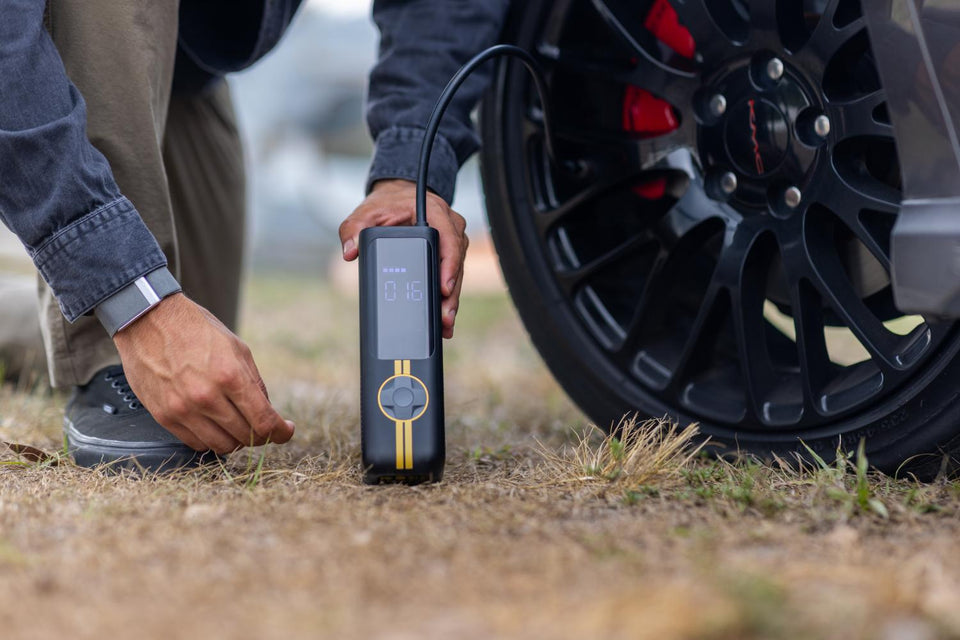
A cordless tire inflator has an onboard battery and a small compressor. You charge it at home, put it in the glovebox or trunk, and run it with no lead back to the car or the wall. That is the whole distinction.
A 12V inflator still has a cord. It plugs into the vehicle's 12V accessory outlet (the old cigarette lighter). Retail pages sometimes call these "portable" or even "cordless" because they do not use a household outlet. They are not cordless. If the car is off, the outlet is dead, or the lead will not reach the far tire, the tool does not work.
A wall compressor plugs into household AC. Garage units, and some "portable" pumps that still need a wall socket, belong here. They can run as long as the motor's duty cycle allows. They do not travel.
If the listing does not say where the electrons come from, read the spec sheet before you buy. Battery, 12V, and wall are three different machines that happen to share a chuck.
Cordless vs 12V vs wall: three different machines
The job is the same: push air into a tire until it hits the pressure on the driver's-door label, checked on a cold tire. The power source changes where you can stand, how long you can run, and what happens if the car itself has no power.
| Cordless (battery) | 12V plug-in | Wall / AC compressor | |
|---|---|---|---|
| Power source | Onboard rechargeable battery | Vehicle 12V accessory outlet | Household AC outlet |
| Works away from the car | Yes, if charged | No. Tethered to that vehicle | No. Tethered to a building |
| Works if the car battery is dead | Yes, if the inflator is charged | No | Only at home |
| Runtime limit | Battery capacity, then motor heat | Motor heat; needs the vehicle running for long jobs | Motor heat, or a tank on shop units |
| Typical job | Top-ups, roadside, bikes, balls, a trailer the cord cannot reach | Several large tires in one sitting, long trips | Garage work, repeated fills, shop tasks |
| What you maintain | Keep the pack charged. Cold weather cuts output | Cord, 12V plug fuse, outlet power | Cord, outlet, sometimes oil or a tank |
Cordless vs corded is the same split with worse vocabulary. "Corded" might mean 12V, wall, or both. Ask which outlet it uses. That answer decides the purchase; the word "corded" does not.
A shop compressor with a tank is a different category again. It stores air and can dump a lot of volume quickly. A handheld inflator, battery or 12V, does not. The air compressor vs portable inflator comparison covers that line. This page stays on how the inflator is powered.
When a cordless tire inflator is the better tool
Cordless wins when the outlet is the problem, not the motor.
- The car cannot supply 12V. EV trunks often bury or omit a useful accessory socket. A 12V pump that needs the vehicle running is a poor match for a car you did not start. A charged battery pump does not care.
- The hose-plus-cord will not reach. Rear tires on a long-bed truck, a trailer, a bike in the garage, a spare on the ground. Walking the tool to the valve is the point of a battery.
- The job is a top-up, not a rebuild. Monthly pressure checks, a cold snap, a TPMS light after a highway run. That is a few PSI, not a flat. A compact battery pack handles it many times over.
- You also inflate things that are not on the car. Road bikes, motorcycle wheels on a stand, balls. Dragging a 12V lead out of the cabin for those jobs is theatre.
Keep the pack charged if it lives in the car. A cordless inflator that sat empty for months is a paperweight, and lithium-ion delivers less in freezing weather. Charge it at home on a schedule, the same way you would a jump pack.
When 12V or a wall compressor is the better tool
Cordless is the wrong default in a few honest cases.
- You regularly fill large tires from flat. Pickup, HD truck, travel-trailer, and air-down/air-up off-road work eat watt-hours. A 12V unit pulling from the running vehicle does not hit empty mid-tire. A small battery pack can.
- The session is long. Four large tires from low, then a trailer, then a second vehicle. Duty cycle still applies to every tankless pump, but at least 12V and wall units are not also racing a fuel gauge.
- The inflator will live on a garage shelf and never leave. Wall power is simpler. No charge ritual, no pack to replace in a few years.
- You need a shop compressor, not an inflator. Seating a tire bead takes a fast dump of volume. No handheld cordless unit does that, and most 12V plug-ins do not either.
Some brands sell dual-power tools that run on a pack or a 12V lead. That is a real category, and a way to pay for two compromises in one housing. Top-ups and bikes want a dedicated cordless unit. Airing up a truck and a trailer after a trail wants a large battery or 12V, not a glovebox pump with a spare cigarette-lighter cable in the box.
Once you want cordless, pick by vehicle class
This is the step most "best cordless tire inflator" roundups skip. They rank brands. You should rank the battery against the tire.
Max pressure is the wrong number. Almost every portable unit advertises 150 PSI. Passenger cars run at the door-jamb spec, usually in the 30s PSI. You will never use the ceiling on a Civic. The ceiling matters for road-bike tires, which often sit at 80–120 PSI. For cars, read fill time on a stated benchmark, tires per charge from flat, and the vehicle class the maker actually lists.
Fanttik publishes those three on the same test: a 25-inch tire, 30 to 35 PSI for speed, and 0 to 35 PSI for how many tires you get from a full charge. Three cordless sizes show how wide the battery spread is:
| Example (cordless) | Rated for | Battery | Fill time (25", 30→35 PSI) |
Tires per charge (from flat) |
Weight |
|---|---|---|---|---|---|
| X9 Pro | Sedan, Motorcycle, Bike | 18.5 Wh | 70s | 3 | 0.96 lbs |
| X8 APEX | SUV, Sedan, Motorcycle, Bike | 28.86 Wh | 35s | 4 | 1.87 lbs |
| X9 Ultra | Pickup Truck, SUV, Sedan | 92.5 Wh | 18s | 12 | 8.81 lbs |
Read that as three jobs, not three trophies. The 0.96 lb sedan unit disappears in a glovebox and is not rated for an SUV. The 1.87 lb SUV unit halves the fill time. The 8.81 lb pickup unit is a trunk tool: twelve flat tires per charge is the spec after airing down on a trail, and it will not live in a door pocket. Do not buy the sedan pump for a truck to save money.
For the rest of the range, fill-time rows, and which model fits which vehicle, use the full portable tire inflator comparison. The current cordless lineup is on the Fanttik cordless inflator collection.
Auto-stop at a preset pressure is worth having on any of these. Set the door-jamb number, start the pump, and let it cut out. The portable inflator how-to walks through cold-tire checks, the hose, and the shutoff. NHTSA's rule is still the one that matters: use the vehicle label, not the maximum molded into the tire sidewall, and measure when the car has sat at least three hours.
What a cordless inflator cannot do
- Seat a tire bead. That is a volume problem. Handheld battery pumps are high-pressure, low-volume tools.
- Replace a shop compressor for commercial truck or RV tires. Large carcasses at high pressure will empty a compact pack and heat the motor before the tire is full.
- Run as a continuous-duty compressor. These motors are built for a fill, a pause, a fill. Twenty minutes straight is how you trip a thermal cutout.
- Repair a puncture. Inflation gets you to a shop. It does not patch a sidewall, and driving on a tire that will not hold air is still a bad idea.
- Deflate a car tire, except on one Fanttik model. Fanttik cordless inflators are air-up tools. The only model with One-Click Deflate is the X10 Pro Max, which uses a side release button and shows pressure on the way down. Every other model in this lineup needs a valve-core tool or a separate deflator. There is no "deflate mode if equipped" on the X8, X9, or X10 Pro.
FAQs About This Topic
What is the best cordless tire inflator?
There is not a single winner independent of the vehicle. Power source first (battery vs 12V vs wall), then vehicle class. A sedan owner wants a ~1 lb unit rated for sedans; an SUV owner wants the faster, larger-battery class; a pickup or air-down driver wants the truck-rated pack. Model-by-model specs are in the portable inflator buying guide.
Cordless vs 12V tire inflator: which should I buy?
Buy cordless to work away from the car, or when the 12V socket may be dead. Buy 12V to fill large tires from a running vehicle without watching a pack. Monthly sedan top-ups favor cordless. Airing up a truck and a trailer after every trip favors 12V or a very large battery.
Is a cordless tire inflator the same as a corded one with a 12V plug?
No. Cordless vs corded is a power-source split. A 12V plug-in is corded to the car. A wall unit is corded to the building. If the product photo shows a cigarette-lighter lead and no pack, it is not cordless, whatever the title says.
Can I use a cordless inflator if my car battery is dead?
Yes, if the inflator's own battery is charged. That is the roadside case 12V cannot cover. It will not jump the car. It will fill a tire so you can drive to a charger or a shop.
Is 150 PSI the spec that makes a cordless inflator "more powerful"?
Not for cars. 150 PSI is a ceiling. Fill time and watt-hours decide whether the tool matches your tires. Save the 150 PSI check for high-pressure bicycle tires.


114 comments
Leave a comment
This site is protected by hCaptcha and the hCaptcha Privacy Policy and Terms of Service apply.