









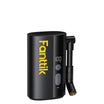
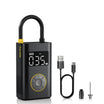
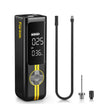


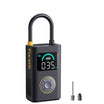









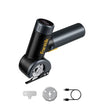

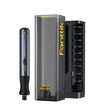
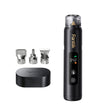
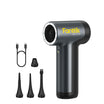


Short answer: read the cold PSI on the driver's door jamb, measure the tire before you drive, attach the chuck, set that number as the target, and start the pump. Auto-stop units shut off at the target. Recheck with a gauge, then again after a short drive once the tire is cold. Do not treat 150 PSI as a car setting, and do not inflate while the vehicle is moving.
Find the door-jamb PSI, not the sidewall number
The target for a car tire is the vehicle manufacturer's recommended cold inflation pressure. NHTSA tire safety guidance puts that number on the Tire and Loading Information label on the driver's side door edge or B-pillar, and in the owner's manual. On some cars it also appears on the fuel-filler door or in the glove box. Front and rear pressures can differ. Write both down before you start.
The large PSI figure molded into the tire sidewall is a maximum, not a target. BFGoodrich tire pressure guidance is blunt: do not compare your gauge reading to the sidewall. Most passenger cars land between 30 and 35 PSI, but that range is a description of the category, not a setting. Use the placard on your car.
| What you are filling | Typical pressure | Where the number lives |
|---|---|---|
| Car or SUV | Often 30–35 PSI; do not guess | Door-jamb placard |
| Compact spare | Often around 60 PSI | Printed on the spare itself |
| Motorcycle | Varies by bike and axle | Motorcycle placard or owner's manual |
| Road bike | Often 80–120 PSI | Recommended range on the tire |
| Sports ball | Usually under 10 PSI | Printed on the ball |
This is also why the 150 PSI number on almost every portable inflator box is a machine ceiling, not a car instruction. A sedan will never use it. The ceiling starts to matter on a high-pressure road bike, which is a different job.
How to use a portable tire inflator, step by step
These are the same steps if you are learning how to use a portable air pump for car tires. Cordless battery units and 12V plug-in units follow the same PSI logic. Only the power source changes.
- Park and inspect. Level ground, parking brake on, well off the travel lane. Look for cuts, bulges, nails, or a sidewall puncture. Do not inflate a damaged tire. An inflator gets a slow leak to a shop. It does not repair anything.
- Read the placard. Open the driver's door and copy the cold PSI for that axle. If you are topping up all four, note front and rear separately.
- Measure cold. NHTSA defines cold as a car that has not been driven for at least three hours. Warm tires read high. If you already drove and the tire is low, fill it to the cold placard number anyway, then plan a true cold recheck later. Do not bleed a hot tire down to the cold number. Goodyear inflation guidance notes that pressure rises as you drive; releasing that extra air leaves the tire underinflated once it cools.
- Power the unit. A cordless inflator needs a charged battery and works away from the car. A 12V plug-in unit needs the accessory socket and, for any fill longer than a brief top-up, the engine running so you do not drain the car battery.
- Attach the chuck. Unscrew the valve cap and keep it in a pocket. Seat the chuck on the Schrader stem: thread a screw-on fitting until it is snug, or press a lever-lock chuck on square and flip the lever. A short hiss as the valve core opens is normal. A continuous hiss means the chuck is crooked. Straighten it before you start the motor.
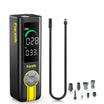
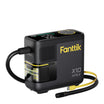
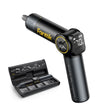
- Set the target. Dial the door-jamb PSI, not 150, not "a bit extra for the highway," and not a leftover bicycle or ball preset. Car mode is only a starting point. Cordless examples such as the Fanttik X8 APEX offer bicycle, motorcycle, car, and ball presets plus a custom range of 3–150 PSI; the useful number is still the one on the door.
- Start the pump and let auto-stop finish. If the inflator has auto-stop, it should cut the motor when it hits the target. The X8 APEX product page states that it stops once the preset pressure is reached. If your unit has no auto-stop, watch the gauge and shut it off as you reach the number.
- Disconnect and recap. Stop the motor if it has not already stopped. Pull or unscrew the chuck in one motion and replace the valve cap. The cap keeps grit out of the core.
- Recheck with a gauge you trust. Built-in gauges vary. Confirm each tire against the placard. If you overshot, let air out with the gauge tip or a valve-core tool. If you undershot, add a few seconds and measure again.
- Recheck after a short drive, then again when cold. Drive a few minutes so the tire-pressure warning can update. That dashboard light is not a gauge: NHTSA notes that TPMS only warns when a tire is already significantly underinflated. The reading that matters for the next week is a cold check after the car has sat. Top up or bleed then, not on a hot tire in a parking lot.
Cordless, 12V, or the station hose
The PSI procedure does not change with the machine. Runtime and whether you must stay next to the car do.
| Power source | Use it when | Watch for |
|---|---|---|
| Cordless battery inflator | Glovebox top-ups, bikes, a tire away from the 12V socket | Charge before a trip; pause between long fills |
| 12V plug-in inflator | You want runtime from the car, not a battery pack | Run the engine; a long fill can drain a parked battery |
| Gas-station or shop compressor | A fully flat tire, or several large tires in a row | Many have no auto-stop; you are the shut-off |
If you are choosing a tool rather than using one you already own, fill time and battery size matter more than the 150 PSI headline. That buying decision is in the guide to how to choose a portable tire inflator. If the job is really continuous airflow, not a tire, see the portable inflator versus shop compressor comparison.
What not to do
- Do not treat 150 PSI as a car target. That figure is the pump's maximum. Passenger-car tires run at roughly a fifth of it. Setting 150 on a sedan is how you over-inflate, not how you "make sure it is full."
- Do not inflate while driving. Park first. A hose on a spinning wheel can tear the valve stem out of the rim. "Keep it plugged in on the way to the shop" is not a procedure.
- Do not over-inflate "for safety." Extra pressure wears the center of the tread. If you are towing or carrying a full cargo load, use the load-specific figures on the same label or in the manual, not a round-up of your own.
- Do not skip the monthly check because TPMS is on. NHTSA still wants a monthly cold check of all four tires and the spare. Tires lose around 1 PSI a month with no puncture, and they drop 1–2 PSI for every 10°F change.
- Do not run the motor until the housing is too hot to hold. Portable inflators are built for a fill, a pause, and another fill. If the case is hot, stop.
- Do not use the ball preset on a car, or the car preset on a ball. A ball preset will stop a car tire around single-digit PSI. A car preset will wreck a basketball.
How to let air out if you overshot
Most portable tire inflators only air up. Press the metal pin in the center of the Schrader valve with the nub on a gauge or a dedicated valve-core tool, in short bursts, and remeasure. An independent deflator is the right tool if you regularly air down for dirt or snow.
Do not expect a Fanttik inflator to bleed a car tire unless it is the X10 Pro Max, which is the only model in that range with One-Click Deflate (a side release button). The X8 APEX, X9 Pro, X10 Pro, and X10 APEX are air-up tools. For those, the inflator puts air in; a valve-core tool takes air out.
Bikes, motorcycles, and balls
The car procedure still holds: find the correct pressure, set the target, auto-stop, recheck. Cars, most motorcycles, and many bikes use a Schrader valve, so the same chuck fits. Road bikes often use a Presta valve and run 80–120 PSI, which is the one common case where a 150 PSI ceiling is a real specification. Balls need the needle adapter and the number printed on the ball.
When a portable inflator is the wrong tool
- Seating a tire bead. That needs a large, fast volume of air. No glovebox inflator does it.
- A puncture you have not inspected. Re-inflating a tire with a sidewall cut or a bulge is not a roadside fix.
- Commercial truck, RV, or large off-road tires from flat. A portable unit will heat up and flatten its battery before those volumes are full. Top-ups are fine; full fills often are not.
- Continuous, back-to-back inflation with no rest. Duty cycle is a limit of the category, not a defect of one brand.
Check tires monthly, and again when the seasons change. A 10°F swing is enough to move PSI by 1–2 pounds, which is why winter and summer inflation changes belong in the same habit. The Fanttik cordless inflator lineup is the catalog if you still need a unit that lives in the car.
FAQs About This Topic
How do you use a portable air pump for car tires?
Read the door-jamb PSI, measure cold, attach the chuck, set that number, and start the pump. Recheck with a gauge, drive a short distance so TPMS can update, and confirm again when the tire is cold.
Should I set a portable tire inflator to 150 PSI for a car?
No. 150 PSI is the pump's maximum, not the tire's operating pressure. Use the door-jamb number, which for most passenger cars is in the 30–35 PSI range.
Do I need the engine running?
For a cordless inflator, no. For a 12V plug-in inflator, yes if the fill is more than a few seconds. The accessory socket will otherwise pull from the car battery.
Can a portable inflator fill a completely flat tire?
Often, if the bead is still seated and the tire is not damaged. It takes much longer than a 5 PSI top-up and will heat the motor. If the tire has come off the rim, you need a shop compressor.
Why did the TPMS light stay on after I inflated?
Many systems need a short drive before they reread the sensors. Check with a gauge first. If the gauge matches the placard and the light stays on after a drive, follow the reset procedure in the owner's manual rather than adding more air.

Continue reading
 Can a Power Bank Jump Start a Car? Peak Amps vs Watt-Hours
A phone power bank cannot jump-start a car. Peak amps, not watt-hours, crank the engine; a battery charger...
Can a Power Bank Jump Start a Car? Peak Amps vs Watt-Hours
A phone power bank cannot jump-start a car. Peak amps, not watt-hours, crank the engine; a battery charger...
 Tire Inflator vs Air Compressor: Which Tool Do You Need?
Tire inflators are for tires and small inflatables. Shop air compressors store air to run tools. Same 150...
Tire Inflator vs Air Compressor: Which Tool Do You Need?
Tire inflators are for tires and small inflatables. Shop air compressors store air to run tools. Same 150...
Leave a comment
This site is protected by hCaptcha and the hCaptcha Privacy Policy and Terms of Service apply.