








































There is no single recommended tire pressure for a pickup truck that works for every situation. The correct number for daily driving comes from your specific truck's documented cold tire pressure, and hauling heavy gravel or tools may call for a different, separately documented setting. Start by finding your truck's own numbers instead of guessing at a general PSI.
That documented pressure lives in one place: the driver-side door label or the owner's manual. The tire's sidewall number is not the same thing, and mixing the two up is a frequent way pickup owners end up with the wrong pressure.
What PSI Should a Pickup Truck Have When Empty or Loaded?
For empty or lightly loaded driving, use the exact cold PSI printed on your truck's driver-side door label or owner's manual. For hauling heavy gravel or tools, use a separate loaded-condition pressure only if your truck's documentation actually lists one, or check the tire's load-and-inflation data for your specific tire size.
| Driving condition | Pressure source | Reader action |
|---|---|---|
| Empty or light daily use | Vehicle placard or owner's manual | Match the listed cold PSI for front and rear |
| Hauling heavy gravel or tools | Documented loaded-condition pressure or tire load-and-inflation table | Confirm the value applies to your exact tire and load before adjusting |
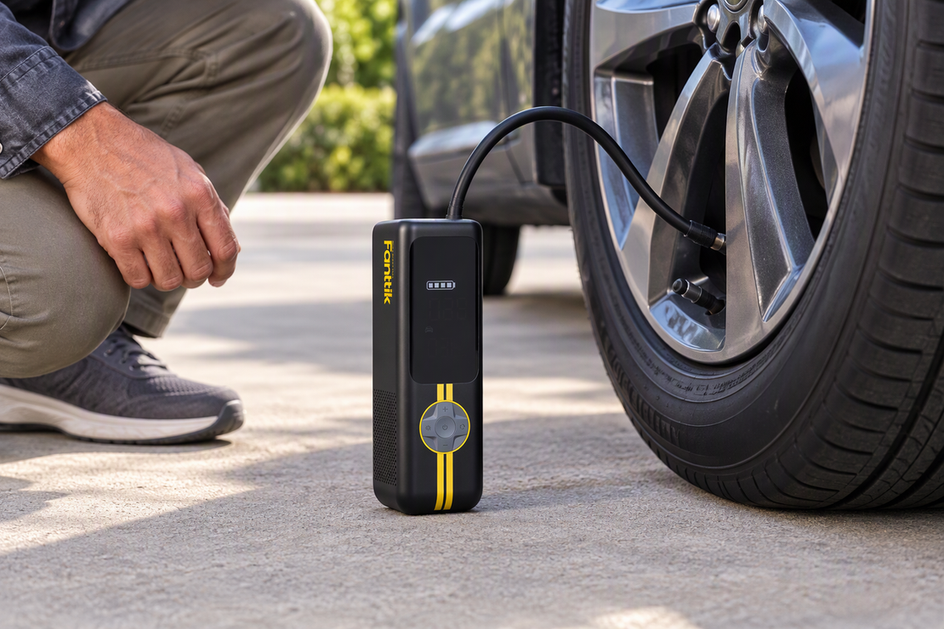
Some trucks list one pressure that covers every condition; others list a separate value for maximum load. Neither situation lets you skip checking the actual label. A pickup truck tire inflator can help you hit whatever number the documentation gives you, but it cannot tell you what that number should be.
Where Do You Find the Correct Pickup Truck Tire Pressure?
The pressure that matters is on the driver-side door edge or post, or inside the owner's manual, not on the tire itself. According to NHTSA tire safety guidance, the correct pressure is whatever the vehicle manufacturer lists, not what is printed on the tire.
That label usually gives separate front and rear values, since a pickup's front and rear axles rarely carry the same load. Use both numbers exactly as listed rather than averaging them or applying one target to all four tires.

If you switch to a replacement tire size that isn't the original equipment fitment, the label may no longer match your setup. In that case, the tire's own load-and-inflation documentation for that specific size becomes the relevant reference, not a number pulled from a different tire or a different truck. Reviewing seasonal pressure habits, such as those covered in this seasonal tire pressure guide, can help you stay on top of the correct baseline as temperatures shift, but it doesn't replace the placard as your source.
What Changes When You Haul Gravel or Tools?
Loading the bed with gravel or tools shifts weight toward the rear axle, and that shift is what determines whether a different pressure applies, not the cargo's weight alone. There is no fixed PSI increase that safely covers every load; the applicable number still has to come from your truck's documentation or the tire's load-and-inflation table.
A few variables decide whether a loaded adjustment is even available to you. Your truck's configuration, the tire size and load range actually mounted, how the cargo is distributed between the axles, and whether the manufacturer published a separate loaded-condition pressure all factor in. If your documentation only lists one pressure for all conditions, that single number is what you have, and adding air by guesswork can push the tire past its safe range for the load it's carrying. Distributing weight sensibly in the bed, as described in this guide to gear weight distribution, can reduce uneven axle loading, but it doesn't create a documented pressure where none exists.
When your exact truck, tire, and load combination isn't covered by any of these sources, that's the point to stop guessing rather than pick a number that feels reasonable.
How to Switch Between Empty and Loaded Tire-Pressure Checks
Switching between daily driving and hauling comes down to five repeatable steps, done in order every time you change conditions.
- Identify whether you're driving empty/light or about to haul a documented loaded condition, and pull up the matching pressure source.
- Let the tires sit unused so they're truly cold. NHTSA defines that as cold after at least three hours parked without driving.
- Measure all four tires, plus the spare if you carry one, and record each value separately for front and rear.
- Adjust each axle to its documented target and recheck every tire before you leave.
- After the hauling trip ends, measure again once the tires are cold and restore the applicable empty or light-load target; don't leave the loaded setting in place for normal driving.
If you only have time to check right after a drive, treat that warm reading as a temporary estimate. NHTSA advises drivers to recheck a warm reading when the tires are cold rather than treating the warm number as the final setting.
When Should You Stop and Get Model-Specific Guidance?
Stop and get model-specific guidance before hauling if your truck's documentation doesn't clearly cover the tire size, axle load, or loading condition you're dealing with. Improvising a number in that gap risks both an incorrect ride pressure and a tire pushed past its rated capacity.
Federal vehicle labeling rules require manufacturers to list cold tire inflation pressure, and a vehicle manufacturer cannot specify an inflation pressure that exceeds the tire's maximum permissible pressure. That means two hard boundaries apply regardless of your situation: never exceed the tire's documented maximum permissible pressure, and never treat a regulation written for labeling requirements as a substitute for your specific truck's numbers. If you've added a replacement tire or an unusual load that isn't addressed anywhere in your documentation, get the correct figure from your dealer, manufacturer, or the tire's official technical resources before you load up and drive.

When in doubt, park the truck, confirm your axle targets from the door placard or authorized tire specification sheet, and inflate only to those documented limits before carrying any heavy payload.
FAQs
Can I use the maximum PSI printed on the tire sidewall for my pickup?
No. The sidewall number is the tire's maximum permissible pressure, not your truck's recommended everyday setting. Go back to the driver-side placard or owner's manual for the pressure your vehicle manufacturer actually specifies, and treat the sidewall figure only as an upper limit you should not exceed.
Should I add a fixed amount of PSI when hauling gravel or tools?
No. There's no universal amount of extra air that safely covers every load. Use your truck's documented loaded-condition pressure if one exists, or the applicable tire load-and-inflation data for your exact tire size, and stop to get model-specific guidance if neither source covers your situation.
Can I set my pickup's tire pressure right after driving?
You can check it right after driving as a rough, temporary read, but don't set your final pressure from a warm tire. Park for at least three hours so the tires are cold, then compare that reading against your documented target and adjust from there.
Leave a comment
This site is protected by hCaptcha and the hCaptcha Privacy Policy and Terms of Service apply.