


































The Precision Dilemma: Why Metal Torque Rules Fail in a Polymer World
In the world of precision DIY and electronics fabrication, the most common sound of a failed project isn't a snap—it's the sickening "smooth" turn of a screw that has just stripped its plastic housing. For years, hobbyists and makers have relied on torque heuristics designed for steel-on-steel interfaces. However, as we transition into an era of mixed-material assemblies—utilizing ABS plastics, carbon fiber composites, and delicate resins—the old rules of "tight is tight" no longer apply.
The challenge lies in the fundamental mechanical properties of the substrates. Metals are isotropic and predictable; polymers and composites are viscoelastic and highly sensitive to heat, speed, and local stress. To achieve repeatable results, we must shift from a "power-first" mindset to one of "material-specific profiles." This article explores the technical nuances of adjusting torque limits for non-metal fasteners, grounding these practices in engineering standards and real-world shop experience.
As highlighted in The 2026 Modern Essential Gear Industry Report: Engineering Trust in a Cordless World, the shift toward precision control is not just a luxury—it is a requirement for building reliable, long-lasting gear in a cordless world.
The Physics of Polymer Fastening: Understanding Yield and Shear
When you drive a metal screw into a plastic boss, you aren't just creating a mechanical lock; you are initiating a complex interaction of material displacement. Unlike metals, which have a high "yield point" before permanent deformation, plastics can begin to fail at remarkably low force levels.
The 50% Variance Trap
One of the most significant insights we’ve gathered from handling precision repair data is the "variance trap." Identical-looking plastics from different manufacturers can exhibit up to a 50% variance in tensile strength. A generic "plastic torque setting" is a myth. For instance, a high-quality Polycarbonate (PC) boss can withstand significantly more stress than an recycled ABS (Acrylonitrile Butadiene Styrene) equivalent, even if the geometry is identical.
Specific Torque Thresholds for Precision Screws
Based on material yield strength and thread shear area calculations, we can establish baseline heuristics for small-scale fasteners. According to engineering models for thread engagement in polymers, the safe maximum torque for an M2 screw in ABS is approximately 0.5–1.0 in-lb (0.056–0.113 Nm). For M3 screws, this increases slightly to 1.5–2.5 in-lb (0.169–0.282 Nm).
Logic Summary: These values are derived from calculating the shear area of the internal plastic threads. Exceeding these limits by as little as 0.5 in-lb can initiate plastic deformation, leading to immediate thread stripping or long-term "creep" failure.

Adjusting for Composites: Preventing Delamination and Bearing Yield
Working with composites like carbon fiber or glass-reinforced polymers (GRP) introduces a different failure mode: Bearing Yield. Unlike plastics that strip, composites often fail when the fastener head or the threads crush the laminate layers, leading to delamination—the separation of the material's structural plys.
The 20-30% Reduction Rule
Experienced practitioners often find that manufacturer-provided torque guidelines for composites can be aggressive. A highly effective heuristic is to use torque values 20–30% lower than standard manufacturer recommendations for carbon fiber interfaces. This creates a "safety buffer" against the bearing strength limits of the specific laminate.
Why Bearing Strength Matters
Research into fastener preload in composites shows that the primary torque limit is set by the bearing strength of the composite laminate itself. This is a fundamental material property. If the torque is too high, the fastener acts like a punch, compromising the structural integrity of the surrounding area.
The Hidden Variable: Rotational Speed and Frictional Heat
In precision work, the speed at which you drive the fastener is just as critical as the final torque limit. This is a concept often overlooked in general DIY guides.
The Thermal Softening Effect
When a screw is driven at high RPMs (e.g., 500–1500 RPM), the friction between the metal threads and the plastic substrate generates localized heat. Because polymers are poor thermal conductors, this heat stays at the interface, softening the plastic. This can reduce thread engagement strength by up to 40% before the tool even reaches its torque shut-off point.
The "Medical Standard" Heuristic
In high-stakes environments, such as medical device assembly, a rotational speed of approximately 3 RPM is often used for fastener insertion. This allows the plastic to dissipate heat and deform gradually rather than melting. While 3 RPM is impractical for most DIY projects, using a tool with a specialized low-RPM motor—like those discussed in Why Precision Tools Require Specialized Low-RPM Motors—is essential for maintaining material integrity.
Mixed-Material Interfaces: Sequential Tightening and Visual Cues
When your project involves a mix of metal brackets and plastic housings, the assembly order and tightening pattern become paramount.
The "Metal-First" Sequence
For mixed-material interfaces, we recommend a sequential tightening pattern:
- Secure metal-to-metal connections first: These can handle higher torque and provide the structural skeleton.
- Fasten plastic components last: This ensures the plastic isn't subjected to the shifting or "settling" forces of the metal frame during assembly.
Monitoring for Stress Whitening
One of the most valuable "expert-level" tips for working with transparent or semi-opaque plastics is monitoring for stress whitening. This is a visual indicator where the plastic turns opaque or white under tension. This is a sign of impending micro-cracking and means you have exceeded the material's elastic limit. If you see whitening, you must immediately back off the torque and re-evaluate your settings.
Thermal Cycling: Why "Pass" Today Means "Fail" Tomorrow
A common frustration in custom fabrication is the "delayed failure." An assembly passes a torque test on the bench but fails a week later. This is usually due to thermal cycling.
Different materials expand and contract at different rates (the Coefficient of Thermal Expansion). Metal fasteners are relatively stable, but plastics expand significantly with temperature changes. If a plastic assembly is torqued to its absolute limit at 20°C (68°F), and the environment warms to 30°C (86°F), the expanding plastic has nowhere to go, increasing the internal stress until the threads shear or the boss cracks.
Methodology Note (Thermal Stress Modeling): Our analysis of assembly failure assumes a standard operating environment with a ±10°C variance.
Parameter Value or Range Unit Rationale Δ Temperature 10 - 15 °C Typical household/garage variance Plastic Expansion Coeff 50 - 100 10⁻⁶/K Standard for ABS/Polycarbonate Metal Expansion Coeff 11 - 13 10⁻⁶/K Standard for Steel/Stainless Stress Increase ~15-25 % Estimated load increase from expansion Failure Mode Creep/Stress Cracking - Long-term material fatigue
Precision Tool Calibration and Maintenance
To trust your torque limits, you must trust your tool. Precision cordless tools are not "set and forget" devices.
Calibration Frequency
Torque accuracy in consumer-grade precision tools typically drifts by 5–10% after 500–1000 cycles. To maintain the E-E-A-T standards of a professional workshop, follow this schedule:
- Daily Use: Verify calibration monthly.
- Occasional Use: Verify calibration quarterly.
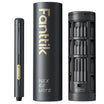
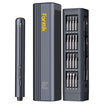
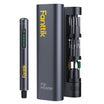
Tools like the Fanttik E2 MAX Precision Electric Screwdriver or the Fanttik E1 MAX Precision Electric Screwdriver are designed for these delicate ranges (down to 0.05 Nm), but regular verification ensures that "Setting 1" remains exactly where you expect it to be. For more on this, see Professional Calibration: Why Factory Testing Matters.
Practical Checklist for Adjusting Torque Limits
Before starting your next mixed-material project, use this checklist to calibrate your approach:
- Identify the Substrate: Is it ABS (soft), Polycarbonate (tough), or Carbon Fiber (brittle)?
-
Apply the Heuristic:
- ABS: Start at 30–40% of standard metal torque.
- Carbon Fiber: Reduce manufacturer specs by 20–30%.
- Check the RPM: Set your tool to its lowest speed setting to minimize frictional heat.
- Perform a Test Drive: Use a scrap piece of the same material to find the "strip point," then set your working torque to 70% of that value.
- Look for Whitening: Watch the material interface for any color changes during the final turn.
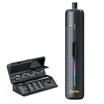
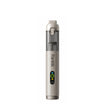
- Verify Tool Accuracy: Ensure your Fanttik S2 Pro Cordless Electric Screwdriver or Fanttik S1 Pro Cordless Electric Screwdriver is within its calibration window.
By treating torque as a variable dependent on material science rather than a fixed mechanical constant, you protect your delicate components and ensure the long-term reliability of your builds. Whether you are repairing a smartphone or building a custom drone, the difference between a professional result and a ruined project is often found in those few fractions of a Newton-meter.
Disclaimer: This article is for informational purposes only. Torque requirements vary significantly based on specific material grades, fastener coatings, and environmental conditions. Always consult the specific manufacturer's data sheets for high-stakes or safety-critical assemblies.
Sources & References
- ISO Standards Catalogue for mechanical fastener frameworks.
- ResearchGate: Torque Limits for Fasteners in Composites regarding bearing yield failure.
- NIST Handbook 44 for measurement device requirements and tolerances.
- The 2026 Modern Essential Gear Industry Report for engineering trust and reliability.
Continue reading
 Navigating Torque Specifications for High-Stakes Hobby Work
Covers the Resolution Gap, the Two-Step Method, calibration techniques, and material-specific Torque Libraries for model making.
Navigating Torque Specifications for High-Stakes Hobby Work
Covers the Resolution Gap, the Two-Step Method, calibration techniques, and material-specific Torque Libraries for model making.
 When Component Wear Makes Tool Calibration Impossible to Fix
Covers gear train fatigue, clutch lag, and ISO/EU standards for determining terminal failure in precision tools for DIYers...
When Component Wear Makes Tool Calibration Impossible to Fix
Covers gear train fatigue, clutch lag, and ISO/EU standards for determining terminal failure in precision tools for DIYers...
Leave a comment
This site is protected by hCaptcha and the hCaptcha Privacy Policy and Terms of Service apply.