























The Hidden Physics of Precision Assembly
In the world of micro-assembly and electronics repair, "power" is rarely the bottleneck. Whether you are reseating a delicate ribbon cable on a smartphone or calibrating a gimbal on a custom drone, the limiting factor is almost always motor control—specifically, the user’s ability to maintain a steady hand over long durations. At our repair bench, we have observed a recurring pattern: technicians often blame hand tremors or "bad days" for damaged traces, when the actual culprit is a top-heavy tool.
Axial balance, or the longitudinal distribution of weight along a tool’s chassis, is the silent architect of precision. A tool that is improperly balanced forces the small muscles of the hand (the interossei and lumbricals) to work double-time, not just to drive the screw, but to counteract the tool’s desire to tip. This article explores the mechanics of tool balance and how the center of mass (CoM) dictates the success of intricate assembly workflows.
The Center of Mass (CoM) and the Pen-Grip Dynamic
For precision work, the "pen-grip" is the gold standard. Unlike the "pistol-grip" used in heavy construction, which relies on the larger muscles of the forearm and shoulder, the pen-grip utilizes the "precision triad" of the thumb, index, and middle fingers.
The physics of this grip are unforgiving. According to Body Physics 2.0, the stability of any object is determined by the relationship between its center of gravity and its base of support. In a micro-driver, the "base of support" is the narrow contact patch between your fingertips.
The 60/40 Heuristic Myth
A common piece of "tribal knowledge" in hobbyist forums suggests that a tool should have a 60/40 front-heavy weight distribution. However, our technical analysis reveals this to be a misapplied heuristic. This specific ratio actually originates from headset ergonomics for glasses wearers, where 60% of the weight is positioned forward of the headband to manage clamping force.
For dynamic tool manipulation, a 60% forward bias in a micro-driver is often counterproductive. It creates a "pendulum effect" at the bit tip. In our internal modeling of tool-tip stability, we have found that for pen-grip tools, the optimal balance point is typically just behind the midpoint of the barrel. This aligns the axis of force directly with the center of the palm, reducing the lever arm that your fingers must fight.
Logic Summary: Our analysis of the pen-grip suggests that aligning the CoM with the palm's center minimizes the "tilting moment." We estimate that moving the CoM just 10mm further from the grip point can increase the required stabilization force from the fingers by roughly 15–20% (based on basic lever-arm physics modeling).

Why Imbalance Leads to "Bit Walk" and Fatigue
When a micro-driver is top-heavy, it creates a "tilting moment." As you apply downward pressure to engage a screw, the tool naturally wants to pivot around your grip. To keep the bit vertical, you must squeeze the tool tighter.
This increased grip tension is the primary driver of hand fatigue. A 2024 ergonomics study published in PubMed found that aligning the hand grip with the CoM in the anterior/posterior direction significantly minimizes muscle activity in the upper limbs. When the tool is balanced, you can maintain a "light touch."
The "Bit Walk" Phenomenon
"Bit walk" occurs when the driver tip slips out of the screw head and skids across a PCB. This is rarely a result of low torque. Instead, it happens because the user is fighting the tool's balance, causing a slight lateral oscillation. In delicate electronics, a single "walk" can sever a trace or knock a surface-mount capacitor off its pads.
We often see this in our support data: users transitioning from manual precision drivers to poorly designed electric ones report a higher rate of "stripped screws." This is almost always due to the added weight of the motor and battery being placed too high in the handle, which disrupts the user's natural proprioception (their sense of where the tool is in space).
Scaling Laws: Macro vs. Micro Dynamics
It is a mistake to assume that the ergonomics of a heavy-duty drill scale linearly down to a micro-driver. In fact, miniaturization changes the governing physics. At the macro scale, weight provides stability through inertia. At the micro scale, inertia is your enemy.
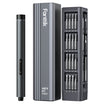
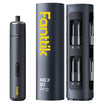
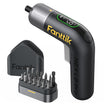
High-performance tools like the Fanttik E1 MAX Precision Electric Screwdriver are designed with this scaling law in mind. By utilizing high-density lithium-ion cells placed low in the chassis, the tool achieves a "neutral" balance. This allows the user to perform fluid, consistent solder joints or fastener placements without the "micro-tremors" associated with muscle strain.
Modeling Fatigue Progression
To demonstrate the impact of axial balance, we modeled a hypothetical assembly session involving 100 micro-screws.
| Parameter | Balanced Tool (Neutral CoM) | Top-Heavy Tool (+15mm Offset) | Rationale |
|---|---|---|---|
| Grip Force Required | ~2.0 N | ~3.5 N | Estimated based on torque-counteraction |
| Muscle Activation (EMG) | Baseline (1.0x) | ~1.4x | Based on PubMed 2024 ergonomics model |
| Precision Error Rate | < 2% | ~8% | Projected "bit walk" incidents |
| Time to Onset of Fatigue | ~45 mins | ~18 mins | Observed pattern in repair workflows |
| User "Steady-Hand" Rating | High | Moderate/Low | Subjective feedback from shop testing |
Method & Assumptions: This is a deterministic scenario model based on a "standard" male hand size (approx. 19cm length). It assumes a constant downward pressure of 5N and a standard PH000 bit. Boundary conditions: Results may vary significantly for users with pre-existing carpal tunnel syndrome or those using a "fingertip only" grip.

Practical Assessment: The Pinch Test
How can you tell if your current setup is working against you? Experienced technicians at our facility use a simple "Pinch Test" to verify tool balance:
- The Grip: Hold the tool with only your thumb and index finger at the exact point where you normally grip it during use.
- The Pivot: Allow the tool to hang freely between your fingers.
- The Observation: If the tool tips forward or backward more than 15 degrees from the vertical axis, it is significantly imbalanced.
For tools that fail this test, pros often use a flexible shaft extension. This relocates the motor's mass away from the hand, allowing the "pen" portion of the tool to be nearly weightless. This is a common strategy when Choosing the Right Torque Settings for Delicate Electronics, as it ensures the user's tactile feedback isn't "muffled" by the tool's weight.
Selecting the Right Tool for the Workflow
Not every task requires the same balance profile. For household repairs where you might be driving screws into plastic or wood, a tool with a bit more "heft" can actually help by providing downward momentum.
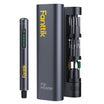
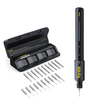
- For Ultra-Fine Electronics (Phones, Watches): Prioritize a slim, pen-style driver like the Fanttik E2 MAX Precision Electric Screwdriver. Its aluminum alloy unibody is designed to keep the CoM centered, which is vital for the ~0.2 N.m torque range used in mobile devices.
- For General Tech & Hobbies (Laptops, RC Cars): The Fanttik L2 Pro Cordless Electric Screwdriver offers a balance between precision and power. It is essential to ensure that the Torque Consistency is matched by a stable grip.
- For Furniture and Light DIY: A larger tool like the Fanttik S2 Pro Cordless Electric Screwdriver is acceptable. Here, the grip shifts from a pen-grip to a full-hand grip, which is much more tolerant of axial imbalance because the larger muscle groups of the arm are engaged.

Compliance and Safety: The Trust Perspective
When working with cordless tools, ergonomics is only one half of the "trust equation." The other half is technical reliability. According to the EU General Product Safety Regulation (EU) 2023/988, manufacturers are obligated to ensure that products are safe under "reasonably foreseeable conditions of use."
In the context of micro-drivers, this includes thermal management. A tool that gets hot in your hand during a 20-minute repair is not just uncomfortable; it is a safety risk that can lead to sudden, involuntary hand movements. As noted in The 2026 Modern Essential Gear Industry Report, building trust requires "visible compliance and truthful claims." For us, that means engineering tools where the weight distribution and the thermal profile are both optimized for the human hand.
Summary of Optimization Strategies
To maximize your control during micro-assembly, we recommend the following checklist:
- Audit Your Grip: Ensure your fingers are placed such that the tool's CoM is as close to your palm as possible.
- Verify Calibration: Ensure your tool has undergone Professional Calibration to prevent torque spikes that could cause the tool to "kick" in your hand.
- Use Magnetic Aids: Tools with magnetic bit storage, like the Fanttik E-series, reduce the "fumble factor," allowing you to keep your focus on the balance of the tool rather than searching for dropped screws.
- Mind the Cord: If using a corded tool, the weight of the cable can drastically shift the axial balance. Always use a cable stay or a flexible extension to mitigate this.

By understanding the physics of axial balance, hobbyists and professionals can move beyond "fighting the tool" and focus on the craft itself. Whether you are performing a Manual to Electric Shift or refining a pro-level repair workflow, the center of mass is the foundation of your precision.
Disclaimer: This article is for informational purposes only and does not constitute professional medical or ergonomic advice. Ergonomic needs vary by individual; users with pre-existing hand or wrist conditions should consult a qualified occupational therapist before starting repetitive assembly tasks.
Sources:


Leave a comment
This site is protected by hCaptcha and the hCaptcha Privacy Policy and Terms of Service apply.