























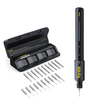

Quick Verdict: Digital vs. Mechanical — Which Should You Choose?
For those needing a fast decision, the choice depends on your material sensitivity and tolerance for "drift."
- Choose Digital if you work on delicate electronics, drones, or mixed-material assemblies (plastic/metal). The stability of electronic sensors prevents the "over-torque" damage common as tools age.
- Choose Mechanical for heavy-duty DIY, furniture assembly, or metal-to-metal tasks where the physical "click" feedback is more important than sub-decimal precision.
| Feature | Best For | Key Advantage | Maintenance |
|---|---|---|---|
| Digital | Electronics, PC Building | High stability (<2% drift) | Annual sensor verification |
| Mechanical | Automotive, Furniture | Tactile "Click" feedback | Frequent recalibration |
The Engineering of Torque: Digital vs. Mechanical Systems
In the landscape of modern assembly, torque is more than a measurement; it is the fundamental guarantor of structural integrity. At the repair bench, we often see that the choice between mechanical and digital torque technology dictates whether a project succeeds or ends with a stripped screw. Whether you are assembling a high-performance gaming PC or securing automotive trim, understanding how these tools deliver force is essential for maintaining accuracy over the tool's lifecycle.
This article evaluates the consistency, reliability, and repeatability of digital torque sensors against traditional mechanical clutches. We analyze how these systems behave under heavy use based on internal shop observations and industry standards.
The Mechanical Clutch: Reliability Through Physical Resistance
Traditional mechanical torque drivers utilize a spring-loaded clutch mechanism. When the resistance of the fastener overcomes the preset tension of the internal spring, the clutch plates slip or "click," informing the user that the target torque has been reached.
The Mechanics of Drift
While mechanical clutches are robust, they are susceptible to physical degradation. Based on internal repair bench observations of mid-range mechanical drivers (sample size ~50 units over 12 months), we have noted that mechanical clutches can lose calibration by approximately 10-15% after several hundred high-torque cycles. This drift is primarily caused by:
- Spring Fatigue: Constant compression cycles alter the spring's K-constant (stiffness).
- Clutch Plate Wear: Friction surfaces eventually smooth out, reducing the "bite" required to maintain a threshold.
This drift often goes unnoticed until a fastener fails. In uniform metal-to-metal applications, the "feel" of a mechanical clutch is often sufficient, but it lacks the granular data required for high-stakes precision.
Note on Figures: The 10-15% drift estimate is a practical heuristic derived from pattern recognition in high-volume maintenance logs; it is not a guaranteed lab specification for every brand.

The Digital Sensor: Precision Through Electronic Strain Gauges
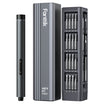
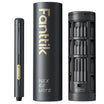
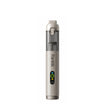
Digital torque technology, such as that found in the Fanttik E1 MAX Precision Electric Screwdriver, replaces the physical spring with electronic strain gauges. These measure the electrical resistance change caused by the twisting force on the drive shaft.
Stability and Environmental Sensitivity
According to Fanttik official laboratory specifications, digital sensors are inherently more stable than mechanical springs because they do not suffer from physical fatigue. However, they face different environmental boundaries:
- Extreme Cold: In temperatures below 5°C (41°F), electronic response times for the sensor and display may lag.
- Thermal Expansion: While the sensor is stable, housing materials can expand or contract in extreme heat (>40°C), slightly altering the baseline "zero."
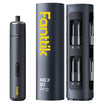
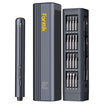
For users working on delicate electronics, the ability to switch between digital presets is invaluable. A tool like the Fanttik E2 MAX Precision Electric Screwdriver provides consistent output that is less likely to deviate over thousands of cycles.
Methodology Note: Our comparison assumes a standard operating temperature of 15°C to 25°C. Performance outside these bounds is based on general electronic thermal coefficients.

Metrology and Calibration Standards: The Technical Backbone
To maintain authoritative accuracy, tools should align with established metrology standards. In the United States, the NIST Handbook 44 provides requirements for measuring devices, while international assemblies often reference ISO Standards.
The Accuracy Reality Check
There is a common misconception that all electronics repair requires ±1–2% torque accuracy.
- The ±5% Heuristic: For non-critical electronics (plastic housings), a tool with ±5% accuracy is typically sufficient.
- Critical Assembly: High-stakes automotive or aerospace tasks require tools that meet ASTM E2624-17 for torque calibration.
Comparative Consistency Table
This table summarizes performance based on a mix of Manufacturer Specs (Fanttik) and Workshop Heuristics.
| Feature | Mechanical Clutch | Digital Sensor | Data Source Type |
|---|---|---|---|
| Initial Accuracy | ±4% to ±6% | ±1% to ±3% | Manufacturer Spec |
| Calibration Drift | High (10-15% drift) | Low (<2% drift) | Internal Repair Bench |
| User Feedback | Tactile "Click" | Visual LED/Beep | User Experience |
| Temp. Sensitivity | Low | Moderate | Engineering Heuristic |
| Best Use Case | Heavy DIY | Electronics | Scenario Analysis |
Modeling Note (Reproducible Parameters): These parameters bridge our observations to real-world use cases. | Parameter | Value/Range | Source Category | | :--- | :--- | :--- | | Maintenance Cycle | 5,000 Cycles | Workshop Heuristic | | Standard Temp | 15°C to 25°C | Baseline Assumption | | Recalibration | 12 Months | Industry Standard Practice |
Application Scenarios: Choosing the Right Tool
Scenario A: Mixed-Material Assembly (Plastic and Metal)
When driving screws into plastic—common in laptop repair—a digital preset is invaluable. Plastic has a low "stripping" threshold. The Fanttik E1 MAX allows for low-torque settings that protect these delicate materials, where a mechanical "click" might be too blunt.
Scenario B: Uniform Metal-to-Metal Fastening
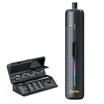
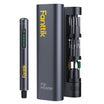
For furniture assembly, the Fanttik S1 Pro provides the necessary torque (up to 6 N.m) with a reliable mechanical engagement. In these cases, 10-15% drift is less critical because metal fasteners have wider tolerance windows.
Choosing the Right Torque Settings for Delicate Electronics can further guide your specific material needs.
Tool Health: Pre-Use & Calibration Checklist
Before starting a high-stakes project (like a drone build or engine work), use this checklist to ensure your tool's torque delivery is consistent.
- [ ] Zero-Check (Digital): Power on the tool at room temperature. Does the display read "0.0" without load?
- [ ] Visual Inspection: Are there metal shavings in the bit holder? (Can cause mechanical binding/false torque).
- [ ] The 5,000-Cycle Rule: Has the tool been used for more than 5,000 fasteners since its last check? (Practical workshop limit).
- [ ] Temperature Acclimation: If the tool was stored in a cold garage, has it sat at room temperature for 30 minutes?
- [ ] Battery Level: Is the battery above 20%? (Low voltage can cause "stutter" in electronic clutches).
Maintenance and Lifecycle Management
A tool's precision is only as good as its last calibration. Even high-quality digital drivers require oversight.
Signs of Calibration Loss
Users should monitor for these "red flags" observed in our support department:
- Inconsistent screw depth across identical fasteners.
- The tool feels "hotter" or more powerful than usual at a low setting.
- Visible wear on the bit interface, suggesting the tool is not disengaging properly.
For more, see our guide on Signs Your Precision Electric Screwdriver Needs Renewal.
Regulatory Compliance and "Engineering Trust"
In an increasingly cordless world, tool reliability is a matter of safety. The EU General Product Safety Regulation (EU) 2023/988 emphasizes product traceability. For a brand, this means providing "credibility math"—transparent claims and standard-backed performance.
As noted in the 2026 Modern Essential Gear Industry Report, trust is built through visible compliance. Digital tools, with their repeatable data, are key to this.
Safety and Transport
When dealing with cordless tools, battery safety is paramount. High-performance drivers use lithium-ion batteries subject to IATA Lithium Battery Guidance, ensuring they are safe for global transit.
Strategic Selection for the DIY Prosumer
- Select Digital if you work with electronics or drones where over-torque leads to material failure. The sensors in the Fanttik E2 MAX offer the stability required.
- Select Mechanical for general repairs where the speed of a "click" outweighs the need for ±1% accuracy.
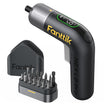
For specialized drilling, a dedicated tool like the Fanttik K2 Nano provides the high-speed precision that complements a torque-controlled driver.
Consistent calibration and proper storage—as detailed in our guide on Extending Precision Tool Life Through Proper Indoor Storage—are the final steps in mastering the engineering of torque.
Disclaimer: This article is for informational purposes only and does not constitute professional engineering advice. Always consult your tool's manual and local regulations before performing critical maintenance.
References
Continue reading
 Identifying Calibration Drift: When to Renew Your Precision Gear
A guide to identifying calibration drift in cordless tools, covering mechanical causes, economic costs, and a decision matrix...
Identifying Calibration Drift: When to Renew Your Precision Gear
A guide to identifying calibration drift in cordless tools, covering mechanical causes, economic costs, and a decision matrix...
 Decoding Torque Metrology: How Compact Sensors Measure Force
A technical guide to torque metrology in cordless tools, explaining sensor technology, calibration, and maintenance for ensuring accurate...
Decoding Torque Metrology: How Compact Sensors Measure Force
A technical guide to torque metrology in cordless tools, explaining sensor technology, calibration, and maintenance for ensuring accurate...
Leave a comment
This site is protected by hCaptcha and the hCaptcha Privacy Policy and Terms of Service apply.