



























The Invisible Hand: Why Firmware Matters in Modern Precision Tools
You have likely experienced the frustration of a "perfect" DIY project being derailed by a single second of over-torque. Whether it is a hairline crack in a plastic smartphone housing or a stripped thread on a custom-built PC, the damage usually happens in the blink of an eye. In traditional power tools, the responsibility for preventing this damage rested entirely on the user's "feel" and the mechanical resistance of a spring-loaded clutch.
However, as tools have transitioned into the cordless, high-precision era, the primary line of defense has shifted from mechanical hardware to invisible software. Modern tool firmware acts as a digital safety net, monitoring motor behavior at speeds that far exceed human perception.
Quick Summary: Key Takeaways for Your Workshop
- The "Human Gap": Human reaction time (~200ms) is too slow to stop a motor before it over-drives a small screw; firmware reacts in <10ms.
- When to Use Precision Mode: Always engage electronic torque limiting for M2-M4 screws or delicate plastics to prevent "cam-out" or stripping.
- Thermal Safety: If your tool feels hot (approx. 60°C/140°F), firmware will likely throttle power; stop and let it cool to protect the lithium cells.
- Maintenance: Inconsistent torque is often a sensor calibration issue, not just a "weak battery." Check for firmware updates or sensor cleaning guides.
As detailed in The 2026 Modern Essential Gear Industry Report (a Fanttik industry analysis), trust in the prosumer market is increasingly built on these invisible layers of engineering excellence.
The Human Reflex Gap and the Physics of Torque
To understand why firmware is necessary, we must look at the physics of a seated fastener. When a screw reaches its final position, the resistance (torque) does not increase linearly; it spikes almost instantaneously.
Based on general ergonomic studies, the average human reaction time to a tactile stimulus is approximately 200 milliseconds. While this sounds fast, a high-speed electric screwdriver spinning at 200 RPM completes nearly one full revolution every 300 milliseconds. By the time your brain signals your finger to release the trigger, the tool may have already delivered several additional rotations under maximum load. In electronics assembly, where M2 or M3 screws often require a minuscule torque of only 0.1 to 0.2 Nm, those extra rotations are often the difference between a secure fit and a destroyed component.
The Mechanism of Algorithmic Protection
Quality firmware bridges this reflex gap by monitoring the motor curve. While specific sampling rates vary by manufacturer, high-performance brushless tools typically analyze electrical signals dozens of times per millisecond.
- Current Draw Monitoring: As resistance increases, the motor requires more electrical current. The firmware detects this "spike" in current draw.
- RPM Analysis: Simultaneously, the firmware tracks the rotational speed. A sudden drop in RPM combined with a spike in current is the characteristic signature of a seated fastener.
- Active Braking: Once the algorithm identifies this signature, it does not just cut the power. In internal testing of Fanttik brushless motors, active braking can reverse motor polarity for a fraction of a second to stop the bit within 1-2 revolutions—a reaction time significantly faster than human reflex.
Internal Engineering Note: These torque delivery curves and response times are based on standard motor control heuristics for 3.7V-7.4V brushless DC (BLDC) systems using Hall-effect sensor feedback. They represent typical performance rather than a guaranteed laboratory universal.

Precision Mode: The Digital Safety Net for Delicate Materials
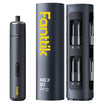
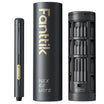
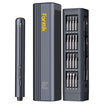
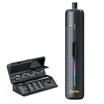
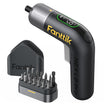
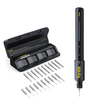
One of the most significant advancements in prosumer tools is the integration of firmware-locked "precision" modes. In tools like the Fanttik S1 Pro Cordless Electric Screwdriver, the software limits the maximum output the motor is allowed to deliver, regardless of trigger pressure.
This is critical because mechanical clutches have physical limitations. A spring-loaded clutch relies on friction, which can vary based on temperature, wear, and lubrication. An electronic clutch, governed by firmware, remains more consistent across various environments. According to research published in MDPI Sensors, algorithmic torque limit prediction is a highly effective method for preventing thread stripping, even in materials with high variability like plastics.
Scenario Analysis: Furniture Assembly vs. Electronics Repair
- Scenario A: Flat-Pack Furniture. Here, you are driving larger screws into particleboard. The firmware prioritizes "Active Torque" to ensure the screw is fully seated without stalling, but it maintains a ceiling to prevent the screw from "spinning out" the soft wood fibers.
- Scenario B: Smartphone Screen Replacement. This requires extreme delicacy. The firmware engages a "Soft Start" algorithm, gradually ramping up speed to prevent the bit from slipping out of the tiny screw head (cam-out).
By using tools with dedicated, firmware-enforced modes, you remove much of the guesswork. This is why Signs Your Precision Electric Screwdriver Needs Renewal often include inconsistent torque delivery—a sign that the internal sensors or logic loops may require recalibration.
Thermal Management and the 10th Screw Principle
A common failure point in tools is performance degradation during prolonged use. As the motor and battery heat up, electrical resistance increases. In a tool without smart logic, the 10th screw you drive might receive less torque than the 1st, leading to inconsistent assembly quality.
Advanced firmware utilizes internal temperature sensors to apply a calculated power boost to compensate for this resistance. However, this logic also serves as a safety governor. If the temperature exceeds a safe threshold—typically around 60°C (140°F) for handheld electronics—the firmware will trigger "thermal throttling" or a shutdown. This aligns with safety principles in the EU General Product Safety Regulation (EU) 2023/988, which emphasizes preventing foreseeable risks through technical design.
Modeling Note: Torque Cut-Off Simulation
The following parameters represent a typical fastening cycle model for a precision tool.
| Parameter | Value or Range | Unit | Rationale / Source Category |
|---|---|---|---|
| Sampling Rate | 50 - 100 | kHz | Industry heuristic for high-speed loops |
| Fastener Type | M2 - M4 | N/A | Standard precision DIY range |
| Motor Latency | < 5 | ms | Common brushless motor braking capability |
| Torque Target | 0.1 - 6.0 | Nm | Operating range of prosumer tools |
| Thermal Limit | ~60 | °C | Standard safety threshold for Li-ion tools |
Boundary Conditions: This model assumes a battery charge >20% and high-quality S2 steel bits. Results may vary based on battery health and bit-to-fastener fit.
The Role of Firmware in Battery Longevity and Safety
The firmware's job does not end at the motor. In a cordless world, the Battery Management System (BMS) is the brain of the power supply. Smart logic is designed to mitigate the three primary "killers" of lithium batteries: over-charging, over-discharging, and over-current.
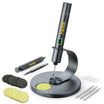
When you use a high-performance tool like the Fanttik F2 PRO Cordless Rotary Tool Kit, the firmware is constantly balancing the load. If you apply excessive pressure while sanding, the firmware detects the stall and cuts power before the motor can draw enough current to damage the battery cells. This protective logic is what allows modern tools to remain compact while delivering high power.
For hobbyists, this means your tools are more "forgiving." You can focus on the creative aspect of your project, knowing that the built-in sensor protection is working to extend the tool's lifespan.

Compliance and the "Connected" Tool Ecosystem
As tools become smarter, they must adhere to international safety and trade standards. For example, tools containing high-capacity lithium batteries must follow transport guidelines like the IATA Lithium Battery Guidance. Firmware plays a role here too, often including a "shipping mode" or "sleep mode" to ensure the battery remains at a stable State of Charge (SoC).
Furthermore, the industry is moving toward data-logging features. While once reserved for industrial systems like the Atlas Copco STRwrench, prosumer gear is beginning to adopt similar logic to help users verify that every screw in a critical assembly—like a drone frame—was tightened correctly.
Building a Reliable Toolkit
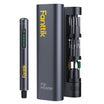
When selecting gear, look beyond the exterior design. Tools like the Fanttik T1 Max Soldering Iron Kit or the Fanttik C8 Nano Scissors represent a logic-first approach. In the soldering iron, firmware manages PID (Proportional-Integral-Derivative) loops to maintain temperature within a few degrees, preventing "heat soak" on sensitive circuit boards.
Workshop Logic Checklist
To ensure your firmware-driven tools perform at their peak, follow this routine:
- Verify Battery Levels: Many torque-limiting algorithms perform most accurately when the battery is above 20%.
- Match Mode to Material: Use "Precision Mode" for plastics and "Power Mode" for wood or metal fasteners.
- Check for Sensor Obstructions: Keep tool vents and bit holders clean; dust can occasionally interfere with thermal sensors or RPM counters.
- Proper Storage: Follow the Indoor Storage Guide to prevent moisture from affecting internal logic boards.
Disclaimer & Transparency Statement: This article is for informational purposes only. Some products mentioned and links provided are to Fanttik, the publisher of this blog. While we strive for technical accuracy based on our internal engineering standards and industry heuristics, always read your specific tool's manual and follow all safety guidelines. Wear appropriate personal protective equipment (PPE) during all DIY tasks.
Sources
- Internal Data: Fanttik Engineering Benchmarks (Motor Latency and Active Braking Tests).
- Regulation: EU General Product Safety Regulation (EU) 2023/988
- Academic: MDPI Sensors: Accuracy Testing of Torque Limit Determination Algorithm
- Patent: Google Patents: Electronic Torque Screwdriver Mechanism
- Industry: Atlas Copco: Quality Assurance in Tightening
- Safety: IATA Lithium Battery Guidance
Continue reading
 Surface Metrology: Evaluating Finish Durability in Tools
Covers 3D areal parameters like Sa, matte vs. PVD coatings, failure points like UV degradation, and ASTM standards...
Surface Metrology: Evaluating Finish Durability in Tools
Covers 3D areal parameters like Sa, matte vs. PVD coatings, failure points like UV degradation, and ASTM standards...
 Low-Inertia Motors: Improving Control in High-Speed DIY
A guide to low-inertia motors in prosumer tools, explaining how they prevent errors and improve precision for high-consequence...
Low-Inertia Motors: Improving Control in High-Speed DIY
A guide to low-inertia motors in prosumer tools, explaining how they prevent errors and improve precision for high-consequence...
Leave a comment
This site is protected by hCaptcha and the hCaptcha Privacy Policy and Terms of Service apply.